Industry News • Advanced Ceramics • Passive Components
TDK and Taiyo Yuden Forge Alliance: AI Servers Turn MLCCs into a Strategic Commodity!
AI Server
Strategic Materials
Ceramic Powder
TDK
Taiyo Yuden
⚡ Key Takeaways
- Initially, TDK and Taiyo Yuden signed an MOU on September 29, 2026, to jointly develop advanced MLCCs and inductors for AI servers and physical AI applications.
- Subsequently, both companies extended cooperation into manufacturing, procurement, mutual OEM arrangements, and potential capital partnership under Japan’s Economic Security Promotion Act.
- Furthermore, Taiyo Yuden already commercialized embedded MLCCs in 2025: a 1005-size 22µF and a 2012-size 100µF product for AI server power delivery.
- Meanwhile, the real bottleneck lies in ceramic materials: barium titanate powder refinement, nickel electrode co-firing, and embedded electrode flatness control.
- Ultimately, this alliance elevates MLCCs from ordinary passive components to nationally designated “specific important materials,” with ceramic formulation now determining the ceiling of computing power.
The Announcement That Reveals a Deeper Truth
Recently, Japanese electronics manufacturers TDK and Taiyo Yuden announced a memorandum of understanding to jointly develop advanced multilayer ceramic capacitors, inductors, and related components. Specifically, their collaboration spans R&D, manufacturing, raw material procurement, and even potential future capital ties. Following the news, Taiyo Yuden shares rose 2.27% the next day, while TDK gained 2.12%. For readers in the advanced ceramics sector, the crucial insight is not simply that two Japanese companies are joining forces, but rather that passive components – whose core relies on ceramic material science and precision forming – now sit at the center of the AI narrative.
AI Servers Push Capacitors Beyond Known Boundaries
Both companies stated their rationale plainly: generative AI, AI data centers, AI servers, and physical AI are expanding rapidly, driving surging demand for high-capacitance, high-reliability components that stabilize power delivery and suppress noise. Order data further confirms the intensity – Taiyo Yuden’s MLCC and inductor book-to-bill ratio once reached 1.72, with order intake far exceeding shipments. As AI chip power consumption and transient currents continue rising, power systems must deliver low impedance and fast response. Consequently, the industry is shifting from placing capacitors around the chip to vertical power delivery, positioning components directly beneath the AI chip to shorten the supply path, reduce line losses, and free board space. TDK executive officer Taro Ikushima explicitly highlighted this direction, noting that AI applications require thin, high-capacity products and that both parties will work together to create superior solutions.
Taiyo Yuden already commercialized two embedded MLCC products for AI servers in 2025: a 1005-size 22µF unit and a 2012-size 100µF unit, with the latter representing the industry’s highest-capacity embedded MLCC at launch. These components embed inside the PCB substrate near the chip, cutting the power path to under 1 mm and significantly reducing parasitic inductance and voltage fluctuation.
The Real Barrier Lives in Ceramic Material Science
The phrase “smaller, thinner, higher capacity” translates on the production line into several demanding capabilities. First, dielectric layer thinning requires barium titanate ceramic powder to maintain reliability while shrinking layer thickness and stacking more layers, placing near-extreme demands on powder particle size and dispersion. Second, nickel internal electrode co-firing demands precise atmosphere control and shrinkage-rate matching with the ceramic, making it the primary yield bottleneck. Third, embedded compatibility requires components to coexist with copper interconnects inside the substrate, imposing new requirements on plating, external electrode structure, and surface flatness. Additionally, TDK’s automotive-grade heat-resistant and thin-forming technologies can migrate into AI server scenarios with high temperature and high density. In essence, the ceiling of computing power is, to some extent, determined by ceramic formulation, tape-casting thickness, and co-firing工艺.
Dielectric Thinning
Barium titanate powder refinement enables thinner layers and higher layer counts.
Ni Electrode Co-firing
Atmosphere control and shrinkage matching remain the primary yield bottleneck.
Embedded Compatibility
Copper plating and electrode flatness enable PCB substrate integration.
Market Concentration and the Logic of Two Challengers
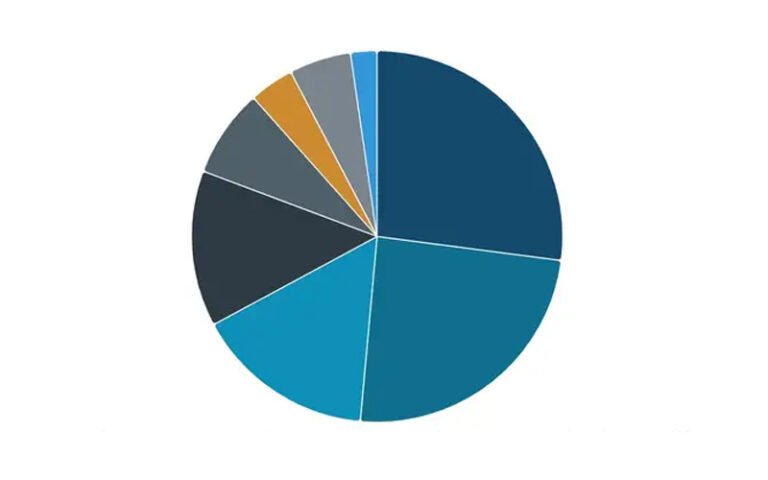
The global MLCC market remains highly concentrated, with the top five manufacturers accounting for approximately 77.3% of global share as of 2026. The two challengers bring complementary strengths to the table.
| Company | Global Share (2025-2026) | Core Strength |
|---|---|---|
| Murata | ~31.8% – 40% | AI server MLCC leader (~70% segment share) |
| Samsung Electro-Mechanics | ~22.5% – 22.9% | High-volume manufacturing, NVIDIA supply |
| Taiyo Yuden | ~11.2% – 11.3% | Embedded MLCC, miniaturization |
| TDK | ~5.9% – 6.9% | Automotive-grade, inductors, ferrite materials |
| Others | ~18% | Including Yageo, Fenghua, etc. |
From a business structure perspective, nearly 90% of Taiyo Yuden’s revenue comes from MLCCs and inductors, making it a highly focused player. In contrast, TDK operates as a diversified group, with passive components representing only about 20% of its revenue. This complementarity is clear: Taiyo Yuden brings miniaturization and high-capacity process refined during the smartphone era, while TDK contributes automotive-grade heat resistance and thin-forming technologies. The cooperation also includes mutual OEM arrangements, joint procurement, and the possibility of jointly formulating supply assurance plans under Japan’s Economic Security Promotion Act, since MLCCs have now been designated as “specific important materials.” Notably, Taiyo Yuden director Tomomitsu Fukuda offered a candid remark: “We are also competitors, so we will handle information sharing carefully when exploring cooperation possibilities.”
From Commercial Product to National Strategic Asset
Under Japan’s Economic Security Promotion Act, the government has officially classified MLCCs as “specific important materials,” placing them in the same strategic category as semiconductors and batteries. Consequently, supply chain security for these components now receives state-level attention, and joint supply assurance planning between manufacturers has become a legitimate policy objective. This designation reflects a broader reality: AI infrastructure depends not only on advanced logic chips but also on the passive components that keep those chips powered and stable. Therefore, the alliance between TDK and Taiyo Yuden represents more than a commercial partnership; it constitutes a coordinated national response to a recognized supply chain vulnerability.
Strategic Signals for China’s Ceramic Material Industry
For China’s domestic ceramic material supply chain, this alliance sends three clear signals. First, the main battlefield for high-end MLCC import substitution is shifting from “can we make it” to “can we make it stably, in volume, at small sizes,” with ceramic formulations serving as the critical gate. Second, embedded and vertical power delivery architectures represent a new competitive track, and the requirements for component shape, electrode structure, and surface flatness will transmit upstream to ceramic substrates and packaging material suppliers. Third, Chinese manufacturers have already achieved meaningful progress in the mid-to-low price segments, but the next competitive gap will depend on material science and equipment capabilities rather than production capacity alone.
Conclusion
From smartphones to automobiles and now to AI servers, every leap in MLCC technology reflects an evolution in ceramic materials. This time, ceramics stand at the center of the computing power narrative once again. The TDK–Taiyo Yuden alliance confirms that the ceiling of AI computing power is, in no small part, determined by barium titanate powder quality, tape-casting precision, and co-firing process mastery. For the advanced ceramics industry, the message is unmistakable: material science remains the ultimate competitive moat.
❓ Frequently Asked Questions
Why did TDK and Taiyo Yuden form an alliance?
TDK and Taiyo Yuden formed an alliance to jointly develop advanced MLCCs and inductors for AI servers and physical AI applications. They aim to combine Taiyo Yuden’s miniaturization expertise from the smartphone era with TDK’s automotive-grade high-temperature and thin-forming technologies.
What is embedded MLCC and why is it important for AI servers?
Embedded MLCCs are placed inside or beneath the PCB substrate near the AI chip, shortening the power delivery path, reducing parasitic inductance and line losses, and freeing up board surface area. Taiyo Yuden commercialized 1005-size 22µF and 2012-size 100µF embedded MLCCs in 2025.
What are the main technical barriers in high-end MLCC manufacturing?
Key barriers include dielectric layer thinning with barium titanate ceramic powder, nickel internal electrode co-firing under controlled atmospheres, and embedded compatibility requiring precise external electrode flatness and copper plating for PCB interconnection.
What is the current global MLCC market share distribution?
As of 2025-2026, Murata leads with approximately 31.8%-40% global share, Samsung Electro-Mechanics holds about 22.5%-22.9%, Taiyo Yuden accounts for roughly 11.2%-11.3%, and TDK holds approximately 5.9%-6.9%.
What signals does this alliance send to China’s ceramic material industry?
The alliance signals that domestic substitution must shift from “can we make it” to “can we make it stably in high volume at small sizes.” Ceramic material formulations and equipment capabilities, rather than capacity alone, will determine the next competitive gap.