Advanced Ceramics | Heating Technology | Industrial Applications
What Are Silicon Nitride Ceramic Heating Elements?
Silicon nitride ceramic heating elements combine an electrically resistive heating component with a silicon nitride ceramic body. Through this integrated structure, manufacturers can design compact heaters that transfer heat efficiently, provide electrical insulation, and resist corrosion in suitable liquid-heating and industrial environments.
Quick Answer: What Is a Silicon Nitride Ceramic Heating Element?
In simple terms, a silicon nitride ceramic heating element is an electric heater that uses a silicon nitride (Si₃N₄) ceramic body to support, protect, and electrically isolate a resistive heating component. Unlike a conventional design that relies on a metal heating plate or a metal-sheathed resistance wire, this integrated ceramic structure places the heating element on or inside the ceramic body.
Consequently, the design can provide efficient heat transfer, corrosion resistance, and a compact construction. However, actual heating speed, efficiency, electrical safety, and service life depend on the heater geometry, power density, ceramic formulation, installation, liquid chemistry, and operating conditions.
1. What Is a Silicon Nitride Ceramic Heating Element?
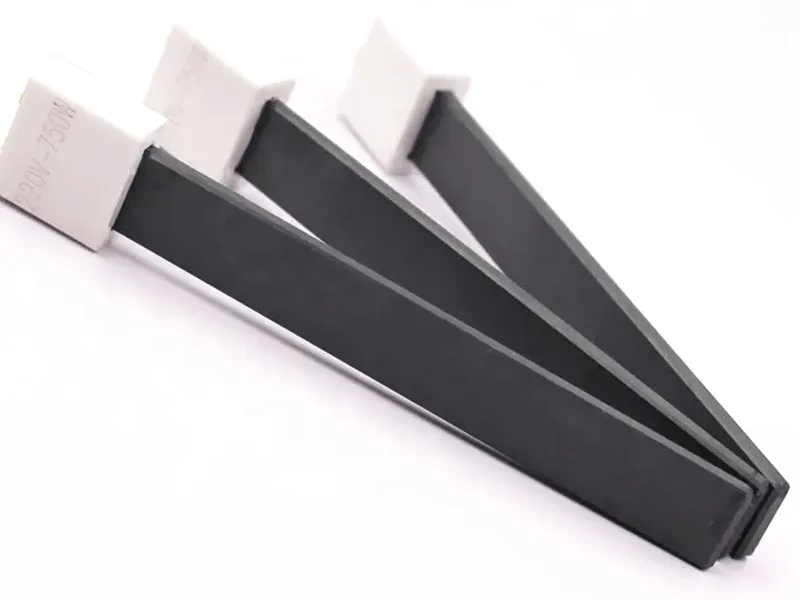
A silicon nitride ceramic heating element is an electrical heating component that integrates a resistive heat source with an engineered Si₃N₄ ceramic body. During manufacturing, engineers arrange a resistive element on the ceramic surface or within the ceramic structure, depending on the product design.
Typically, production involves preparing the ceramic powder, positioning or integrating the resistive element, forming the component, applying a suitable sintering process, and completing the necessary machining and electrical inspections. For embedded-heater designs, the ceramic structure must provide adequate insulation and protect the heating conductor under the specified operating conditions.
Compared with some conventional metal-sheathed heaters, this approach can reduce the number of separate structural layers between the heat source and the heated medium. Nevertheless, the actual heat-transfer advantage depends on the complete assembly, including ceramic thickness, contact area, surface condition, liquid flow, and electrical power.
Meanwhile, silicon nitride offers high mechanical strength, good thermal-shock resistance, and strong wear resistance in suitable grades. Therefore, engineers consider it for demanding applications where conventional materials may face corrosion, thermal cycling, or durability challenges.
1.1 Why Consider Ceramic Heating Technology?
Conventional heating systems may use resistance wires mounted behind a metal plate or resistance wires enclosed by insulation and a metal sheath. Depending on the design, additional thermal interfaces can increase thermal resistance, while metal components may experience corrosion, scaling, or dimensional changes during repeated heating cycles.
By contrast, a ceramic heating element can integrate electrical insulation, mechanical support, and a heat-transfer surface into a compact component. Moreover, an appropriately designed ceramic surface may reduce some scaling or corrosion problems, although performance still depends on water hardness, dissolved chemicals, temperature, and cleaning practices.
Importantly, ceramic construction does not automatically guarantee instant temperature control or higher overall efficiency. Instead, engineers must match the heater’s thermal mass, electrical resistance, power rating, control system, and flow conditions to the application.
2. Material Composition and Heating Element Construction
A ceramic heater requires more than a suitable ceramic powder. In addition, its formulation, resistive conductor, component geometry, electrical connections, and sintering conditions must work together to achieve the required thermal and electrical performance.
2.1 Silicon Nitride Ceramic Powder
According to the supplied technical formulation, silicon nitride powder accounts for approximately 78-98% of the ceramic mixture. Additionally, the formulation may contain approximately 0.2-9% aluminum oxide (Al₂O₃) and yttrium oxide (Y₂O₃) as part of the sintering-additive system.
The supplied material specification also identifies an α-phase silicon nitride content of at least 96%, an average silicon nitride powder particle size of 0.1-6 μm, an average aluminum oxide particle size below 6 μm, and an average yttrium oxide particle size below 8 μm.
During ceramic processing, aluminum oxide and yttrium oxide can participate in liquid-phase sintering reactions under suitable conditions. Consequently, these additives can support densification and influence the resulting grain-boundary phases and microstructure.
However, the supplied composition ranges do not define a complete formulation because the exact proportion of every ingredient, the percentage basis, and the remaining constituents require confirmation. Therefore, manufacturers should verify the production recipe before treating these figures as a complete chemical specification.
2.2 Resistive Heating Component
The resistive heating component converts electrical energy into heat through Joule heating. According to the supplied product information, potential heating materials include tungsten wire, molybdenum wire, or a conductive paste-based heating element.
Depending on the design, engineers can arrange the resistive component on the ceramic substrate or integrate it into the ceramic body. Furthermore, conductor geometry, resistance, spacing, and connection design determine the distribution of electrical power and the resulting temperature profile.
For conductive-paste designs, the supplied formulation mentions a conductive medium, epoxy resin, alcohol, and a cellulose-based thickener. Nevertheless, this ingredient list should be confirmed against the actual product formulation because paste chemistry, curing requirements, and compatibility with high-temperature ceramic processing can vary significantly.
2.3 Ceramic Body and Electrical Insulation
The silicon nitride ceramic body provides mechanical support, an electrically insulating structure, and a pathway for heat transfer. Because the resistive element may operate at an elevated temperature, the ceramic must retain suitable dielectric strength and structural integrity throughout the intended service cycle.
Additionally, the ceramic formulation and manufacturing process must limit defects such as cracks, voids, conductor displacement, and insufficient insulation thickness. Otherwise, localized electric-field concentrations or thermal stress can compromise the component.
Ultimately, the finished heater must meet application-specific requirements for insulation, leakage current, thermal cycling, liquid compatibility, electrical connections, and mechanical integrity.
3. Technical Properties and Performance Data
The following specifications reproduce the key numerical information in the supplied product brief. However, these figures should be treated as stated design or test targets rather than universal values for every silicon nitride ceramic heater, because the exact product model, test method, and certification status have not been provided.
3.1 Material Composition and Powder Specifications
| Parameter | Specified Value | Technical Significance |
|---|---|---|
| Silicon nitride powder content | 78-98% | Forms the primary ceramic phase in the supplied formulation. |
| Aluminum oxide content | 0.2-9% | May participate in sintering and influence grain-boundary chemistry. |
| Yttrium oxide | Included; exact percentage not specified | Can act as a sintering additive in suitable silicon nitride formulations. |
| α-phase silicon nitride content | At least 96% | Identifies the stated phase-content requirement for the starting silicon nitride powder. |
| Average Si₃N₄ particle size | 0.1-6 μm | Influences powder packing, sintering activity, and microstructure. |
| Average Al₂O₃ particle size | Below 6 μm | Helps define the particle-size requirements for the additive powder. |
| Average Y₂O₃ particle size | Below 8 μm | Supports formulation and powder-processing control. |
Importantly, the formulation percentages above do not necessarily represent a complete recipe with a defined mass balance. Therefore, the exact additive levels, purity requirements, powder-size measurement method, and phase-analysis method should be documented in the final material specification.
3.2 Electrical Safety and Chemical Resistance
| Test Item | Supplied Requirement | Interpretation |
|---|---|---|
| Dielectric withstand | 2,500 V AC, 50 Hz, for 1 minute at room temperature; no breakdown | A stated dielectric-strength test condition for the tested component. |
| Leakage current during normal operation | ≤ 0.025 mA | A stated operating leakage-current limit; measurement conditions require confirmation. |
| Leakage current after fracture, when immersed in water | ≤ 10 mA | A supplied damaged-condition test figure, not a declaration that operation after breakage is safe. |
| Acid resistance | Boiling 5% sulfuric acid for 6 hours; corrosion rate < 10 g/(m²·h) | Indicates the stated corrosion-test condition and maximum reported rate. |
| Alkali resistance | Boiling 30% sodium hydroxide for 6 hours; corrosion rate < 0.6 g/(m²·h) | Indicates the stated alkaline corrosion-test condition and maximum reported rate. |
For electrical testing, the specified 2,500 V AC withstand test indicates that the tested specimen showed no breakdown under the stated conditions. However, this figure alone does not establish compliance with a particular product-safety standard, because creepage distances, clearances, grounding, moisture exposure, temperature, and the complete heater assembly also affect safety.
Likewise, the reported normal-operation leakage current of 0.025 mA and damaged-condition value of 10 mA describe different test conditions. Consequently, the damaged-condition result must not be interpreted as permission to operate a cracked or broken heater in water.
For chemical performance, the stated acid and alkali corrosion rates depend on the test specimen, solution concentration, temperature, exposure time, surface condition, and measurement method. Therefore, users should verify the test report and confirm compatibility with the actual liquid before selecting a heater for aggressive chemical service.
3.3 Additional Product Specifications to Confirm
Although the supplied data describe composition and several electrical and chemical tests, they do not specify every parameter required for equipment selection. For example, engineers should request the following details before finalizing a heater design.
- Rated voltage, rated current, electrical resistance, and power tolerance.
- Heater dimensions, active heating area, terminal configuration, and installation requirements.
- Operating temperature range, maximum local surface temperature, and thermal response time.
- Thermal conductivity and thermal-shock performance for the actual ceramic grade.
- Pressure rating, flow-rate range, and compatibility with the intended liquid.
- Thermal-cycle endurance, service-life data, and applicable product-safety certifications.
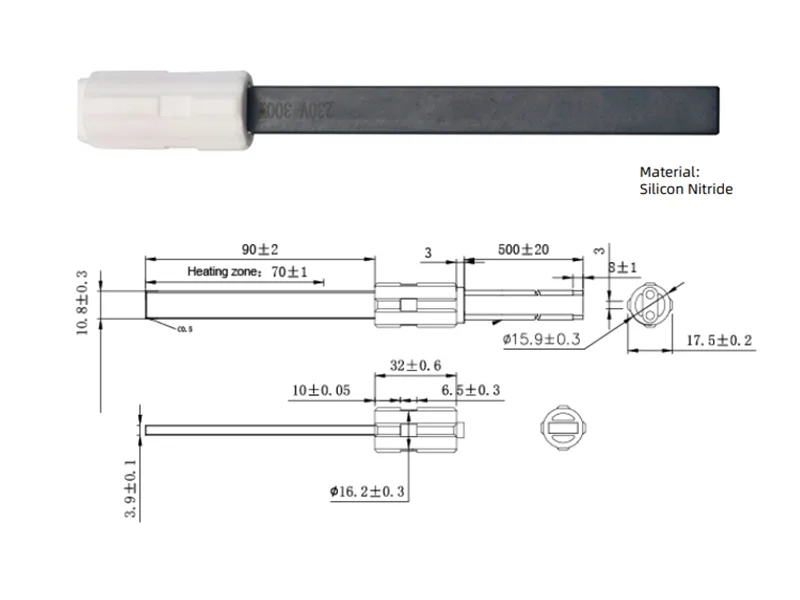
4. Silicon Nitride Ceramic Heating Element Structure
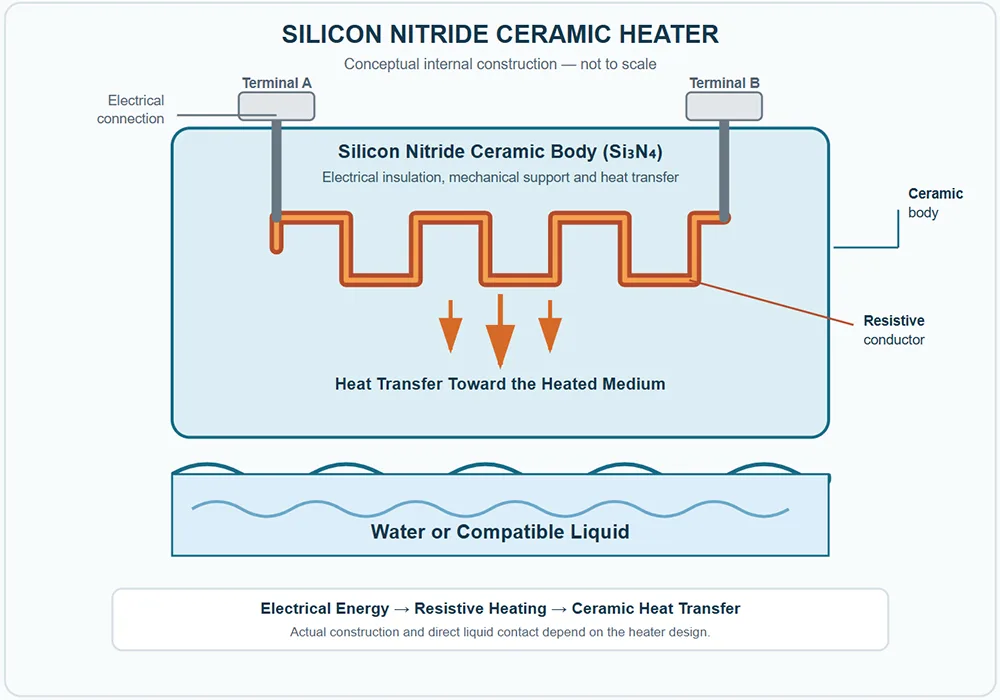
The following schematic illustrates the basic relationship between the ceramic body, embedded resistive conductor, electrical terminals, and heated liquid. Because this drawing represents a conceptual design rather than a production drawing, the exact conductor route, insulation thickness, terminal arrangement, and outer geometry may differ between models.
4.1 Main Structural Components
- Silicon nitride ceramic body: Provides the structural framework and electrical insulation while transferring heat from the resistive component.
- Resistive heating conductor: Converts electrical energy into thermal energy through electrical resistance.
- Electrical terminals: Connect the heating element to the power supply through a suitable insulated connection system.
- Heat-transfer surface: Transfers energy toward the water, liquid, air, or other compatible medium according to the product design.
Importantly, the diagram does not establish that every heater exposes the same ceramic surface directly to water. Instead, manufacturers must confirm the actual assembly, sealing method, electrical isolation, and liquid-contact configuration for each model.
5. Working Principle and Heat-Transfer Characteristics
When an electrical current passes through the resistive conductor, the conductor generates heat according to Joule’s law. Meanwhile, the surrounding ceramic body receives this energy and transfers it toward the intended heating surface.
Electrical Power Relationship
P = V × I = I²R = V²/R
P = electrical power, V = voltage, I = current, and R = resistance.
For a liquid-heating application, the useful heating rate also depends on how much energy reaches the liquid. Consequently, heater surface area, ceramic thickness, liquid flow, thermal contact, and the temperature difference between the heater and the medium all affect performance.
Compared with a design that places a resistance wire behind a separate metal plate, an integrated ceramic design may reduce certain intermediate interfaces. Nevertheless, a ceramic component can still exhibit thermal inertia, and the actual response time depends on its mass, dimensions, conductor layout, and control system.
Furthermore, mineral deposits can develop on many water-heating surfaces when water contains dissolved hardness minerals. Therefore, engineers should assess water chemistry and maintenance requirements instead of assuming that ceramic construction completely prevents scaling.
5.1 Why Temperature and Flow Control Matter
In an instantaneous water heater, the temperature increase depends on electrical input power and water flow rate. For example, at the same power level, a lower flow rate generally produces a larger temperature rise, whereas a higher flow rate generally reduces that rise.
Accordingly, a practical heater system may require temperature sensors, power regulation, flow detection, overtemperature protection, and dry-running protection. In addition, the control system should account for supply-voltage variation and changing inlet-water temperature.
Ultimately, the ceramic element forms only one part of the complete heating system. Therefore, system-level performance depends on the interaction among the heater, housing, electrical controls, fluid circuit, and safety devices.
6. Applications of Silicon Nitride Ceramic Heating Elements
Silicon nitride ceramic heating elements may serve in water heating, steam generation, and other thermal systems that require a compact heater with appropriate electrical insulation and liquid compatibility. However, each application needs a design review to confirm the rated power, operating temperature, pressure, flow rate, and safety requirements.
6.1 Instantaneous Electric Water Heaters
Instantaneous water heaters raise water temperature as the water flows through the heating assembly. According to the supplied product brief, a silicon nitride ceramic heating element for a water-heater application should use a power rating of up to 1,200 W within the stated design scope.
Nevertheless, the suitable rating depends on the required temperature rise, flow rate, inlet-water temperature, and electrical supply. Therefore, the 1,200 W figure should not be interpreted as a universal rating for all instantaneous water heaters.
6.2 Storage Water Heaters
Storage water heaters heat water held in a tank and then maintain it near a selected temperature. Consequently, the heater must match the tank volume, insulation quality, control strategy, and required recovery time.
For silicon nitride ceramic elements, engineers should additionally assess immersion conditions, local temperature, scale formation, corrosion exposure, and the compatibility of seals and electrical connections with the tank assembly.
6.3 Electric Water Faucets and Tap Heaters
Electric water faucets need compact heating assemblies because the available installation space is limited. Therefore, an appropriately designed ceramic heater may help integrate the heat source and insulation into a compact component.
However, designers must verify electrical safety, water-flow stability, thermal protection, and applicable appliance regulations before integrating the component into a consumer-facing product.
6.4 Sauna Steam Generators
Sauna steam generators convert water into steam under controlled heating conditions. According to the supplied brief, the stated design scope recommends a heater power of up to 800 W for steam-generator applications.
Even so, the final power requirement depends on steam output, water supply, heat losses, enclosure design, and the generator’s operating pressure. Additionally, steam service requires suitable pressure protection, temperature control, and materials compatibility.
6.5 Instantaneous Liquid Heaters
Industrial liquid heaters may heat compatible liquids during circulation or intermittent flow. Because the liquid’s chemical composition can affect corrosion and deposits, engineers should evaluate the actual fluid rather than assume that every liquid is compatible with silicon nitride or the complete heater assembly.
Furthermore, flow channels, surface temperature, pressure drop, and sealing arrangements influence the heater’s thermal performance and reliability. Therefore, component selection should follow the process requirements and the supplier’s documented operating limits.
6.6 Auxiliary Heating for Heat Pumps and Solar Water Systems
Heat-pump and solar-water systems may require auxiliary electrical heating when renewable heat input cannot meet demand. In this role, a ceramic heater can supplement the primary heating source when its power, control logic, and installation match the system design.
Nevertheless, engineers should consider operating temperature, electrical supply, circulation, backup-heating strategy, and thermal protection to avoid unnecessary energy consumption or overheating.
6.7 Electric Space Heaters
Electric space heaters convert electrical energy into heat for indoor or industrial environments. Depending on the specific product design, a ceramic heating element may provide a compact heat source or serve within a larger heating assembly.
However, the liquid-heating power limits listed in the supplied brief do not automatically apply to space-heating products. Therefore, manufacturers should establish separate ratings and verify airflow, surface-temperature limits, fire protection, and applicable electrical safety requirements for each product category.
6.8 Application and Power Summary
| Application | Stated Power Scope | Key Design Considerations |
|---|---|---|
| Instantaneous electric water heater | Up to 1,200 W | Flow rate, temperature rise, and overtemperature protection |
| Storage water heater | Up to 1,200 W within the supplied water-heater scope | Tank volume, recovery time, immersion conditions, and controls |
| Electric water faucet | Confirm by model | Compact packaging, flow stability, and electrical safety |
| Sauna steam generator | Up to 800 W | Steam output, pressure protection, and temperature control |
| Instantaneous liquid heater | Confirm by model and fluid conditions | Chemical compatibility, flow rate, and pressure drop |
| Heat-pump or solar-water auxiliary heating | Confirm by system design | Backup strategy, circulation, and system-level controls |
| Electric space heater | Confirm by product design | Airflow, surface temperature, and appliance safety |
Please note that the 1,200 W and 800 W limits above come from the supplied product information. Because no complete model datasheet accompanies those figures, buyers should confirm rated voltage, current, installation conditions, and applicable certifications with the manufacturer before using them for product design or procurement.
7. AOFE MIMCustom: Silicon Nitride Ceramic Heating Element Solutions
AOFE MIMCustom provides silicon nitride ceramic heating elements for customers developing heating equipment and related industrial products, according to the supplied company brief. In addition, the company can present its product offering around ceramic material selection, component design review, application requirements, and custom-part evaluation where these services match its actual manufacturing capabilities.
For a new heating project, customers should define the intended medium, required power, supply voltage, installation space, operating temperature, expected duty cycle, and relevant electrical safety requirements. Consequently, the engineering review can focus on the parameters that directly influence component feasibility and product performance.
7.1 Application-Oriented Component Selection
First, the team should identify whether the application involves instantaneous water heating, storage heating, steam generation, or another thermal process. Because each environment imposes different requirements, the design review should consider liquid chemistry, flow conditions, pressure, thermal cycling, and electrical insulation.
Additionally, customers should provide a drawing or reference sample where available, together with the target dimensions, conductor connections, mounting arrangement, and required power rating. As a result, the manufacturer can evaluate the key mechanical and electrical interfaces before finalizing the design.
7.2 Technical Specification and Quality Verification
A clear specification should identify the material grade, powder or formulation requirements, dimensions, resistance range, rated voltage, rated power, insulation requirements, and test conditions. Furthermore, the inspection plan should identify the applicable acceptance criteria for dielectric withstand, leakage current, corrosion resistance, and dimensional accuracy.
However, customers should verify the available test equipment, actual manufacturing processes, production capacity, quality certifications, and test-report format directly with AOFE MIMCustom. This approach ensures that the purchasing specification reflects the company’s confirmed capabilities rather than assumed services.
Request Information About Silicon Nitride Ceramic Heaters
If you are developing a water heater, steam generator, liquid-heating system, or other thermal product, prepare your application requirements and technical drawing before requesting a quotation. With these details, AOFE MIMCustom can review the required component specifications and confirm the relevant manufacturing options.
8. Silicon Nitride Ceramic Heating Element FAQ
Q1. What is a silicon nitride ceramic heating element?
A silicon nitride ceramic heating element integrates a resistive heat source with a silicon nitride ceramic body that provides structural support, electrical insulation, and heat transfer. Depending on the design, the conductor may sit on the ceramic surface or within the ceramic structure.
Q2. What materials make up the ceramic body?
According to the supplied formulation, silicon nitride powder accounts for approximately 78–98% of the mixture, while aluminum oxide may account for approximately 0.2-9%, with yttrium oxide also included. However, the complete composition and percentage basis require confirmation before the figures can serve as a production recipe.
Q3. Which materials can serve as the resistive heating conductor?
The supplied product information identifies tungsten wire, molybdenum wire, and conductive-paste heating structures as possible options. Nevertheless, the actual conductor depends on the product design, operating temperature, electrical requirements, and compatibility with the ceramic manufacturing process.
Q4. What dielectric withstand voltage does the supplied specification list?
The supplied brief lists a dielectric withstand test of 2,500 V AC at 50 Hz for one minute at room temperature, with no breakdown. However, users should obtain the original test report and confirm the applicable safety standard, test configuration, and acceptance criteria for the finished heater assembly.
Q5. What leakage-current limits appear in the supplied data?
The supplied brief specifies a normal-operation leakage current of no more than 0.025 mA and a value of no more than 10 mA after the element breaks and enters water. Because these conditions differ, the second figure must not be interpreted as proof that a damaged heater is safe to use.
Q6. Can silicon nitride ceramic heating elements resist acids and alkalis?
The supplied brief reports a corrosion rate below 10 g/(m²·h) after six hours in boiling 5% sulfuric acid and below 0.6 g/(m²·h) after six hours in boiling 30% sodium hydroxide. However, these figures require confirmation against the original test method, and users must assess compatibility with the complete heater assembly and the actual process liquid.
Q7. What power ratings are recommended for the listed liquid-heating applications?
According to the supplied brief, the stated limits are up to 1,200 W for water heaters, up to 1,000 W for drinking-water boilers, and up to 800 W for steam generators. However, these are application-specific figures from the supplied information, so the final rated power must match the actual model, supply voltage, flow conditions, and safety requirements.
Q8. Does a ceramic heating element prevent all scale formation?
No, ceramic construction does not guarantee scale-free operation. Because mineral deposition depends on water hardness, temperature, flow, and surface conditions, engineers should evaluate the intended water quality and maintenance schedule before selecting the heater.
Q9. What information should buyers provide when requesting a custom heater?
Buyers should provide the application, heated medium, target power, rated voltage, installation dimensions, operating temperature, pressure, flow rate, and electrical safety requirements. Additionally, a drawing, reference sample, and required inspection criteria can help the manufacturer evaluate feasibility and prepare an accurate quotation.
Q10. Can silicon nitride ceramic heating elements be customized?
Custom design may be possible when the manufacturer can support the required ceramic formulation, conductor configuration, geometry, electrical rating, and qualification tests. Therefore, customers should confirm AOFE MIMCustom’s available design and manufacturing options before finalizing the product specification.
Conclusion: Engineering Reliable Ceramic Heating Elements
Silicon nitride ceramic heating elements combine an electrically resistive conductor with a ceramic body designed to provide insulation, structural support, and heat transfer. Consequently, they offer a potential solution for compact water heaters, steam generators, liquid-heating equipment, and other thermal applications that require carefully engineered electrical and material performance.
Nevertheless, a reliable product requires more than a suitable ceramic material. Instead, manufacturers must coordinate powder formulation, conductor placement, ceramic processing, electrical testing, thermal design, and application-specific safety validation. Ultimately, verified specifications and system-level testing provide the strongest foundation for selecting a silicon nitride ceramic heating element.
Key Technical Takeaways
- Silicon nitride ceramic heaters integrate a resistive heating component with a ceramic body.
- The supplied formulation lists 78-98% silicon nitride powder, 0.2-9% aluminum oxide, and yttrium oxide as an additional constituent.
- The supplied electrical test data specify a 2,500 V AC, 50 Hz, one-minute dielectric withstand test with no breakdown.
- Reported chemical resistance includes six-hour boiling tests in 5% sulfuric acid and 30% sodium hydroxide.
- The supplied application guidance lists up to 1,200 W for water heaters, up to 1,000 W for drinking-water boilers, and up to 800 W for steam generators.
- Actual product performance and safety require model-specific specifications, test reports, and system-level validation.