Advanced Ceramics | Materials Engineering
What Are the Corrosion Resistance Mechanisms of Silicon Nitride Balls?
In demanding industrial environments, corrosion can damage rolling elements, increase friction, contaminate process fluids, and shorten equipment service life. However, silicon nitride ceramic balls offer a different material solution because their strong covalent bonding, chemical stability, low density, and high hardness help them resist many corrosive and wear-related conditions.
More importantly, engineers must understand how silicon nitride resists chemical attack, which material properties influence its performance, and where its limitations lie. Therefore, this article examines the corrosion resistance mechanisms of silicon nitride balls, their manufacturing process, their major industrial applications, and the factors that determine their suitability for demanding operating conditions.
Key Engineering Answer
In general, silicon nitride balls resist corrosion because their silicon–nitrogen covalent bonding and stable ceramic microstructure limit many chemical reactions and prevent conventional electrochemical rusting. Consequently, they can offer advantages over steel balls in selected wet, chemical, and marine applications. Nevertheless, strong acids, strong alkalis, elevated temperatures, and prolonged exposure can affect performance, so engineers should verify compatibility under the actual operating conditions.
1. What Are Silicon Nitride Ceramic Balls?
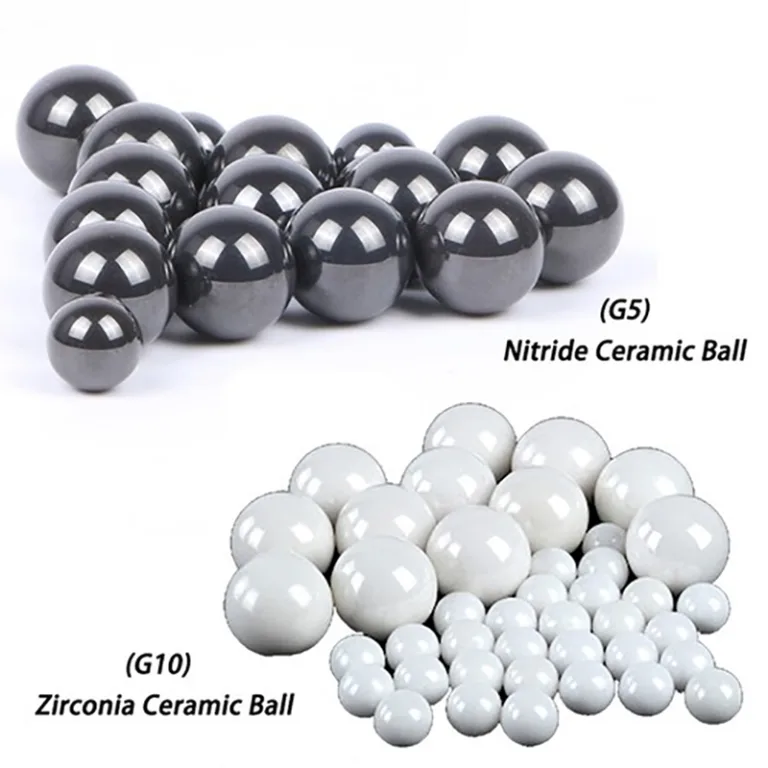
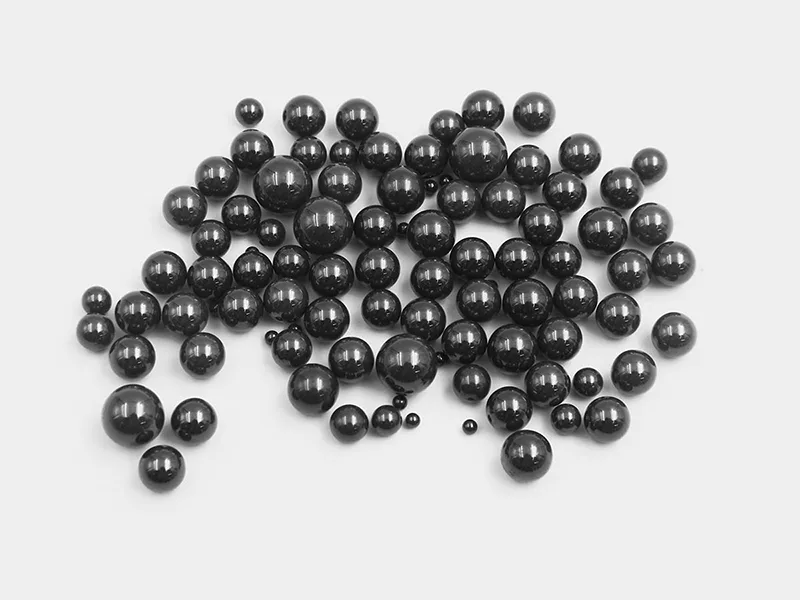
First, silicon nitride balls are precision-engineered rolling elements manufactured from silicon nitride, a technical ceramic commonly represented by the chemical formula Si₃N₄. Unlike conventional steel balls, these ceramic components combine low density, high hardness, good wear resistance, and strong performance under suitable thermal and chemical conditions.
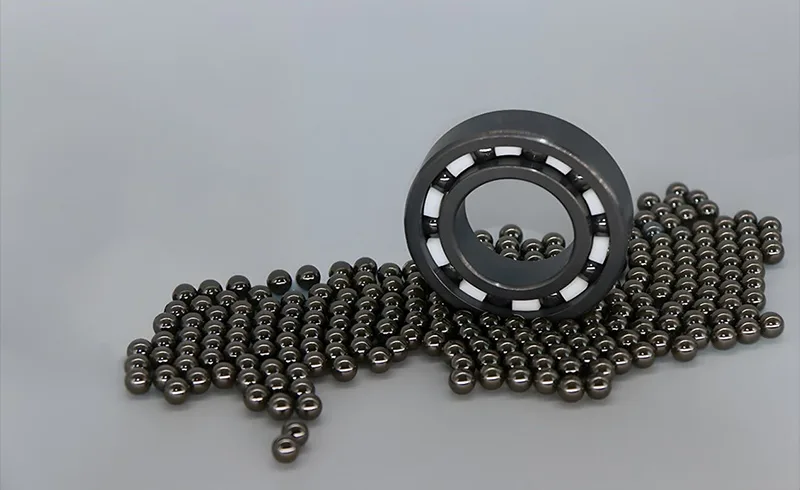
In practical engineering, manufacturers use silicon nitride balls in ceramic bearings, hybrid ceramic bearings, precision motion systems, chemical-processing equipment, and selected fluid-handling assemblies. Additionally, their electrical insulation characteristics can benefit applications that require electrical isolation, although engineers should confirm the resistivity of the selected grade.
From a materials perspective, silicon nitride is a covalently bonded ceramic rather than a metallic alloy. Therefore, it does not undergo the same iron oxidation and electrochemical rusting mechanisms that affect carbon steel. However, the absence of conventional rust does not mean that the ceramic remains chemically unchanged in every aggressive environment.
Why Do Engineers Consider Silicon Nitride Balls?
- First, their low density reduces rolling-element mass and centrifugal loading in suitable high-speed bearings.
- Additionally, their high hardness helps resist abrasive wear and surface damage.
- Meanwhile, their low thermal expansion and favorable thermal-shock resistance support applications involving temperature changes.
- Furthermore, their ceramic structure avoids conventional electrochemical rusting associated with iron-based materials.
- Ultimately, their suitability depends on the complete operating environment, including chemistry, temperature, load, lubrication, and surface finish.
2. Key Material Properties of Silicon Nitride Balls
Before examining corrosion resistance, engineers should understand the physical and mechanical properties that influence the behavior of silicon nitride balls. In particular, density, hardness, fracture toughness, thermal conductivity, and thermal expansion affect their performance in bearings and other precision assemblies.
The following table presents indicative engineering ranges for silicon nitride ceramics. However, actual values vary with powder chemistry, sintering additives, manufacturing route, microstructure, and test method, so buyers should consult the technical data for the specific grade.
| Property | Indicative Range | Engineering Significance |
|---|---|---|
| Chemical Formula | Si₃N₄ | Identifies the primary ceramic compound. |
| Density | Approximately 3.2-3.3 g/cm³ | Reduces rolling-element mass compared with bearing steel. |
| Vickers Hardness | Approximately 1,400-1,800 HV | Supports resistance to indentation and abrasive wear. |
| Flexural Strength | Often approximately 600-1,000 MPa for suitable grades | Indicates bending performance; it does not directly equal ball contact-load capacity. |
| Fracture Toughness | Often approximately 5-8 MPa·√m | Helps resist crack propagation compared with many conventional ceramics. |
| Thermal Conductivity | Commonly approximately 15-30 W/(m·K) | Helps transfer heat; the exact value depends strongly on the ceramic grade. |
| Thermal Expansion Coefficient | Approximately 2.8-3.3 × 10⁻⁶/K | Limits dimensional change as temperature varies. |
| Electrical Behavior | Generally insulating for conventional grades | Supports electrical isolation when the selected grade meets the required resistivity. |
| Corrosion Behavior | Good resistance to many environments; chemistry-dependent | Avoids conventional rusting, but aggressive chemicals can still attack the ceramic. |
Notably, these values describe representative material behavior rather than guaranteed specifications for every silicon nitride ball. For this reason, engineers should request grade-specific data, dimensional tolerances, surface-finish requirements, and inspection criteria before approving a production component.
3. What Are the Corrosion Resistance Mechanisms of Silicon Nitride Balls?
Fundamentally, the corrosion resistance of silicon nitride comes from its strong silicon–nitrogen bonding, chemically stable ceramic framework, and lack of an iron-based metallic structure. Nevertheless, engineers should distinguish electrochemical corrosion from chemical dissolution, oxidation, and hydrothermal degradation because each mechanism follows different reaction pathways.
3.1 Strong Covalent Bonds and a Stable Ceramic Framework
First, silicon and nitrogen form strong covalent bonds within the silicon nitride crystal structure. Consequently, many common corrosive agents cannot readily disrupt the ceramic framework under moderate temperatures and compatible chemical conditions.
By contrast, carbon steel depends on its surface condition and environmental chemistry to control oxidation and rusting. Silicon nitride contains no iron-based matrix, so it does not develop conventional iron oxide rust or suffer the same iron-driven electrochemical corrosion mechanism.
However, strong bonding does not make silicon nitride chemically invulnerable. In particular, aggressive acids, concentrated alkalis, high temperatures, and prolonged exposure may cause surface reactions, dissolution, or changes associated with grain-boundary phases.
3.2 No Conventional Electrochemical Rusting
In wet industrial environments, steel corrosion often involves anodic metal dissolution, cathodic reactions, and the movement of ions through an electrolyte. Silicon nitride, however, lacks the metallic iron matrix required for this conventional rusting process.
Therefore, silicon nitride balls can provide an advantage in humid equipment, water-contact assemblies, and selected chemical systems where metal rust could contaminate the process or damage precision surfaces. Even so, engineers should evaluate galvanic interactions involving other components, deposits, and the full assembly rather than judging the ball in isolation.
3.3 Surface Chemistry and Environmental Stability
Under certain oxidizing conditions, silicon nitride can develop a silica-rich surface layer through reactions involving oxygen. Depending on temperature, exposure time, and the surrounding chemistry, this layer may influence the subsequent reaction rate.
Nevertheless, engineers should not assume that this surface layer always protects the component. Strong alkaline solutions can attack silica-containing phases, while certain acidic environments can also affect the surface or grain-boundary constituents. Consequently, chemical compatibility testing remains important for severe service conditions.
3.4 Microstructure and Manufacturing Quality
Additionally, the manufacturing route influences corrosion performance because sintering additives and grain-boundary phases can react differently from the silicon nitride grains themselves. Porosity, microcracks, inclusions, and surface defects may also provide easier pathways for chemical attack or accelerate damage under mechanical loading.
For this reason, a dense ceramic body, controlled microstructure, appropriate material chemistry, and a well-finished ball surface all contribute to dependable service. Ultimately, material selection should consider the complete ceramic grade rather than the Si₃N₄ chemical formula alone.
Important Chemical Compatibility Note
Although silicon nitride balls can resist many corrosive environments, no universal compatibility rule applies to every acid, alkali, salt solution, or chemical vapor. Therefore, buyers should specify the chemical identity, concentration, operating temperature, exposure duration, and expected mechanical load when requesting a material recommendation.
4. How Do Silicon Nitride Balls Perform in Different Corrosive Environments?
In practice, corrosion resistance depends on the interaction between the ceramic grade and the surrounding medium. Therefore, the following comparisons provide an initial engineering guide rather than a substitute for application-specific testing.
| Environment | Potential Advantage | Engineering Consideration |
|---|---|---|
| Humid Air and Water | Avoids conventional iron-based rusting. | Check water chemistry, dissolved salts, temperature, and bearing lubrication. |
| Acidic Solutions | Can offer better stability than susceptible metal grades in selected conditions. | Acid identity, concentration, temperature, and exposure time determine compatibility. |
| Alkaline Solutions | Avoids metal-specific rusting mechanisms. | Strong alkalis can attack silica-containing surface or grain-boundary phases. |
| Saltwater and Marine Atmospheres | Does not undergo conventional chloride-induced steel pitting. | Check the complete assembly, bearing materials, deposits, and exposure duration. |
| Chemical Process Fluids | May combine chemical stability with wear resistance. | Evaluate additives, impurities, temperature, pressure, and fluid velocity. |
| High-Temperature Oxidizing Conditions | Can maintain useful mechanical properties in suitable applications. | Oxidation kinetics, surface-layer stability, thermal cycling, and grade selection matter. |
For example, a silicon nitride ball used in clean water may experience very different chemical exposure from one operating in hot concentrated alkali. Accordingly, engineers should test the actual ceramic grade in the intended medium whenever failure would create a significant safety, quality, or maintenance risk.
5. Silicon Nitride Balls Compared with Metal and Other Ceramic Balls
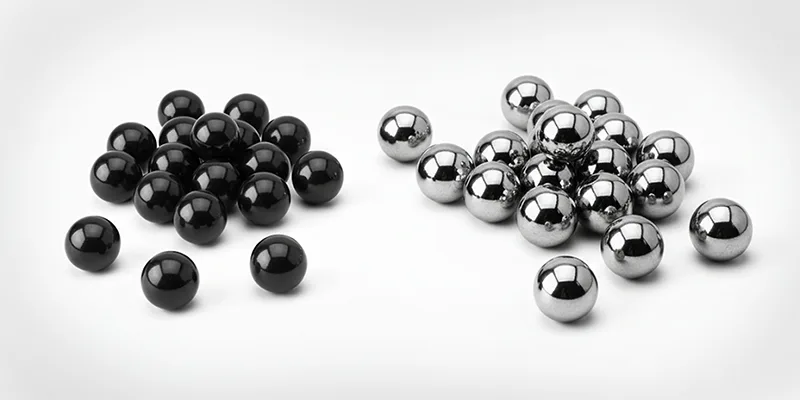
When engineers select rolling elements, they should compare chemical compatibility alongside contact fatigue, fracture resistance, lubrication, speed, dimensional accuracy, and cost. Therefore, silicon nitride should be treated as one candidate within a broader material-selection process.
| Material | Main Strengths | Key Limitations | Typical Selection Logic |
|---|---|---|---|
| Silicon Nitride (Si₃N₄) | Low density, high hardness, good fracture toughness for a ceramic, low thermal expansion. | Higher cost than many standard metal or ceramic alternatives; chemical compatibility remains grade-dependent. | High-speed bearings, precision equipment, and selected chemically demanding applications. |
| Bearing Steel | High toughness, established bearing technology, and competitive cost. | Can rust or corrode in unsuitable environments; relatively high density. | General-purpose bearings with controlled corrosion exposure and suitable lubrication. |
| Stainless Steel | Useful corrosion resistance in many water and industrial environments; good toughness. | Certain chloride-rich or aggressive chemical conditions can cause pitting, crevice corrosion, or other attack. | Applications that need metallic toughness and suitable corrosion resistance at a moderate cost. |
| Alumina (Al₂O₃) | Good hardness, electrical insulation, and broad utility in technical ceramic components. | Generally lower fracture toughness than silicon nitride; thermal-shock behavior depends on grade and design. | Cost-conscious ceramic applications that suit its mechanical and chemical characteristics. |
| Zirconia (ZrO₂) | High fracture toughness for a ceramic and good wear resistance in suitable grades. | Higher density and lower thermal conductivity than silicon nitride; compatibility depends on chemistry and stabilizer. | Applications that prioritize toughness, wear performance, and suitable chemical stability. |
| Silicon Carbide (SiC) | High hardness, strong wear resistance, and high thermal conductivity. | Fracture toughness is generally lower than silicon nitride; electrical behavior varies by grade. | High-wear, high-temperature, or heat-transfer applications with suitable geometry and loading. |
Ultimately, no single material provides the best combination of corrosion resistance, toughness, cost, and wear performance in every application. For this reason, a material recommendation should follow the operating requirements rather than rely on a general ranking.
6. Manufacturing Process of Silicon Nitride Ceramic Balls
Consistent corrosion resistance begins with appropriate raw materials and a controlled ceramic manufacturing process. In particular, powder purity, sintering additives, densification, grinding quality, and final inspection influence the mechanical reliability and chemical behavior of the finished ball.
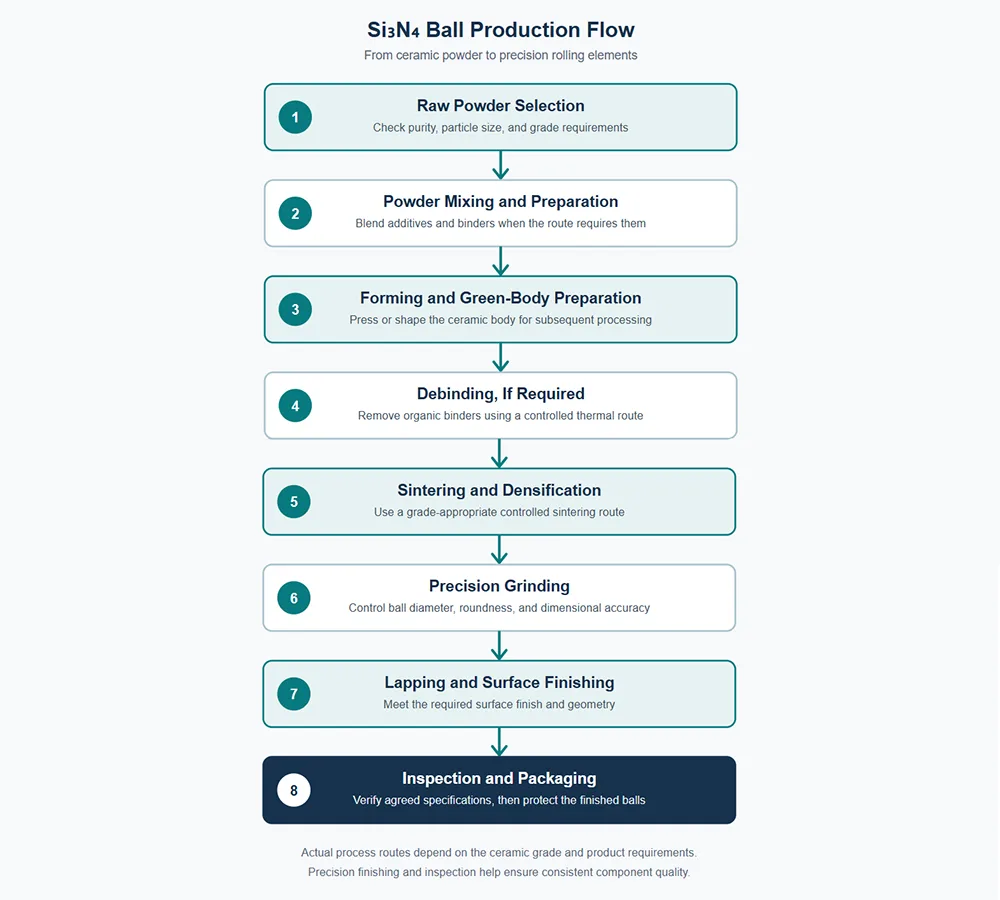
Although manufacturers may adjust individual steps to suit the grade and required tolerance, the following diagram summarizes a representative production route for precision silicon nitride balls.
6.1 Raw Material Preparation
First, manufacturers select silicon nitride powder according to the required purity, particle characteristics, and final performance targets. Additionally, they control powder handling and blending to promote uniform composition before forming.
6.2 Forming and Sintering
Next, the prepared powder enters a suitable forming process, which may involve pressing or another route designed for the required geometry. When the formulation contains organic binders, manufacturers remove them through a controlled debinding stage before densification.
Subsequently, sintering develops the dense ceramic microstructure. For silicon nitride, manufacturers may use gas-pressure sintering or another grade-appropriate route to achieve the required density, strength, and microstructure.
6.3 Precision Grinding and Lapping
After sintering, precision grinding brings the balls closer to the specified diameter, roundness, and dimensional tolerances. Meanwhile, lapping or additional finishing can improve the surface condition for applications that require low friction, accurate rolling contact, or controlled wear.
6.4 Quality Inspection
Finally, manufacturers inspect the characteristics specified in the purchase agreement, which may include diameter, dimensional variation, roundness, surface finish, visible defects, and relevant material properties. For chemically demanding service, buyers should also discuss grade documentation, chemical compatibility evidence, and any application-specific qualification tests.
Consequently, a well-controlled manufacturing process supports reliable performance, but it cannot compensate for an unsuitable material grade or an incompatible chemical environment.
7. Main Applications of Silicon Nitride Balls and Their Industries
Because silicon nitride combines low density, high hardness, and useful chemical stability, engineers can consider it for precision components that operate under demanding mechanical or environmental conditions. However, each application requires a suitable bearing design, compatible mating materials, and an appropriate lubrication or operating strategy.
7.1 Precision and Hybrid Bearings
In high-speed or precision bearing systems, silicon nitride balls can reduce rolling-element mass and centrifugal loading compared with steel balls of similar size. Additionally, their hardness and wear resistance can support demanding rolling-contact conditions when engineers select suitable races and lubrication.
Typical industries: Machine tools, industrial machinery, precision spindles, robotics, and selected high-speed rotating equipment.
7.2 Chemical Processing Equipment
In compatible chemical environments, silicon nitride balls may serve as rolling elements or precision ceramic components in selected pumps, valves, and fluid-handling assemblies. Nevertheless, engineers should confirm the chemical compatibility of the complete component, including seals, cages, housings, and mating surfaces.
Typical industries: Chemical manufacturing, specialty chemicals, industrial fluid handling, and selected process-control systems.
7.3 Marine and Water-Handling Systems
In selected marine or water-contact applications, silicon nitride avoids conventional iron-based rusting. Therefore, designers may consider it for suitable bearings and precision assemblies exposed to humid air or salt-containing environments, subject to compatibility and mechanical validation.
Typical industries: Marine engineering, water treatment, selected offshore equipment, and industrial water-handling systems.
7.4 Pumps and Fluid-Control Components
In pump and valve assemblies, ceramic balls may function as rolling elements or as ball-shaped functional components, depending on the design. Meanwhile, chemical compatibility, dimensional accuracy, contact stress, and sealing requirements determine whether silicon nitride offers a suitable solution.
Typical industries: Chemical pumps, dosing systems, precision fluid control, and specialized industrial equipment.
7.5 Electrical and Precision Motion Systems
Additionally, silicon nitride’s generally insulating behavior can benefit selected systems that require electrical isolation in rolling contacts. However, the design team should confirm the grade’s electrical resistivity and evaluate any electrical discharge or current-related risks within the complete assembly.
Typical industries: Electrical machinery, automation, precision instruments, and specialized motion-control equipment.
7.6 Semiconductor and High-Purity Equipment
In selected precision systems, ceramic components can reduce dependence on metallic rolling elements and avoid conventional rust formation. Nevertheless, semiconductor applications require particular attention to contamination control, surface quality, cleaning procedures, and the compatibility of every wetted material.
Typical industries: Semiconductor equipment, precision manufacturing, selected clean-process systems, and advanced industrial automation.
How to Match the Component to the Application
Before specifying silicon nitride balls, engineers should identify the exact component function, whether it involves rolling contact, fluid control, or another mechanical role. Next, they should define the operating medium, concentration, temperature range, load, rotational speed, lubrication conditions, and dimensional requirements.
Finally, the purchasing team should confirm the required ball diameter, tolerance class, roundness, surface finish, material grade, packaging, and inspection documentation. As a result, the specification can address both chemical durability and mechanical reliability.
8. AOFE MIMCustom: Custom Silicon Nitride Ceramic Ball Solutions
For industrial buyers, selecting the correct silicon nitride ball involves more than choosing a ceramic material. Instead, the supplier must understand the component’s dimensions, mechanical function, chemical exposure, surface requirements, and production quantity before recommending a manufacturing approach.
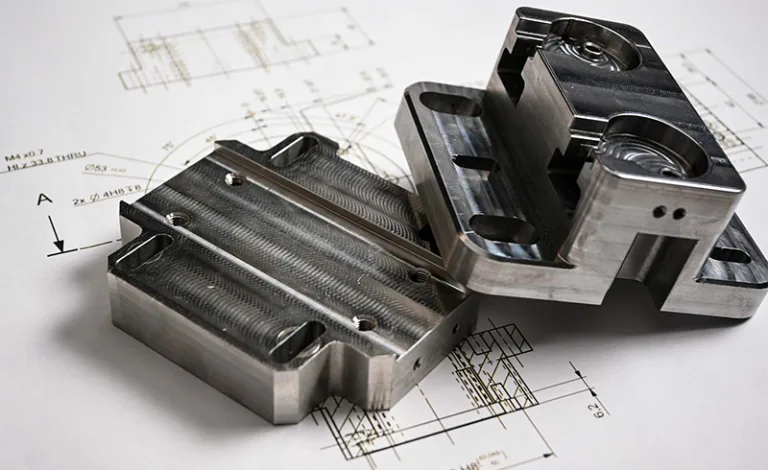
AOFE MIMCustom can support custom ceramic component inquiries by discussing material selection, product geometry, technical requirements, prototype coordination, and production feasibility. Additionally, buyers can provide operating conditions and drawings so the project team can review the requirements before quotation.
Material Selection Support
First, share the chemical medium, concentration, temperature, and mechanical loading requirements. Accordingly, the project team can discuss whether silicon nitride or another technical ceramic merits further evaluation.
Custom Geometry Review
Additionally, provide the ball diameter, tolerance requirements, surface-finish target, and intended component function. This information helps clarify manufacturing feasibility and inspection needs.
Prototype and Production Discussion
Meanwhile, early technical discussions can help establish sample requirements, production quantities, finishing expectations, and the information needed to evaluate a proposed manufacturing route.
Inspection and Documentation Planning
Finally, buyers can define the required inspection records, material information, dimensional checks, and traceability expectations during the quotation stage, subject to the supplier’s available capabilities.
Request a Silicon Nitride Ball Quotation
To help evaluate your project, prepare the component drawing or dimensions, target quantity, operating temperature, chemical medium, concentration, and expected mechanical load. Furthermore, indicate the required tolerance, surface finish, and any material documentation needed for qualification.
With these details, AOFE MIMCustom can review the inquiry and discuss the next steps for a suitable custom ceramic component solution.
9. Frequently Asked Questions About Silicon Nitride Ball Corrosion Resistance
Q1. Why do silicon nitride balls resist corrosion?
Primarily, strong silicon-nitrogen covalent bonds and a stable ceramic microstructure limit many chemical reactions. Moreover, silicon nitride lacks the iron-based metallic structure responsible for conventional steel rusting. However, aggressive chemicals can still react with the ceramic or its grain-boundary phases under certain conditions.
Q2. Can silicon nitride balls withstand strong acids?
In some acidic environments, silicon nitride performs well compared with susceptible metal materials. Nevertheless, no general statement applies to every acid concentration, temperature, or exposure period. Therefore, engineers should check grade-specific compatibility data or conduct representative testing before long-term service.
Q3. Are silicon nitride balls resistant to strong alkaline solutions?
Although silicon nitride avoids conventional metal corrosion, concentrated alkalis can attack silica-containing surface phases and certain grain-boundary constituents. Consequently, buyers should verify compatibility under the intended concentration, temperature, and exposure duration rather than assume universal alkali resistance.
Q4. Do silicon nitride balls rust in seawater?
No, silicon nitride does not form conventional iron oxide rust because it contains no iron-based metallic matrix. However, seawater exposure can still affect other parts of the assembly, and the ceramic’s long-term performance depends on the grade, temperature, deposits, mechanical load, and actual service conditions.
Q5. Do silicon nitride balls outperform stainless steel balls?
In selected applications, silicon nitride offers lower density, high hardness, and freedom from conventional iron-based rusting. By contrast, stainless steel may offer greater toughness, easier availability, or a lower overall component cost. Therefore, the better option depends on chemical compatibility, bearing design, operating speed, load, lubrication, and budget.
Q6. Can silicon nitride balls operate at high temperatures?
Yes, suitable silicon nitride grades can retain useful mechanical properties at elevated temperatures. Nevertheless, the maximum service temperature depends on the grade, atmosphere, applied load, thermal cycling, and bearing or component design. Accordingly, engineers should verify the supplier’s data for the actual operating conditions.
Q7. Do all silicon nitride balls have the same corrosion resistance?
No, different grades can contain different sintering additives, grain-boundary phases, impurity levels, and microstructures. Therefore, two silicon nitride balls may behave differently in the same chemical environment even when both use Si₃N₄ as their primary ceramic compound.
Q8. Which industries commonly use silicon nitride balls?
Common application areas include precision bearings, machine tools, industrial machinery, selected chemical-processing equipment, fluid-handling systems, marine-related equipment, and specialized automation. However, each proposed application requires a review of mechanical loading, chemical compatibility, and dimensional requirements.
Q9. What information should buyers provide when ordering custom silicon nitride balls?
First, provide the ball diameter, dimensional tolerances, roundness requirements, surface finish, and estimated quantity. Additionally, specify the chemical medium, concentration, temperature, load, rotational speed, lubrication conditions, and any documentation or inspection requirements. As a result, the supplier can evaluate the application more accurately.
Q10. How can engineers verify the corrosion resistance of silicon nitride balls?
For demanding applications, engineers should review the ceramic grade and any available compatibility data before testing representative samples in the actual process medium. Moreover, they should establish measurable acceptance criteria, such as mass change, dimensional change, surface condition, or retained mechanical performance, where appropriate. Ultimately, a controlled test provides stronger evidence than a general material description.
10. Conclusion: Selecting Silicon Nitride Balls for Corrosive Environments
In summary, silicon nitride balls offer a valuable combination of chemical stability, low density, high hardness, and useful fracture toughness for selected precision and industrial applications. Fundamentally, their corrosion resistance comes from strong covalent bonding and the absence of conventional iron-based rusting mechanisms.
Nevertheless, chemical resistance depends on more than the material’s primary compound. In particular, grain-boundary chemistry, sintering additives, microstructure, temperature, chemical concentration, and exposure duration can influence long-term performance.
Therefore, engineers should evaluate the complete operating environment before replacing metal rolling elements with ceramic balls. By combining appropriate material selection, precision manufacturing, application-specific testing, and clear purchasing specifications, companies can make better-informed decisions about silicon nitride ball performance and service life.
Discuss Your Silicon Nitride Ball Requirements
If your equipment operates in corrosive fluids, humid conditions, or demanding precision-bearing applications, share your operating parameters and component requirements with AOFE MIMCustom. Additionally, a clear specification can help establish the appropriate material, dimensional tolerances, inspection requirements, and next steps for your project.