Materials Science · Thermal Management · Advanced Ceramics
What Factors Influence the Thermal Conductivity of Advanced Ceramics?
As electronic components become smaller, lighter, more highly integrated, and more reliable, thermal management becomes increasingly important. Consequently, advanced ceramic substrates and ceramic fillers help dissipate heat while providing electrical insulation, dimensional stability, and application-specific mechanical performance.
However, a ceramic’s thermal conductivity depends on much more than its chemical formula. In particular, impurity-related defects, residual porosity, grain-boundary phases, and processing conditions can determine whether a ceramic effectively transfers heat or becomes a thermal bottleneck.
Key Takeaways
- First, oxygen-related lattice defects and other impurities can scatter heat-carrying phonons, particularly in aluminum nitride (AlN).
- Additionally, pores, grain boundaries, and poorly distributed secondary phases can interrupt heat-transfer pathways.
- Meanwhile, high-purity powders, controlled sintering additives, and suitable densification processes help improve thermal transport.
- Ultimately, manufacturers should optimize thermal conductivity together with mechanical strength, dielectric performance, production cost, and component geometry.
1. Understanding Thermal Conductivity in Advanced Ceramics
In materials engineering, thermal conductivity, represented by k or λ, describes a material’s ability to conduct heat. Typically, engineers express this property in watts per meter-kelvin (W·m-1·K-1).
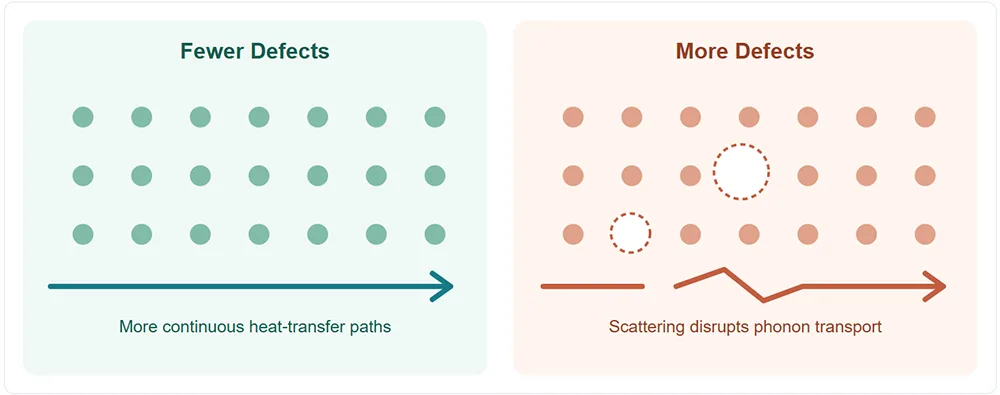
In electrically insulating ceramics, lattice vibrations transport much of the heat through phonons. Therefore, a relatively ordered crystal lattice with fewer phonon-scattering defects can support more effective heat transfer, although the actual conductivity also depends on crystal structure, bonding, temperature, and microstructure.
A simplified model of phonon thermal transport
For an illustrative isotropic solid under a simplified kinetic model, thermal conductivity can be expressed as:
Here, Cv represents volumetric heat capacity, vg represents an effective phonon group velocity, and ℓ represents an effective phonon mean free path. Accordingly, defects that shorten the mean free path can reduce thermal conductivity.
Note: This expression is a simplified kinetic model rather than a universal quantitative prediction for every ceramic.
For example, aluminum nitride (AlN) offers high thermal conductivity while maintaining electrical insulation, which makes it valuable for electronic substrates and heat-spreading components. Meanwhile, silicon nitride (Si3N4) combines useful thermal transport with strong mechanical properties and thermal-shock resistance, making it attractive for demanding structural and electronic applications.
Nevertheless, neither composition guarantees a particular conductivity by itself. Instead, powder purity, defect chemistry, densification, grain-boundary structure, and the final test conditions all influence the measured result.
2. Four Major Factors That Influence Thermal Conductivity
2.1 Impurities and Oxygen-Related Lattice Defects
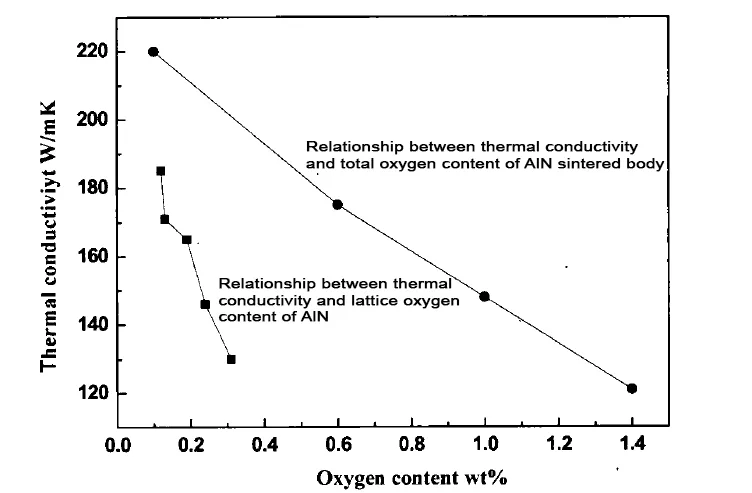
Among the most important factors, impurity chemistry can strongly affect the thermal conductivity of AlN and Si3N4. In particular, oxygen can interact with the crystal lattice and promote defect complexes that scatter heat-carrying phonons.
In AlN, oxygen can substitute for nitrogen in the lattice, while charge compensation may involve aluminum vacancies and associated defect structures. Consequently, oxygen-related defects can shorten phonon mean free paths and reduce conductivity, even when the ceramic appears dense.
Beyond oxygen, impurities such as iron (Fe), silicon-containing contaminants, magnesium (Mg), and silica (SiO2) may also influence thermal transport. However, their effects depend on chemical form, concentration, solubility, and whether they remain within grains or form secondary phases at grain boundaries.
Technical consideration: Lower oxygen content can improve AlN thermal conductivity, but the final result also depends on how processing redistributes oxygen and removes it from the lattice. Therefore, manufacturers should measure impurity content and evaluate the finished microstructure instead of relying solely on the raw powder specification.
2.2 Density and Residual Porosity
High relative density generally supports high thermal conductivity because pores interrupt solid-state heat-transfer pathways. Furthermore, the interfaces around pores scatter phonons, while trapped gas typically conducts heat less effectively than the ceramic matrix.
As densification progresses, interconnected and isolated pores decrease, allowing heat to move through a more continuous solid network. However, conductivity does not necessarily rise linearly with density because oxygen-related defects, grain-boundary phases, and intrinsic lattice scattering can remain important.
In practice, engineers should distinguish bulk density from relative density. Relative density compares the measured bulk density with the theoretical density of the relevant composition, which provides a more useful basis for comparing samples with different formulations.
Moreover, improved densification often enhances mechanical properties by reducing pore-related stress concentrations. Even so, the optimal process must avoid excessive grain growth, undesirable phase formation, and other defects that could offset the benefits of reduced porosity.
2.3 Grain Boundaries and Secondary Phases
Beyond density and impurity concentration, the microstructure of a sintered ceramic plays a central role in thermal transport. Typically, a polycrystalline ceramic contains primary grains, grain boundaries, secondary phases, and residual pores, each of which can influence heat flow.
At grain boundaries, structural disorder and chemical segregation can scatter phonons. Likewise, a secondary phase with lower thermal conductivity than the primary crystal may introduce additional thermal resistance, particularly when it forms a continuous or poorly distributed boundary layer.
In contrast, a carefully designed sintering-aid system may promote densification and help remove lattice oxygen. Nevertheless, any benefit depends on the chemistry and distribution of the resulting phases, because excessive or highly resistive boundary phases may lower the conductivity of the finished ceramic.
For Si3N4, the alpha-to-beta phase transformation, beta-grain morphology, and grain-boundary chemistry can all affect heat transport. Accordingly, engineers should evaluate phase composition and grain structure alongside the overall porosity level.
2.4 Powder Characteristics and Sintering Conditions
Although impurities and microstructure describe the material itself, powder characteristics and manufacturing conditions determine how that structure develops. Fine powders with suitable activity and a controlled particle-size distribution can improve packing and promote densification when the forming and sintering conditions are appropriate.
However, finer powder does not automatically produce higher conductivity. For instance, a high specific surface area can increase surface contamination and oxygen pickup, while agglomeration may create large pores that remain after firing.
Similarly, the sintering temperature, holding time, atmosphere, pressure, and heating schedule influence grain growth, pore elimination, phase formation, and oxygen redistribution. Therefore, a successful process must balance densification with chemical and microstructural control.
| Factor | Thermal transport mechanism | Manufacturing response |
|---|---|---|
| Oxygen and other impurities | Defects and impurity-related phases scatter phonons. | Select high-purity powders and control contamination. |
| Residual porosity | Pores interrupt conductive pathways and increase thermal resistance. | Optimize forming, powder packing, and densification. |
| Grain boundaries and secondary phases | Boundary disorder and low-conductivity phases impede heat transfer. | Control additives, phase distribution, and grain development. |
| Sintering parameters | Temperature, time, atmosphere, and pressure shape the final microstructure. | Develop a composition-specific, validated firing schedule. |
3. How to Improve the Thermal Conductivity of Advanced Ceramics
To improve thermal conductivity systematically, manufacturers should address the main sources of phonon scattering and avoid treating densification as the only objective. In particular, powder purity, additive chemistry, and sintering conditions must work together to produce the desired final microstructure.
3.1 Select High-Purity, Well-Controlled Ceramic Powders
First, choose powders with low impurity levels, suitable particle-size distributions, and sufficient sintering activity. For AlN, oxygen control deserves particular attention because oxygen-related lattice defects can substantially limit the conductivity achievable in a dense body.
Additionally, establish incoming-material specifications for oxygen, metallic contaminants, particle-size distribution, specific surface area, and agglomeration. Meanwhile, maintain clean milling, mixing, storage, and forming practices to prevent avoidable contamination before sintering.
Nevertheless, manufacturers should not select powders based on fineness alone. Instead, they should assess how powder characteristics influence packing density, forming behavior, oxygen pickup, sinterability, and the resulting thermal conductivity.
3.2 Optimize Sintering Additives
Next, select a sintering-aid system that promotes densification without leaving excessive low-conductivity material at grain boundaries. Depending on the ceramic composition, suitable additives may form a transient liquid phase at elevated temperatures, which improves mass transport and accelerates pore elimination.
In AlN, selected additives can also help transfer oxygen from the lattice into secondary phases that may be removed or redistributed during processing. Consequently, the right additive system can improve conductivity through both densification and defect-chemistry control.
Even so, the outcome depends on additive type, concentration, oxygen content, sintering atmosphere, and cooling conditions. Therefore, excessive additive loading may produce persistent grain-boundary phases or other defects that counteract the intended improvement.
Practical development principle
Rather than maximizing additive content, establish a controlled formulation window and validate it using relative density, phase analysis, oxygen measurements, and thermal-conductivity testing.
3.3 Optimize Sintering Temperature and Holding Time
As the temperature rises, diffusion and other mass-transport processes generally become faster, which can promote densification and, where the composition supports it, liquid-phase sintering. However, higher temperatures also increase energy consumption and may encourage excessive grain growth, volatilization, or unwanted reactions.
Accordingly, determine the minimum effective thermal cycle that achieves the required density and microstructure instead of raising the peak temperature without a defined target. Furthermore, optimize the holding time and heating schedule because the full thermal history influences pore removal and phase development.
3.4 Choose a Suitable Sintering Method
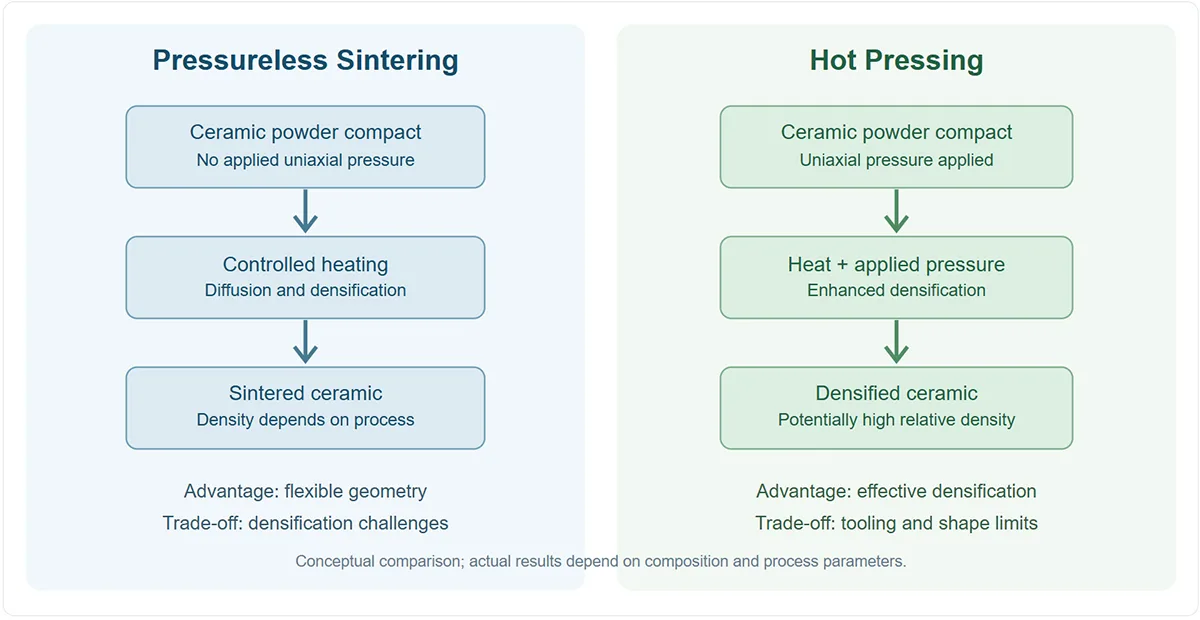
Beyond temperature control, the selected sintering method determines how effectively a ceramic body densifies and how much freedom manufacturers retain over component geometry. For example, pressureless sintering supports relatively flexible production, whereas hot pressing applies uniaxial pressure at elevated temperature to help achieve high density.
Nevertheless, hot pressing usually requires more specialized equipment and tooling, and the applied pressure can limit the shape and size of practical components. Therefore, engineers should choose the method according to the ceramic composition, required conductivity, dimensional tolerances, production volume, and total manufacturing cost.
4. Pressureless Sintering vs. Hot Pressing
For many advanced ceramic components, pressureless sintering and hot pressing represent two important manufacturing options. However, their performance depends on composition and equipment, so engineers should validate any claimed temperature or conductivity advantage for the specific material system.
| Parameter | Pressureless Sintering | Hot Pressing |
|---|---|---|
| Applied pressure | No external uniaxial pressure during sintering. | Applies pressure at elevated temperature. |
| Densification | Depends strongly on powder activity, additives, and firing conditions. | Pressure can support effective densification. |
| Shape flexibility | Generally suitable for a broader range of complex shapes. | Tooling and pressure direction can limit component geometry. |
| Equipment and cost | Often suitable for scalable batch production. | Usually requires specialized presses, dies, and process controls. |
| Thermal conductivity outcome | Can achieve high conductivity with suitable chemistry and densification. | Can achieve high conductivity when pressure, chemistry, and microstructure are optimized. |
Although hot pressing can achieve effective densification and may allow lower sintering temperatures in some systems, a universal temperature reduction of 200-300°C should not be assumed. Instead, compare actual processing windows for the selected powder, additive system, pressure, and target properties.
Furthermore, pressureless sintering remains attractive for components requiring complex shapes or higher production flexibility. Ultimately, the most appropriate method is the one that meets the conductivity specification and other engineering requirements at an acceptable manufacturing cost.
5. Manufacturing and Quality-Control Recommendations
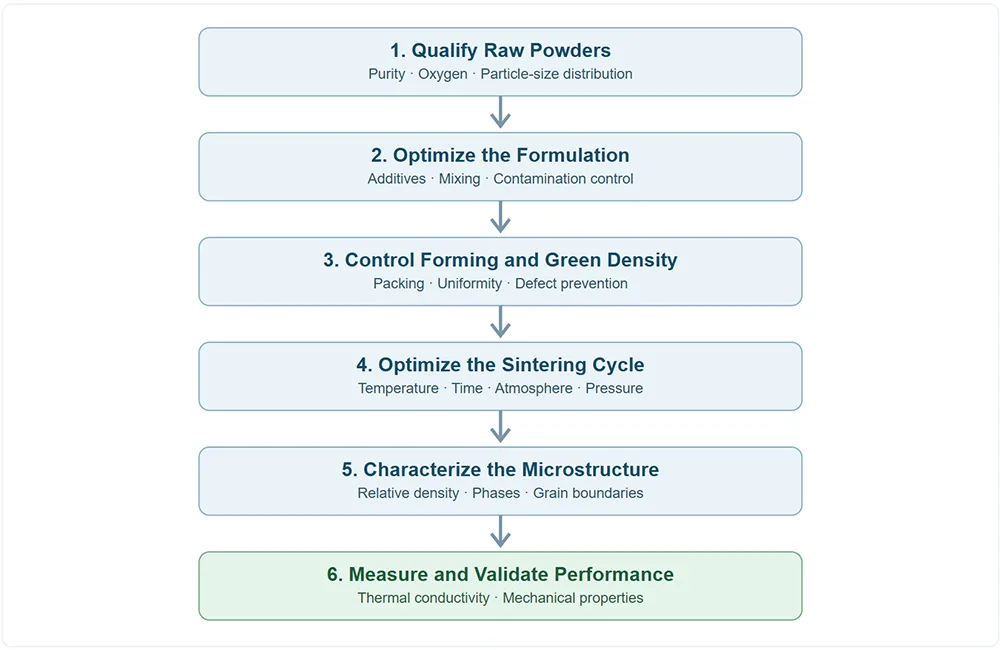
To turn material-science principles into consistent production results, establish a process-control plan that connects incoming powders, sintering parameters, microstructure, and final thermal performance.
5.1 Establish Measurable Process Controls
- Incoming powder: Monitor chemical purity, oxygen content where relevant, particle-size distribution, and powder agglomeration.
- Forming: Check green density and its uniformity, because uneven packing can produce residual pores and firing defects.
- Sintering: Record peak temperature, holding time, atmosphere, pressure where applicable, and cooling conditions.
- Microstructure: Evaluate bulk density, relative density, porosity, grain size, phase composition, and grain-boundary phases.
- Final performance: Measure thermal conductivity under documented test conditions and verify the mechanical and electrical properties required by the application.
5.2 Use a Root-Cause Approach When Conductivity Falls Below Target
If a dense ceramic still exhibits unexpectedly low conductivity, investigate oxygen-related defects, grain-boundary chemistry, and secondary phases before simply increasing the firing temperature. Conversely, when porosity remains high, review powder packing, forming defects, additive selection, and the densification schedule first.
For reliable comparisons, use the same test method, specimen preparation, measurement direction, and temperature whenever possible. Additionally, document the ceramic composition and thermal history, because these variables can complicate comparisons between different batches or suppliers.
6. Applications in Electronic Thermal Management
As semiconductor packages and power electronics continue to increase in power density, thermal management becomes a critical part of system reliability. Consequently, advanced ceramics serve several important roles in components that must transfer heat while maintaining electrical insulation or mechanical stability.
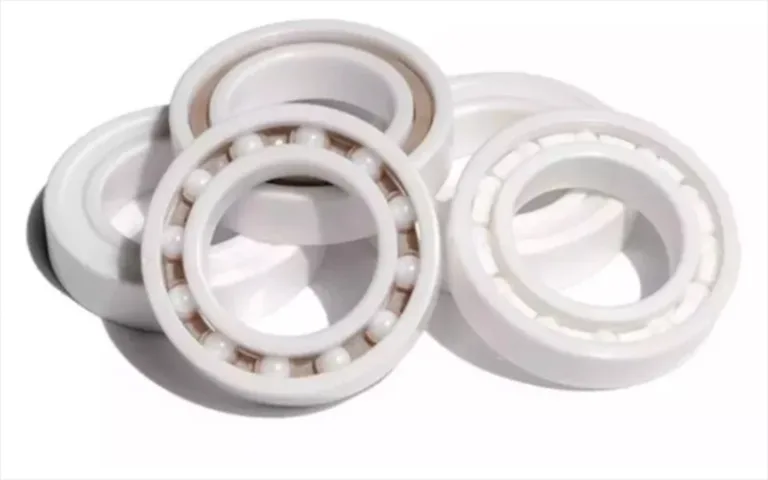
AlN Ceramic Substrates
High thermal conductivity and electrical insulation make AlN attractive for power modules, electronic packaging, and heat-spreading substrates.
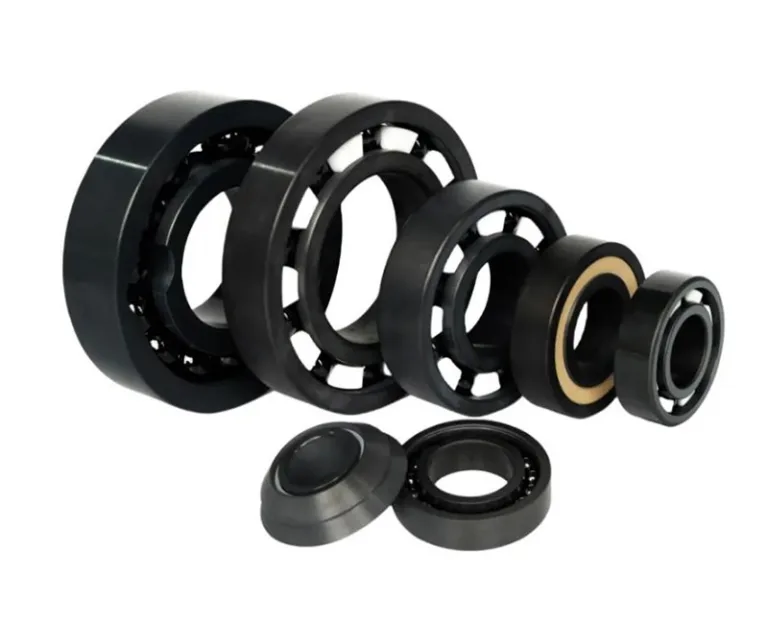
Si3N4 Substrates
Silicon nitride can support demanding power-electronics applications where thermal transport, mechanical strength, and thermal-shock resistance must work together.
Ceramic Thermal Fillers
Selected ceramic fillers can improve heat transfer in electrically insulating polymers, adhesives, potting compounds, and thermal-interface formulations.
Even so, the highest bulk conductivity does not always produce the best component-level thermal performance. Instead, engineers should also consider substrate thickness, interface resistance, bonding quality, thermal expansion, dielectric requirements, mechanical loading, and the overall heat-flow path.
7. Frequently Asked Questions
What factors most strongly influence the thermal conductivity of advanced ceramics?
Generally, impurity-related lattice defects, residual porosity, grain-boundary phases, and crystal microstructure play major roles. However, their relative importance varies with ceramic composition, processing conditions, and measurement temperature.
Why does oxygen reduce the thermal conductivity of AlN ceramics?
In AlN, oxygen can participate in lattice defect complexes and associated charge-compensation mechanisms. Consequently, these defects scatter phonons and can reduce thermal conductivity, although the final effect depends on oxygen concentration and its distribution within the ceramic.
Does higher ceramic density always mean higher thermal conductivity?
Not necessarily. Although reducing porosity usually improves heat transfer, oxygen-related defects and low-conductivity grain-boundary phases may continue to limit conductivity after the ceramic reaches high relative density.
How can sintering additives improve ceramic thermal conductivity?
Suitable additives can promote liquid-phase sintering, accelerate densification, and help redistribute oxygen-related defects in certain compositions. Nevertheless, excessive additives or persistent low-conductivity secondary phases may reduce the final thermal performance.
Is hot pressing always better than pressureless sintering?
No. Hot pressing can promote densification under applied pressure, but it may involve higher equipment costs and geometry constraints. Meanwhile, pressureless sintering can offer greater shape flexibility and production scalability when the formulation and firing schedule are well designed.
How should manufacturers verify improvements in thermal conductivity?
Manufacturers should measure thermal conductivity using a consistent, suitable test method and compare results under equivalent conditions. Additionally, relative density, chemical analysis, phase identification, and microstructural examination help identify the reasons behind performance changes.
Conclusion: Engineer the Microstructure, Not Just the Density
Ultimately, improving the thermal conductivity of advanced ceramics requires coordinated control of powder purity, oxygen-related defects, porosity, grain-boundary chemistry, and sintering conditions. Although high density provides an essential foundation, the final conductivity also depends on how effectively the process preserves favorable crystal and microstructural characteristics.
Therefore, manufacturers should combine suitable raw materials, carefully selected sintering additives, validated firing schedules, and consistent quality-control methods. By linking process parameters to measurable microstructural characteristics, engineers can develop AlN, Si3N4, and other advanced ceramic materials that better meet demanding thermal-management requirements.