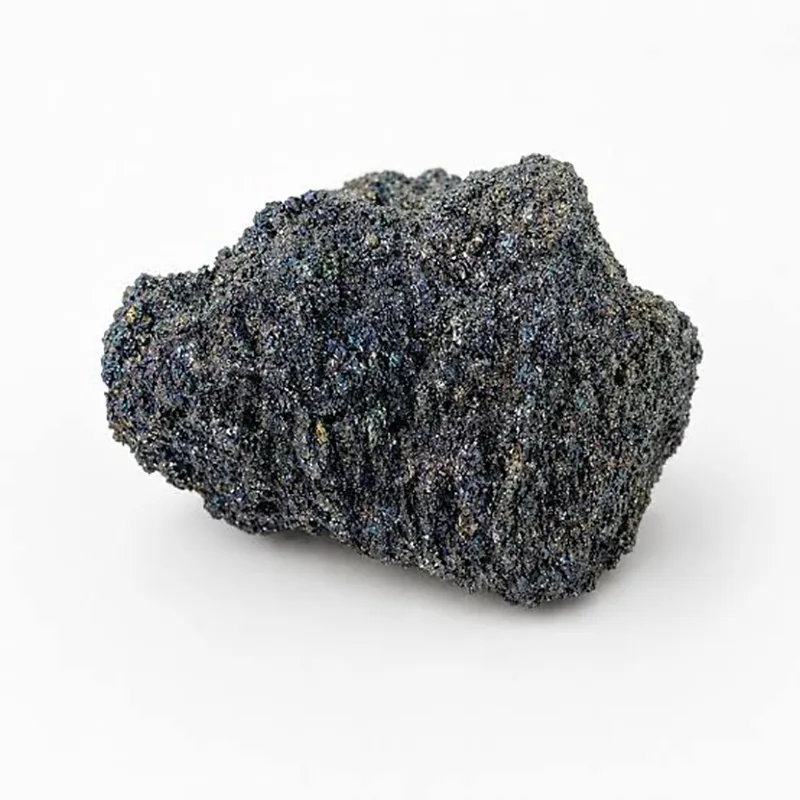
Materials Engineering · Technical Guide
What Are Silicon Carbide Ceramic Materials?
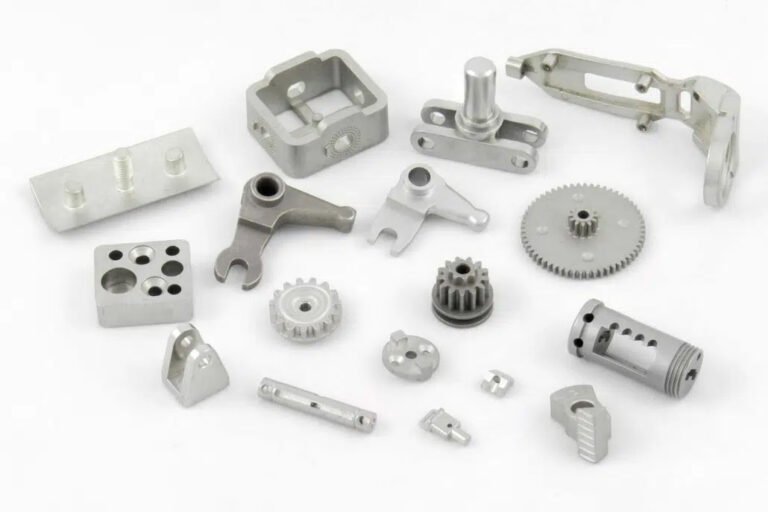
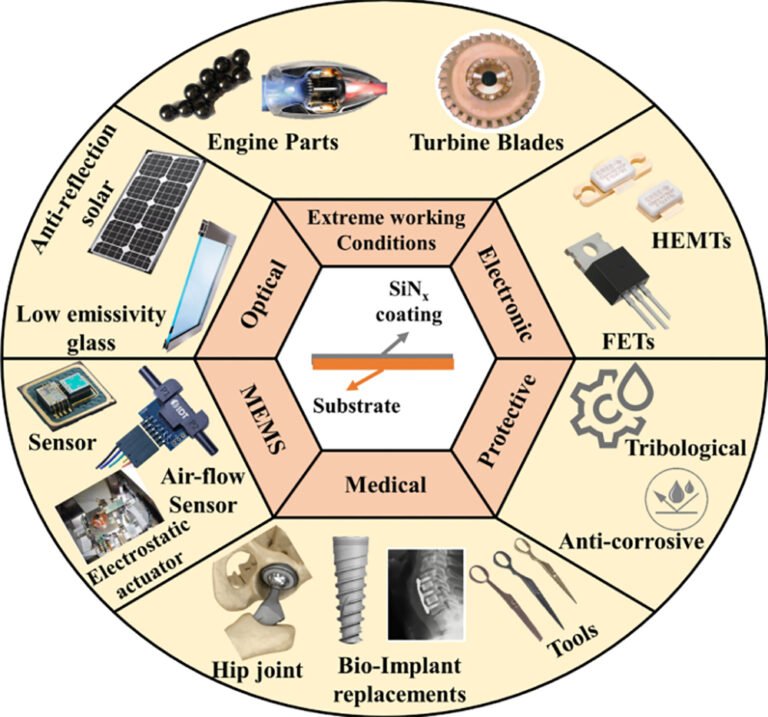
Silicon carbide ceramics combine a strong covalent crystal structure with high hardness, useful thermal conductivity, wear resistance and stability in many demanding environments. As a result, engineers use SiC in abrasive products, mechanical seals, high-temperature components, semiconductor equipment, energy-material processing and filtration systems.
Material class: Non-oxide ceramic
Focus: Structure · Properties · Applications
Quick Answer: What Is Silicon Carbide Ceramic?
In simple terms, silicon carbide ceramic is an engineered non-oxide ceramic made from silicon and carbon in an approximately 1:1 atomic ratio. Because strong Si-C bonds form a three-dimensional crystal network, SiC can offer high hardness, stiffness, thermal conductivity, oxidation resistance and wear resistance. However, the actual performance depends on the crystal polytype, porosity, grain structure, sintering route, residual silicon or secondary phases, and the service environment.
1. Silicon Carbide Composition and Crystal Structure
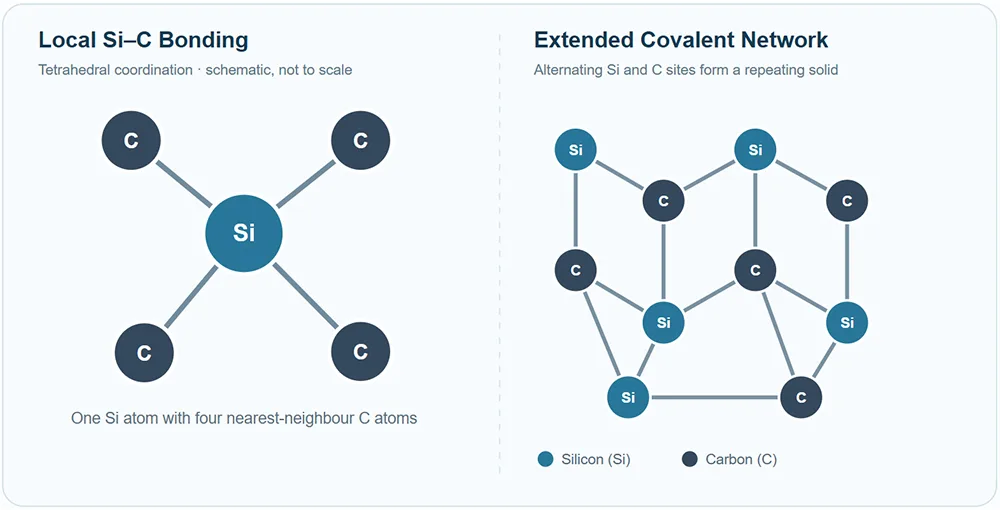
At the chemical level, silicon carbide (SiC) contains silicon and carbon in a nominal 1:1 atomic ratio. Rather than forming isolated SiC molecules in an ordinary engineering ceramic, these atoms build an extended covalent crystal lattice. In the common tetrahedral bonding environment, each silicon atom bonds to four carbon atoms, while each carbon atom bonds to four silicon atoms.
Consequently, the strong directional Si–C bonds help explain the material’s high hardness, stiffness and resistance to high-temperature deformation. Nevertheless, the crystal is not limited to one repeating arrangement: SiC exhibits many polytypes, which share closely related local bonding but differ in the stacking sequence of atomic layers.
Common SiC Polytypes
For example, cubic 3C-SiC differs from hexagonal 4H-SiC and 6H-SiC mainly in the stacking sequence of Si–C bilayers. Although engineers often discuss these forms in semiconductor contexts, the polytype, grain-boundary chemistry and processing route can also matter when choosing SiC powders or sintered ceramic grades.
- 3C-SiC: a cubic polytype often associated with cubic stacking sequences and studied in electronic, coating and materials applications.
- 4H-SiC: a hexagonal polytype widely used in power-semiconductor substrates because of its electronic properties.
- 6H-SiC: another hexagonal polytype found in electronic-grade crystals and materials research.
Importantly, bulk structural SiC ceramics and electronic-grade single-crystal SiC wafers are related but not interchangeable product categories. Structural ceramics usually prioritize density, strength, wear, corrosion and thermal behavior, whereas semiconductor wafers require controlled polytype, doping, defect density and electronic quality.
2. Key Properties of Silicon Carbide Ceramics
Because SiC combines strong covalent bonding with a relatively low density for a high-stiffness ceramic, it supports designs that need wear resistance and thermal stability without the mass of many metallic alternatives. Even so, engineers should use grade-specific data rather than assume that every SiC component delivers identical performance.
| Property | Engineering Significance | Design Consideration |
|---|---|---|
| High hardness | Resists abrasion and particle erosion. | Hardness also raises machining and finishing difficulty. |
| High stiffness | Supports dimensionally stable fixtures, mirrors and precision parts. | Geometry, joints and defects still govern system stiffness. |
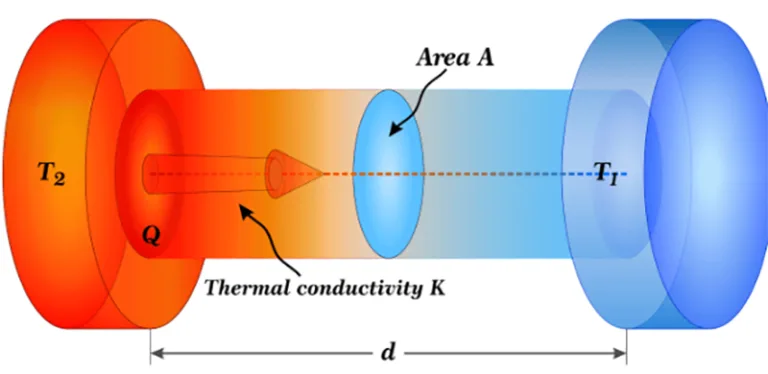
| Thermal conductivity | Spreads heat and reduces localized temperature gradients. | Values vary with porosity, purity, grain boundaries and grade. |
| Low thermal expansion | Helps limit thermally induced dimensional changes. | Mounting and temperature gradients still require analysis. |
| Chemical and oxidation resistance | Supports service in many chemical and high-temperature environments. | Molten salts, reactive metals, steam and gas chemistry can change performance. |
| Brittle fracture behavior | Provides no metal-like plastic yielding before fracture. | Avoid sharp corners and tensile stress concentrations; inspect flaws. |
Heat, Oxidation and Thermal Shock
Under many oxidizing conditions, SiC forms a silica-rich surface layer that can slow further oxidation within a suitable temperature and chemistry window. However, protective-scale behavior depends on atmosphere, temperature, time and contaminants, so designers should not rely on a single maximum-temperature value for all grades.
Similarly, thermal conductivity and a relatively low coefficient of thermal expansion can help reduce thermal gradients and stress during fast heating or cooling. Nonetheless, thermal shock resistance also depends on strength, flaw population, component thickness, shape and the speed of temperature change.
Wear, Corrosion and Fracture
In sliding-contact components, SiC can resist abrasive wear and work well in correctly designed lubricated or fluid-lubricated interfaces. Meanwhile, its chemical stability supports seals, pump components and process equipment that contact many corrosive liquids. Nevertheless, SiC remains a brittle ceramic, and inappropriate fits, impact loads, tensile stresses or poor surface finish can initiate cracking even when the bulk material is hard.
3. How Manufacturers Produce SiC Ceramic Components
Since the strong covalent bonds in SiC limit diffusion during conventional sintering, manufacturers must control powder characteristics and use a suitable combination of additives, temperature, atmosphere, pressure or infiltration. Therefore, the processing route strongly affects density, microstructure, dimensional change, thermal behavior, chemical purity and cost.
Reaction-Bonded SiC
First, a porous SiC/carbon preform receives molten silicon or silicon-bearing infiltration. Next, the silicon reacts with carbon to form additional SiC, while some routes retain residual free silicon. This process usually offers very low shrinkage and suits complex or larger components, although residual silicon can limit performance in some high-temperature or corrosive conditions.
Pressureless-Sintered SiC
By using sintering aids and a controlled atmosphere, this route densifies shaped parts without external pressure during firing. As a result, manufacturers can produce complex shapes and a broad range of component sizes, although shrinkage prediction and defect control are critical.
Hot Pressing and HIP
During hot pressing, heat and uniaxial pressure act together, often enabling high density but limiting part geometry. By contrast, hot isostatic pressing applies high gas pressure from multiple directions to reduce pores in a suitable preform or previously sintered body, with equipment and encapsulation requirements influencing cost.
Recrystallized SiC
Through a graded powder packing and high-temperature evaporation–condensation process, recrystallized SiC forms bonded contacts between grains while retaining designed porosity. Consequently, the material can offer useful thermal shock behavior and gas permeability, though its residual pores make it different from fully dense grades.
Advanced and Specialized Routes
In research and selected production settings, spark plasma sintering, microwave sintering and flash sintering can accelerate densification or alter microstructure. Additionally, chemical vapor deposition or infiltration can create high-purity SiC layers or fill porous structures for demanding optical, semiconductor and filtration applications.
Ultimately, no single process produces the best SiC for every use. Instead, the correct route depends on required density, allowable residual phases, component dimensions, tolerance, pore structure, strength, service temperature, chemical exposure and target cost.
4. Major Applications of Silicon Carbide Ceramic Products
Across manufacturing industries, silicon carbide appears both as a loose abrasive or process additive and as an engineered ceramic component. The following application groups show how engineers connect the material’s properties to product requirements rather than choosing SiC solely because it is hard or heat-resistant.
4.1 Abrasives and Precision Finishing
First, silicon carbide grains serve as abrasive media in grinding wheels, coated abrasives, honing stones, lapping compounds and surface-finishing tools. Their hardness and sharp cutting edges make them useful for materials such as glass, stone, ceramics, cast iron and selected non-ferrous alloys.
In addition, green SiC abrasive grades often target fine grinding of hard materials such as cemented carbides and optical glass, while black SiC commonly serves broader grinding and cutting applications. Specific abrasive choice still depends on workpiece chemistry, toughness, required finish, wheel bond, grit size and process temperature; therefore, colour alone is not a complete grade specification.
4.2 Refractories, Kiln Furniture and High-Temperature Hardware
Because SiC conducts heat well and tolerates rapid temperature changes in suitable grades, manufacturers use it in kiln shelves, setters, saggers, rollers, burner nozzles, furnace fixtures and high-temperature heat-transfer structures. Furthermore, cellular SiC and silicon-infiltrated SiC structures can serve burners, heat exchangers, catalyst supports and other systems exposed to high thermal loads.
During product design, engineers must account for oxidation conditions, contact reactions with the processed material, thermal gradients, creep of any secondary phase and mechanical loading. For example, a kiln setter needs predictable flatness and thermal cycling performance, whereas a burner nozzle also needs the correct flow geometry and resistance to erosion or chemical attack.
4.3 Metallurgy and Steelmaking Deoxidizers
In metallurgical operations, silicon carbide can function as a source of silicon and carbon and, under controlled steelmaking conditions, as a deoxidizing or process additive. Compared with an unsuitable conventional additive, a well-selected SiC feed can support melt chemistry and slag management; however, the result depends on grade, particle size, charge practice, oxygen level, slag chemistry and furnace conditions.
For this reason, metallurgical-grade SiC should be specified by chemical composition and process compatibility instead of assuming that a structural ceramic grade is automatically suitable for steelmaking. In addition, the material’s overall recycling and utilization route can depend on how producers sort and qualify different SiC by-products.
4.4 Mechanical Seals, Bearings, Pumps and Wear Parts
Within pumps and fluid-handling systems, dense SiC grades often form mechanical seal faces, seat rings, sliding bearings, shaft sleeves, bushings, valve trims, impellers and hydrocyclone liners. In these roles, high hardness fights abrasion, while chemical resistance supports contact with many acids, alkalis, slurries and process fluids.
Moreover, a SiC seal face can help maintain dimensional stability and resist wear under properly controlled contact pressure and lubrication. Still, engineers must choose mating materials carefully: seal performance depends on surface finish, flatness, pressure, fluid lubricity, dry-running events, thermal distortion and the combination of the two sliding materials.
4.5 Aerospace, Defense and Lightweight Optical Systems
For aerospace and defense systems, SiC offers an appealing combination of high stiffness, low density relative to many metals, thermal stability and wear resistance. Accordingly, designers consider SiC and SiC-based composites for hot gas components, rocket or combustion-system hardware, selected protective structures and dimensionally stable optical mirrors.
In optical applications, a lightweight SiC mirror substrate can support high stiffness-to-mass ratio and efficient thermal spreading. Nevertheless, reflectivity and surface quality do not arise from the structural ceramic alone; manufacturers still need precise grinding, polishing and sometimes a deposited optical coating. Similarly, armor performance depends on projectile threat, tile architecture, backing, joining and test protocols, so material hardness by itself does not define ballistic performance.
4.6 Electrical, Electronic and Heating Components
Meanwhile, SiC ceramic components serve selected heaters, protective tubes, high-temperature fixtures, electrical equipment and electronic manufacturing tools. Because bulk SiC can combine thermal conductivity with high-temperature stability, it can help distribute heat or support wafers in demanding process equipment.
However, structural SiC ceramics are not automatically interchangeable with high-quality SiC semiconductor substrates. Power devices typically use carefully controlled single-crystal wafers-often 4H-SiC-with strict requirements for epitaxy, doping, defects, resistivity and surface finish. In contrast, a ceramic wafer-handling arm or furnace component prioritizes mechanical, thermal, chemical-purity and dimensional properties.
4.7 Battery Materials and New-Energy Manufacturing
As battery-material production expands, SiC ceramic liners, mill chambers and selected wear components can support bead milling and dispersion processes for cathode powders such as lithium iron phosphate. In this setting, abrasion resistance helps reduce equipment wear, while thermal conductivity can help manage heat produced during milling.
Furthermore, SiC kiln furniture, crucibles and supports may serve selected calcination and high-temperature processing steps for battery or advanced ceramic powders, provided the material remains compatible with the composition and atmosphere. Since contamination limits can be strict for active materials, process engineers should evaluate element transfer, residual free silicon, binder systems and wear particles instead of assuming every SiC grade is contamination-free.
4.8 Photovoltaic and Silicon-Wafer Processing
For photovoltaic manufacturing, SiC components can support high-temperature silicon processing and wafer heat treatment. Typical components include wafer boats, cantilever paddles, vertical supports, furnace fixtures and selected process tubes or coated structures, depending on furnace design and contamination requirements.
Because these parts face high temperatures and repeated thermal cycles, engineers value SiC’s stiffness and dimensional stability. Nevertheless, surface cleanliness, metallic impurities, particle generation, coating integrity and compatibility with the process atmosphere remain central qualification criteria in silicon crystal growth and wafer processing.
4.9 Precision Ceramics for Semiconductor Equipment and Lithography
In advanced semiconductor tools, some SiC-based structural components can provide high stiffness, thermal stability and low mass for precision motion systems, mirror supports, wafer-handling arms, chucks or process fixtures. Their relevance depends on the tool architecture and on whether the design benefits from SiC’s particular combination of stiffness, conductivity and expansion behavior.
Still, high-end equipment requires far more than a material label. Designers must manage flatness, straightness, geometry, vibration, thermal drift, surface finish, joining, coating, cleanliness and long-term stability. Moreover, complex hollow structures and large SiC parts can be challenging to densify and machine, so near-net-shape processing and careful finishing often determine commercial feasibility.
4.10 Porous SiC Filters and Membranes
Unlike dense seal or mirror grades, porous SiC intentionally retains connected pores. As a result, manufacturers can design tubular, honeycomb, plate or multichannel filters for hot-gas cleaning, dust capture, liquid filtration and selected gas-separation processes.
Because SiC can tolerate high temperature and many corrosive conditions, porous structures attract interest in flue-gas purification, waste treatment, process industry, oil and gas, and wastewater systems. Nonetheless, filtration performance depends on pore-size distribution, permeability, cake formation, cleaning approach, thermal cycling and the stability of any binder or membrane layer. Consequently, porosity must be optimized for flux and filtration efficiency without sacrificing strength or resistance to pressure changes.
5. How to Select the Right Silicon Carbide Product
Before specifying a SiC component, translate the service environment into measurable requirements. The table below provides a starting framework rather than a substitute for engineering qualification.
| Application | Key Requirements | Typical Design Checks |
|---|---|---|
| Mechanical seal or bearing | Wear, corrosion and dimensional stability | Surface finish, flatness, contact stress, pairing, lubrication |
| Kiln furniture or burner | Thermal cycling and high-temperature chemistry | Creep, atmosphere, support spacing, thermal shock |
| Mirror or precision stage | Stiffness, low mass and thermal stability | CTE, vibration modes, geometry, polish, coating, mounting |
| Wafer-handling part | Purity and particle control | Outgassing, impurities, cleanability, coating integrity |
| Porous filter | Permeability, filtration and corrosion resistance | Pore distribution, pressure drop, backwashing, fouling |
In addition, buyers should request the exact grade designation, manufacturing route, density or open-porosity data, mechanical-property test conditions, thermal-property measurement method, chemical-compatibility information, dimensional tolerances and inspection plan. For critical parts, a representative prototype and application-relevant validation test often reveal risks that a datasheet cannot capture.
6. Frequently Asked Questions
What does SiC stand for?
SiC stands for silicon carbide, a compound of silicon and carbon with a nominal 1:1 atomic ratio.
Is silicon carbide a ceramic or a semiconductor?
It can serve as both, depending on form and specification. Structural SiC ceramics are engineered for mechanical and thermal functions, whereas single-crystal SiC wafers serve as semiconductor substrates.
Why is silicon carbide difficult to sinter?
Strong covalent bonding slows mass transport. Therefore, manufacturers commonly use sintering aids, applied pressure, silicon infiltration or specialized methods to obtain the required density and microstructure.
Can SiC resist all acids and high-temperature chemicals?
No single ceramic resists every environment. Although SiC performs well in many chemical services, molten salts, reactive metals, steam and extreme oxidation conditions can affect it; validate the exact grade against the actual medium and temperature.
What is the difference between reaction-bonded and sintered SiC?
Reaction-bonded SiC forms additional SiC through reaction between infiltrated silicon and carbon, and it may retain free silicon. Pressureless-sintered or hot-pressed SiC instead densifies powder through a sintering process, typically with different shrinkage, composition, geometry and property trade-offs.
Which industries use silicon carbide ceramic parts?
Common sectors include mechanical engineering, chemical processing, metallurgy, thermal processing, aerospace, optical systems, semiconductor manufacturing, energy-material production and filtration.
Conclusion: A Versatile Material That Requires Grade-Specific Design
Ultimately, silicon carbide ceramic materials derive their engineering value from the combination of strong Si-C bonding, high hardness, stiffness, useful thermal conductivity and resistance to wear and many chemical environments. From abrasives and furnace fixtures to mechanical seals, optical structures, semiconductor equipment and porous filters, SiC supports applications where conventional metals or oxide ceramics may struggle. However, engineers achieve reliable results only when they match the grade, microstructure, manufacturing route and component design to the actual service conditions.
Technical References and Further Reading
The following resources support the descriptions of SiC polytypes, industrial applications and porous ceramic membranes. Product selection still requires grade-specific datasheets and application testing.
- International Union of Crystallography, The prolific polytypism of silicon carbide – crystal polytypes and stacking sequences.
- Fraunhofer IKTS, Ceramics highly resistant against temperature, corrosion, and wear – high-temperature SiC ceramics and industrial components.
- Saint-Gobain Performance Ceramics & Refractories, Chemical Processing Industry – seals, heat-exchanger tubes, nozzles and chemical-service components.
- Review article, Recent Progress in Silicon Carbide-Based Membranes for Gas Separation – SiC membrane preparation, stability and separation applications.
- Review article, Tribology of SiC ceramics under lubrication: Features, developments, and perspectives – bearing, seal and wear applications.
- Eray et al., A roadmap for the development and applications of silicon carbide membranes for liquid filtration – membrane design and water-treatment applications.