Advanced Manufacturing Engineering Series
Complex Components = High Cost? MIM Technology Overturns the Inherent Cost Logic of Precision Manufacturing
Moreover, this technical deep-dive reveals how Metal Injection Molding decouples geometric complexity from production expenses, empowering engineers to maximize performance without triggering exponential cost penalties.
Executive Summary
Historically, the global precision manufacturing sector has operated under a rigid iron law stating that part complexity correlates strongly with production cost. However, Metal Injection Molding (MIM) has matured into a disruptive force that fundamentally invalidates this assumption for high-volume precision components. By achieving near-net-shape forming with over 95% material utilization and integrating multiple assembly features into a single molded geometry, MIM allows complex parts to achieve lower total lifecycle costs than their simplified traditional counterparts. Ultimately, this technology shifts the competitive advantage from those who simplify designs to those who leverage complexity for superior performance at reduced expense.
1. The Traditional Constraint: Why Complexity Equals High Cost
Initially, we must understand the physical boundaries of conventional manufacturing that created the current cost paradigm. Every time an engineer adds an irregular surface, an internal channel, or a thin-wall structure to a CAD model, traditional processes demand exponentially more resources to realize that geometry.
CNC Subtractive Manufacturing Limitations
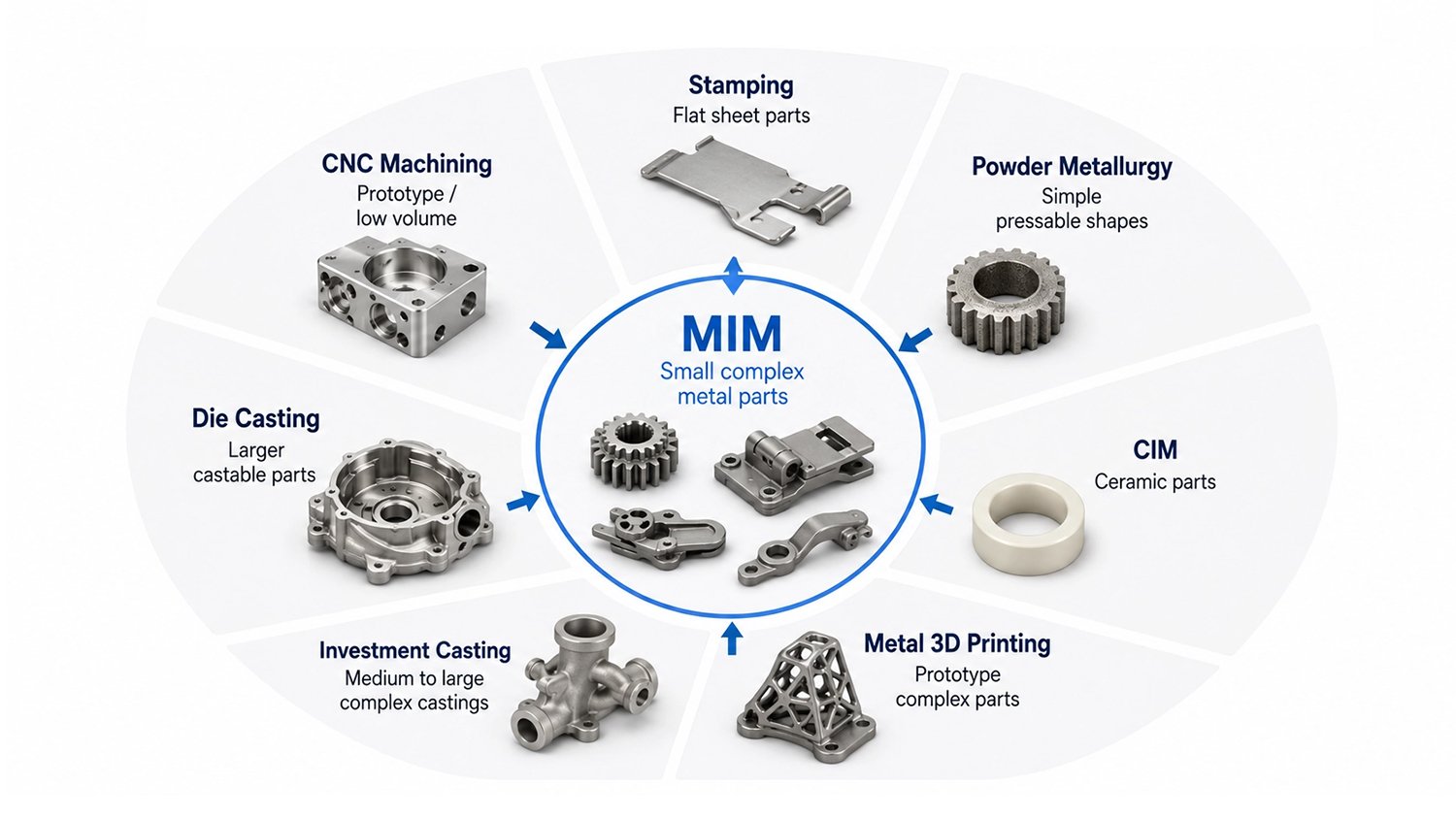
Primarily, CNC machining operates on a subtractive principle where removing material creates the final shape. Consequently, complex structures require multi-axis machines, multiple fixture setups, and specialized tooling that dramatically increases cycle time. Furthermore, material utilization for intricate parts frequently drops below 30%, meaning manufacturers pay for expensive alloy billets only to recycle 70% as scrap. Thus, each additional geometric feature directly translates into longer machining hours and higher waste generation.
Stamping and Die Casting Restrictions
Alternatively, stamping and die casting excel at simple 2D or quasi-3D shapes but fail catastrophically with true geometric complexity. When designers attempt complex features with these methods, factories must employ multiple progressive dies and secondary operations. Additionally, joining these sub-components requires welding, riveting, or adhesive bonding, which introduces assembly labor costs and creates potential failure points. Therefore, what should be a single part becomes a multi-component assembly with compounded quality risks.
Precision Casting Challenges
Meanwhile, investment casting struggles to maintain consistency when producing miniature, thin-walled, or high-tolerance complex structures. Post-processing requirements remain extensive and unpredictable, causing yield rates to fluctuate wildly between batches. As a result, the comprehensive cost stays stubbornly high because factories must price in significant risk buffers for scrap and rework. Beyond direct production, hidden costs from assembly labor, quality control overhead, warranty claims, and extended R&D cycles further compress profit margins.
2. The MIM Paradigm Shift: Reversing the Cost Curve
Conversely, Metal Injection Molding represents a hybrid technology that merges powder metallurgy with plastic injection molding principles. Its core disruptive value lies in one fundamental truth: within the moldable envelope, geometric complexity exerts almost zero influence on unit production cost.
Geometry Agnostic Forming
Specifically, any feature that fits within a mold cavity-whether irregular curves, closed-loop fluid channels, mesh grids, or precision gear teeth-forms simultaneously during a single injection shot. Unlike subtractive methods where each feature adds time, MIM forms all features concurrently in 30 to 60 seconds. Therefore, a highly complex component consumes nearly identical cycle time and raw material as a simple cylindrical spacer. This characteristic completely flattens the traditional cost-complexity curve.
Near-Net-Shape Excellence
Additionally, MIM achieves near-net-shape accuracy that eliminates or minimizes secondary machining operations. Engineers can design functional features directly into the mold rather than planning post-process drilling or milling. Consequently, the factory avoids capital-intensive CNC equipment depreciation and skilled machinist labor for finishing steps. Ultimately, this capability transforms complexity from a cost liability into a free design parameter that enhances product functionality without financial penalty.
3. Direct Production Savings: Material and Cycle Efficiency
Furthermore, the direct economic benefits of MIM manifest immediately on the factory floor through dramatic improvements in resource efficiency. These tangible savings provide the first layer of competitive advantage for manufacturers adopting this technology.
Maximizing Material Utilization
First, MIM processes maintain stable material utilization rates exceeding 95%, representing a threefold improvement over CNC machining for complex geometries. For precious metals like titanium alloys or nickel-base superalloys, this efficiency alone can reduce direct material costs by more than 60%. Since runners and sprues are recyclable back into the feedstock stream, virtually no expensive alloy ends up as unrecoverable waste. Thus, material procurement budgets shrink proportionally with the adoption of near-net-shape forming.
Cycle Time Independence from Complexity
Second, the injection cycle remains constant regardless of part intricacy, whereas CNC cycle times scale linearly or exponentially with feature count. A traditional complex part requiring ten separate operations over thirty minutes might emerge from a MIM mold every forty-five seconds with all features intact. Moreover, high levels of automation allow single operators to manage multiple molding cells simultaneously. Industry benchmarks demonstrate that multi-feature precision components produced via MIM achieve unit cost reductions of 40% to 85% compared to 5-axis CNC alternatives.
4. Total Cost of Ownership: Eliminating Hidden Expenses
Beyond direct production metrics, MIM delivers systemic optimization across the entire product lifecycle by eliminating hidden cost drivers that plague traditional manufacturing approaches. Smart engineering teams recognize that true profitability emerges from minimizing total ownership expenses rather than just unit price.
Part Consolidation Eliminates Assembly
Notably, designers can consolidate three to five separate assembled components into a single monolithic MIM part. This integration eliminates multiple tooling investments, assembly labor hours, and fastener hardware costs entirely. More importantly, it removes dimensional stack-up errors and joint failure risks that inevitably arise from multi-part assemblies. Consequently, warranty claims decrease while supply chain management simplifies significantly.
Consistency Reduces Quality Overhead
Additionally, MIM maintains exceptional dimensional consistency with standard tolerances of ±0.02mm to ±0.05mm, and precision grades reaching ±0.01mm. Simple parts achieve batch yield rates above 97%, while complex precision components stabilize between 90% and 95%. Such predictability drastically reduces inspection frequency, rework labor, and scrap disposal costs. Therefore, quality assurance departments can redirect resources from firefighting defects toward preventive process optimization.
Accelerated Development Cycles
Finally, MIM tooling development and pilot production cycles run 30% to 50% faster than equivalent stamping or die casting tooling. Design iterations require only modifying the mold cavity insert rather than rebuilding entire die sets. This agility compresses time-to-market windows and reduces R&D expenditure per design generation. Ultimately, companies capture market share faster while spending less on development infrastructure.
5. Debunking Three Critical Industry Myths
Despite proven advantages, outdated perceptions continue limiting MIM adoption across industries. Addressing these misconceptions unlocks the full value proposition for forward-thinking manufacturers.
Myth 1: MIM Only Produces Micro Parts
Contrary to popular belief, modern MIM facilities mass-produce components ranging from 0.05 grams up to 750 grams with maximum dimensions reaching 500mm. While laboratory equipment handles larger specials, the standard industrial range covers the vast majority of precision structural needs. Hence, automotive transmission components, surgical instrument housings, and power tool gears all fall comfortably within current capabilities.
Myth 2: Insufficient Precision for Critical Applications
Actually, standard MIM achieves densities between 93% and 97%, while Hot Isostatic Pressing (HIP) post-treatment elevates this to 99% theoretical density. Mechanical properties thus approach or match wrought forgings, enabling deployment in safety-critical automotive and implantable medical applications. Furthermore, tight tolerance capabilities disprove the notion that MIM suits only non-functional decorative parts.
Myth 3: Viability Requires Million-Unit Volumes
Recently, advances in modular tooling and rapid sintering have pushed the economic breakeven point down to 10,000-unit batches. For geometrically complex parts, even small-batch MIM production undercuts 5-axis CNC costs by over 40% due to eliminated programming and setup time. Therefore, mid-volume programs previously locked into expensive machining now benefit from MIM economics.
6. Strategic Implications for Modern Engineering Teams
Ultimately, the manufacturing sector has long suffered from a vicious cycle of “simplify design → sacrifice performance → compress margins.” MIM technology introduces an entirely new cost logic where design complexity serves as a lever for both performance enhancement and cost optimization rather than a burden.
Global competition no longer rewards whoever makes simple parts cheapest; instead, victory belongs to those who deliver high-value complex components at superior cost-performance ratios. For engineering, supply chain, and management teams, the imperative question shifts from “how do we simplify?” to “how do we leverage MIM to break cost constraints and build product differentiation?”
Ibex Precision specializes in MIM manufacturing for high-end tools, lock mechanisms, and medical devices, dedicated to reconstructing the relationship between cost and performance through advanced processing. If you have complex component requirements demanding both precision and economic efficiency, we invite you to initiate a technical consultation with our engineering team today.
7. Technical FAQ: MIM Economics and Capabilities
Q1: Does part complexity increase production costs in MIM?
Conversely, within the moldable range, geometric complexity has almost zero impact on MIM production costs. Therefore, intricate features like internal channels or thin walls form during the initial injection cycle without adding machining time, unlike CNC where complexity exponentially increases expense.
Q2: How does MIM material utilization compare to CNC machining?
Furthermore, MIM consistently achieves material utilization rates above 95%, whereas CNC machining of complex parts often wastes over 70% of the raw billet. Consequently, for expensive alloys like titanium or nickel-base superalloys, this efficiency reduces direct material costs by more than 60%.
Q3: Can MIM produce high-precision critical safety components?
Additionally, modern MIM processes achieve densities between 93% and 97%, and Hot Isostatic Pressing (HIP) can raise this to 99%. Thus, the mechanical properties rival forged steel, allowing safe deployment in automotive safety systems and medical implants with tolerances as tight as ±0.01mm.
Q4: Is MIM only viable for million-unit production runs?
However, recent tooling advancements have made MIM cost-effective for batches as small as 10,000 units. Specifically, for complex geometries, small-batch MIM prototyping and production can be 40% cheaper than 5-axis CNC machining due to reduced setup and programming overhead.
Q5: What is the maximum size limit for MIM components?
Currently, industrial MIM reliably mass-produces components ranging from 0.05g up to 750g with dimensions reaching 500mm. Hence, this range covers the vast majority of precision structural needs across consumer electronics, medical devices, and automotive sectors.
Transform Your Complex Component Strategy Today
Stop compromising performance for cost. Partner with Ibex Precision to leverage MIM technology and unlock simultaneous improvements in functionality, quality, and profitability.