
Advanced Manufacturing & Sustainability Series
How does MIM technology enable lock manufacturers to secure a profit margin of up to 30% under the CBAM carbon cost pressure?
Furthermore, this comprehensive technical guide explores how Metal Injection Molding (MIM) mitigates EU CBAM carbon taxes, slashes manufacturing emissions by 70%, and unlocks unprecedented profitability in the modern lock hardware industry.
Executive Summary
Initially, the European Union’s Carbon Border Adjustment Mechanism (CBAM) entered its mandatory taxation phase in January 2026, transforming previous compliance warnings into severe financial liabilities. Consequently, traditional metalworking processes generate massive carbon emissions, inflating overall lock product costs by 15% to 22% and relentlessly compressing profit margins. However, Metal Injection Molding (MIM) technology offers a strategic lifeline by combining near-net-shape precision with ultra-low emission profiles. Ultimately, by adopting MIM, lock manufacturers can simultaneously reduce carbon compliance costs by 20%, slash production expenses by 15%, and capture green market premiums, thereby securing a robust 30% core profit margin.
1. The CBAM Reality: Carbon Costs Squeezing Lock Manufacturers
Currently, the global manufacturing landscape faces a monumental shift as environmental regulations transition from voluntary guidelines to strict financial penalties. Specifically, the EU CBAM formally entered its tax implementation phase in January 2026, meaning that the transitional compliance warnings of the past have now materialized into mandatory cost expenditures. Therefore, export-oriented lock manufacturing has instantly become one of the most directly impacted sectors, as hardware products rely heavily on carbon-intensive steel and brass processing.
The Hidden Tax on Traditional Machining
Historically, lock manufacturers relied on conventional CNC machining, casting, and forging to produce critical security components. Unfortunately, these traditional methods inherently waste massive amounts of raw material and consume enormous quantities of electrical energy during prolonged cutting cycles. As a result, the high carbon emissions embedded in these processes continuously squeeze the profitability of hardware exporters. Furthermore, because CBAM calculates tariffs based on the total embedded emissions of the imported product, the entire supply chain’s carbon footprint directly translates into a border tax.
Margin Compression and Market Share Risks
Consequently, industry analyses reveal that the overall cost of exported lock products has already surged by 15% to 22% solely due to carbon cost pass-through mechanisms. Naturally, this drastic cost inflation causes industry profit margins to narrow dangerously, threatening the survival of mid-tier manufacturers. Moreover, companies failing to adapt risk losing their competitive pricing edge against localized European producers who benefit from lower regional carbon grids. Thus, lock manufacturers face an urgent dilemma: how to satisfy stringent CBAM compliance requirements while simultaneously maintaining, or even expanding, their profit margins?
Ultimately, the widespread adoption of Metal Injection Molding (MIM) technology emerges as the definitive solution to this complex profitability puzzle. By fundamentally reimagining how metal parts take shape, MIM transforms a regulatory burden into a distinct competitive advantage.

2. Understanding Metal Injection Molding (MIM) Technology
Before analyzing the financial benefits, engineers must first comprehend the underlying mechanics of this advanced manufacturing paradigm. Essentially, MIM represents a highly sophisticated near-net-shape forming technology that seamlessly merges modern plastic injection molding principles with traditional powder metallurgy. Consequently, this hybrid approach enables the single-step formation of highly complex, high-precision metal components, fundamentally resolving the inherent pain points of subtractive manufacturing.
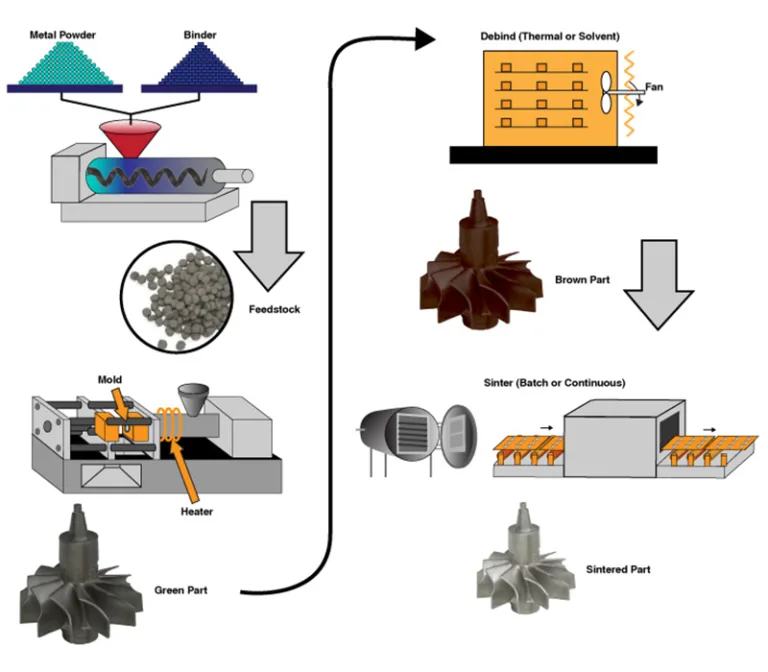
Step 1: Feedstock Preparation and Mixing
Initially, technicians carefully blend ultra-fine metal powders (typically under 20 microns) with a specialized thermoplastic binder system to create a homogeneous feedstock. Therefore, this precise mixture ensures that the metallic particles flow smoothly through the injection barrel while maintaining uniform density. Additionally, the binder acts as a crucial vehicle, granting the powder the rheological properties necessary to fill intricate mold cavities flawlessly.
Step 2: High-Precision Injection Molding
Subsequently, specialized injection machines heat the feedstock and force it into precision-machined steel molds under high pressure. During this phase, the machine produces a “green part” that perfectly mirrors the complex geometry of the final lock component, including internal splines and undercuts. Hence, this step achieves the massive geometric complexity that would otherwise require multiple setups on a 5-axis CNC mill.
Step 3: Debinding and Sintering
Afterward, the manufacturing team subjects the green parts to a debinding process, utilizing thermal or catalytic methods to carefully extract the polymer binder. Following this, the “brown parts” enter a high-temperature sintering furnace, where the metal particles diffusively bond and densify to near-theoretical limits. Ultimately, the component shrinks isotropically by about 15% to 20%, emerging as a fully dense, high-strength metallic lock mechanism ready for immediate assembly.
3. Advantage 1: Slashing Carbon Footprints by 60%-70%
Undoubtedly, the most critical benefit of MIM in the CBAM era lies in its ability to drastically reduce the embedded carbon emissions of every exported lock. Specifically, this direct reduction of 60% to 70% in the carbon footprint forms the bedrock upon which manufacturers protect their bottom line against border carbon taxes.
Maximizing Material Utilization
Firstly, MIM processes boast raw material utilization rates exceeding 98%, meaning the factory generates almost zero production scrap. Conversely, traditional CNC machining of a complex lock cylinder often removes up to 60% of the original steel billet, creating massive amounts of swarf that require energy-intensive recycling. Therefore, by eliminating this waste at the source, MIM effectively erases the hidden carbon emissions associated with raw material extraction, transportation, and secondary recycling loops.
Eliminating Energy-Intensive Secondary Operations
Moreover, the single-step formation of complex structures eliminates over 80% of subsequent machining operations, which drastically lowers production energy consumption. For instance, drilling cross-holes, milling flat spots, and cutting internal threads on a traditional deadbolt consume vast amounts of electricity and cutting fluids. By bypassing these steps entirely, MIM reduces the thermal treatment and mechanical energy footprint so profoundly that the lifecycle carbon emissions fall far below CBAM baseline thresholds. Consequently, manufacturers avoid paying extra carbon tariffs entirely, and in some regional cap-and-trade systems, they might even generate surplus carbon credits.
Ensuring Traceable Compliance Data
Furthermore, the highly automated, closed-loop nature of MIM production allows for complete traceability of energy inputs and material flows. Thus, quality assurance teams can generate precise, verifiable carbon footprint data packages that perfectly satisfy stringent CBAM declaration requirements. Ultimately, this digital transparency thoroughly avoids the risk of punitive compliance fines and prevents sudden market access revocations at European borders.
4. Advantage 2: Reducing Manufacturing Costs by 10%-15%
Simultaneously, while MIM neutralizes the external threat of carbon taxation, it aggressively attacks internal production inefficiencies to lower baseline manufacturing costs. Hence, this dual-action approach provides a vital second layer of profit protection, ensuring that the factory floor itself operates at peak economic efficiency.
Accelerating Production Volumes
Specifically, intricate precision parts like lock cores, deadbolts, and transmission gears emerge from the mold fully formed, requiring absolutely no secondary cutting operations. As a result, the mass production efficiency for these complex components reaches levels up to five times faster than traditional mechanical machining setups. Additionally, because a single operator can oversee multiple automated injection molding cells, the direct labor cost per thousand units plummets by an impressive 70%.
Stabilizing Yield Rates and Reducing Scrap
Furthermore, once the engineering team optimizes the mold and sintering profiles, the production yield rate stabilizes consistently above 98%. In contrast, traditional multi-axis machining of hardened lock components typically averages an 85% yield rate due to tool wear, chatter marks, and human error. Therefore, this dramatic increase in first-pass yield significantly reduces the financial losses associated with scrapped materials, wasted machine hours, and costly rework cycles.
Enhancing Product Durability and Reducing Warranties
Notably, MIM achieves exceptional dimensional tolerances of ±0.03mm, ensuring that every lock cylinder operates with buttery smoothness and zero mechanical binding. Moreover, the uniform microstructure resulting from the sintering process imparts superior wear resistance, rust prevention, and impact toughness compared to cast or heavily machined alternatives. Consequently, this enhanced reliability drastically reduces aftermarket warranty claims and product returns, thereby freeing up substantial capital that directly expands the net profit margin.
5. Advantage 3: Unlocking Green Premiums and High-Value Orders
Beyond merely defending existing margins through cost reduction, MIM technology actively empowers lock manufacturers to increase top-line revenue and pioneer entirely new profit growth vectors. Thus, the strategic pivot toward sustainable manufacturing opens doors to premium market segments that actively reject high-carbon hardware.
Capturing the ESG and Green Premium
Increasingly, low-carbon products perfectly align with the European green consumption trend and stringent corporate ESG (Environmental, Social, and Governance) mandates. Therefore, manufacturers utilizing MIM can confidently command a 5% to 10% “green premium” on their wholesale pricing from eco-conscious distributors. Additionally, possessing verified low-carbon certifications grants immediate access to the procurement thresholds of massive commercial real estate developers, large-scale supermarket chains, and government security projects that strictly mandate sustainable building materials.
Driving Design Innovation and Differentiation
Meanwhile, the geometric freedom inherent in the MIM process allows designers to implement complex internal anti-pick mechanisms, multi-pin tumblers, and patented keyway profiles that traditional machining simply cannot produce economically. Consequently, this design flexibility drastically improves the anti-theft performance, operational lifespan, and overall user experience of the final lock product. Ultimately, by creating these highly differentiated, high-security features, manufacturers escape the brutal “race to the bottom” price wars, establishing a formidable core competitiveness that justifies premium retail pricing.
6. The Profit Equation: Securing the 30% Margin
When we synthesize these three powerful advantages, the financial impact on a lock manufacturing enterprise becomes truly transformative. Specifically, the compounding effect of regulatory savings, operational efficiency, and market premiums creates a fortress around the company’s bottom line.
Firstly, by dropping well below the CBAM emission baselines, the manufacturer effectively secures a 15% to 20% reduction in carbon compliance and border tax costs. Secondly, the elimination of CNC machining and the boost in yield rates simultaneously drive down comprehensive manufacturing expenses by an additional 10% to 15%. Finally, when the sales team leverages these green credentials to capture higher-margin ESG contracts, the additive effect securely locks in a 30% core profit margin. Thus, instead of merely surviving the CBAM era, forward-thinking lock manufacturers can actually achieve reverse profit growth, turning a global regulatory hurdle into their most potent strategic weapon.
7. Technical FAQ: MIM and CBAM Compliance
Q1: How does the EU CBAM regulation specifically impact lock manufacturers?
Consequently, the CBAM regulation imposes mandatory carbon taxes on imported metal hardware, including locks and deadbolts. Therefore, traditional high-emission manufacturing processes increase overall product costs by 15% to 22%, directly compressing profit margins for exporters targeting the European market.
Q2: Why is Metal Injection Molding (MIM) considered a green manufacturing technology?
Furthermore, MIM achieves near-net-shape forming with over 98% material utilization, virtually eliminating metallic scrap. Additionally, it reduces subsequent machining requirements by 80%, lowering the overall lifecycle carbon footprint by 60% to 70% compared to traditional subtractive CNC machining.
Q3: Can MIM technology really improve the mechanical performance of lock components?
Moreover, MIM produces intricate lock cylinders and security bolts with tight dimensional tolerances of ±0.03mm. Thus, this high precision significantly enhances anti-theft performance, wear resistance, and overall operational durability compared to conventionally machined or die-cast parts.
Q4: How do lock manufacturers achieve a 30% profit margin increase using MIM?
Ultimately, manufacturers combine a 15%-20% reduction in carbon compliance costs with a 10%-15% decrease in comprehensive manufacturing expenses. Furthermore, securing green premiums and high-value ESG procurement orders creates an additive financial effect that secures up to a 30% core profit margin.
Q5: What specific lock components benefit most from the MIM process?
Specifically, complex internal mechanisms like high-security lock cylinders, heavy-duty deadbolts, transmission gears, and cam locks benefit immensely from this process. Hence, MIM allows these intricate geometries to be formed in a single step, completely eliminating expensive secondary drilling, tapping, and milling operations.
Future-Proof Your Lock Manufacturing Business Today
Furthermore, do not let CBAM carbon taxes erode your hard-earned market share. Therefore, partner with advanced MIM engineering teams to redesign your lock mechanisms, slash your emissions by 70%, and secure your 30% profit margin in the green economy.