Advanced Ceramics | Material Engineering | Sintering Technology
How to Sinter Dense Alumina Ceramics
Achieving high-density alumina ceramics requires more than increasing furnace temperature. Instead, manufacturers must coordinate powder purity, particle-size distribution, mixing uniformity, green-body density, sintering conditions, and grain-growth control to obtain reliable mechanical, thermal, and electrical performance.
Quick Answer: How Do You Produce Dense Alumina Ceramics?
In practice, manufacturers produce dense alumina ceramics by selecting high-purity aluminum oxide powder, controlling particle agglomeration, distributing sintering additives uniformly, and forming a green body with consistent density. Subsequently, they apply a suitable sintering cycle to promote diffusion, particle bonding, and pore shrinkage while limiting excessive grain growth.
For example, conventional pressureless sintering suits many industrial components, whereas hot pressing, hot isostatic pressing (HIP), and spark plasma sintering (SPS) offer additional process control for demanding applications. Ultimately, the best route depends on alumina purity, component geometry, production volume, cost, and the required final properties.
1. What Is Alumina Ceramic?
Alumina ceramic is an advanced technical ceramic primarily composed of aluminum oxide, with the chemical formula Al₂O₃. Because this material combines high hardness, electrical insulation, chemical stability, and resistance to elevated temperatures, engineers use it in demanding industrial and electronic environments.
Moreover, manufacturers can select different alumina purity grades, including approximately 94%, 96%, 99%, 99.5%, and 99.7% Al₂O₃, to balance performance, processability, and cost. Although higher-purity grades often provide improved electrical insulation, thermal conductivity, or chemical cleanliness, the actual result also depends on microstructure, additives, porosity, and manufacturing conditions.
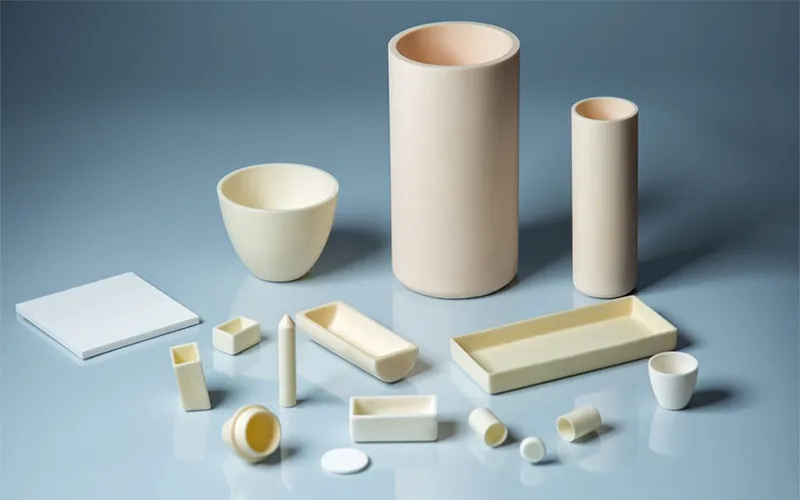
For example, alumina ceramics serve in crucibles, spark plugs, refractory components, thermocouple protection tubes, electrical insulation substrates, mechanical seal rings, cutting tools, and industrial wear parts. Additionally, highly densified alumina can become translucent, which enables specialized uses such as high-pressure sodium lamp arc tubes when manufacturers control purity, grain structure, and residual porosity.
However, translucency does not automatically make alumina equivalent to single-crystal sapphire. Because polycrystalline alumina contains grain boundaries and may retain optical-scattering defects, its transparency and optical performance depend strongly on the specific grade and processing route.
2. Alumina Ceramic Properties and Technical Data
Generally, dense alumina provides a strong combination of mechanical rigidity, wear resistance, electrical insulation, and thermal stability. Nevertheless, engineers should distinguish between typical material values and guaranteed production specifications because alumina purity, test methods, specimen geometry, and operating conditions influence measured results.
2.1 Typical Properties of Dense Alumina
| Property | Typical Value or Range | Engineering Significance |
|---|---|---|
| Alumina content | Approximately 94-99.7 wt% | Determines material grade and influences electrical, chemical, and thermal performance. |
| Density | Approximately 3.7-3.95 g/cm³ | Reflects composition and densification; high-purity grades generally approach the upper end. |
| Flexural strength | Approximately 200-400 MPa | Indicates resistance to bending failure in standardized tests. |
| Compressive strength | Approximately 2,000-2,700 MPa | Supports load-bearing applications, although component design and contact stresses remain important. |
| Vickers hardness | Approximately 11-16 GPa | Provides strong resistance to indentation and abrasive wear. |
| Young’s modulus | Approximately 300-390 GPa | Indicates high stiffness under elastic loading. |
| Fracture toughness | Approximately 3-5 MPa·m1/2 | Describes resistance to crack propagation; alumina remains a relatively brittle ceramic. |
| Thermal conductivity | Approximately 20-35 W/(m·K) | Enables heat transfer while remaining much lower than the conductivity of many metals. |
| Coefficient of thermal expansion | Approximately 7-8.5 × 10⁻⁶/K | Helps engineers estimate dimensional changes during heating and cooling. |
| Volume resistivity | Often above 10¹⁴ Ω·cm at room temperature | Supports electrical insulation, although resistivity decreases as temperature rises. |
| Dielectric constant | Approximately 8-10 at common test frequencies | Supports electrical and electronic component design. |
| Maximum service temperature | Often approximately 1,400-1,700°C, depending on grade and conditions | Defines a practical operating range rather than a universal continuous-use guarantee. |
For clarity, the values above are representative engineering ranges compiled from common dense-alumina grades rather than guaranteed specifications for every component. For example, a 96% alumina grade may provide a density near 3.7 g/cm³, flexural strength around 300-350 MPa, thermal conductivity near 24-25 W/(m·K), and room-temperature volume resistivity above 10¹⁴ Ω·cm.
Meanwhile, 99.5-99.7% alumina can reach densities near 3.9-3.95 g/cm³ and may provide improved thermal conductivity or dielectric performance. Even so, designers should confirm the exact grade, test standard, and supplier data sheet before finalizing a specification.
2.2 Why Density Matters
During sintering, particles develop stronger contacts and pores shrink as material transport occurs through diffusion and other mechanisms. Consequently, higher relative density often improves strength consistency, reduces liquid or gas penetration, and supports better dielectric reliability when the process also controls defects.
However, density alone does not determine every property. Because grain size, grain-boundary chemistry, microcracks, and residual impurities also influence performance, manufacturers must evaluate the complete microstructure rather than relying on density as the only quality indicator.
3. Raw Materials: Selecting and Preparing Alumina Powder
High-quality raw materials form the foundation of dense alumina ceramics. Therefore, powder selection should consider chemical purity, primary particle size, agglomeration, specific surface area, phase composition, and compatibility with the intended forming and sintering process.
3.1 Choose High-Purity Aluminum Oxide
First, manufacturers should select alumina powder with a purity level appropriate for the intended application. Because inorganic impurities may form unwanted secondary phases or alter grain-boundary behavior, they can reduce strength consistency, electrical insulation, corrosion resistance, or optical quality.
Additionally, organic residues and processing binders must decompose and escape during debinding and heating. If gas evolution occurs after the ceramic structure closes its open pore network, trapped gas can slow densification or leave residual pores.
For this reason, semiconductor components, electrical substrates, high-purity crucibles, and optical-grade ceramics may require stricter impurity control than general-purpose wear components. Nevertheless, the required purity should follow application specifications rather than a universal rule that the highest-purity powder always produces the best result.
3.2 Control Particle Size and Agglomeration
Generally, finer alumina particles provide greater specific surface area and shorter diffusion distances, which can promote sintering at lower temperatures or over shorter times. In many high-performance formulations, manufacturers evaluate submicron powders with particle sizes around 0.1–1 μm as a starting range.
Nevertheless, excessively fine powder may agglomerate, absorb contaminants, increase slurry viscosity, and complicate uniform compaction. Furthermore, rapid grain growth can occur during high-temperature treatment when the process does not adequately control temperature, dwell time, and additives.
Accordingly, engineers should assess the full particle-size distribution and agglomerate structure rather than selecting powder solely by its average particle size. As a result, well-dispersed powder often produces a more uniform green body and a more predictable final microstructure.
3.3 Distribute Sintering Additives Uniformly
Depending on the alumina grade and target properties, manufacturers may introduce small quantities of additives to influence grain growth, improve densification, or modify grain-boundary behavior. For example, magnesium oxide can help control abnormal grain growth in suitable alumina formulations.
However, the type and amount of each additive require careful validation because excessive or incompatible additions may create secondary phases, alter electrical properties, or reduce high-temperature performance. Therefore, the formulation should match the required purity, optical transmission, strength, and service environment.
Equally important, uniform mixing prevents local variations in composition. Otherwise, additive-rich areas may develop different liquid-phase behavior or grain-growth rates, while additive-poor regions may densify more slowly and retain undesirable pores.
3.4 Prepare a Homogeneous Powder Batch
Before forming, manufacturers commonly use suitable milling, mixing, dispersion, and granulation procedures to improve powder uniformity. Meanwhile, process engineers must avoid excessive contamination from milling media, mixing equipment, or handling tools.
Ultimately, a consistent powder batch improves forming behavior and helps reduce density gradients, agglomerate defects, differential shrinkage, and cracking during later thermal processing.
4. Alumina Ceramic Forming Processes
Forming converts prepared powder into a green body, which must possess sufficient strength and a suitably uniform density for subsequent processing. Because green-body density and defect distribution influence final shrinkage, manufacturers should select the forming route according to component shape, wall thickness, dimensional tolerance, and production volume.
Broadly, alumina ceramic forming includes dry or semi-dry methods and wet or suspension-based methods. In addition, ceramic injection molding can support complex geometries when the material formulation, binder system, tooling, and debinding process are carefully designed.
4.1 Dry Forming Methods
Uniaxial pressing compacts granulated powder within a rigid die and suits components such as plates, simple rings, and other relatively regular shapes. Although this method supports efficient production, die-wall friction may produce density gradients, particularly in thicker or more complex parts.
By contrast, cold isostatic pressing places powder in a flexible mold and applies pressure through a liquid medium, creating more uniform pressure around the component. Consequently, this process can produce relatively uniform green bodies for larger or more intricate shapes that benefit from multidirectional compaction.
Additionally, higher-pressure pressing routes may improve green density when the powder and tooling tolerate the applied loads. Nevertheless, excessive pressure or poor powder preparation can still create lamination, trapped air, or internal defects.
4.2 Wet Forming Methods
Slip casting disperses ceramic powder in a liquid suspension and uses a porous mold to remove liquid and build a shaped body. Because slurry chemistry controls dispersion, pH, solids loading, and viscosity, these variables strongly influence casting uniformity and defect formation.
Similarly, centrifugal casting uses centrifugal force to promote particle deposition under suitable suspension conditions. Meanwhile, gelcasting forms a shape from a ceramic slurry and then consolidates the body through a gel-forming reaction, which can support complex geometries.
For intricate components, ceramic injection molding mixes ceramic powder with a binder system and injects the feedstock into a mold. Afterward, debinding removes the binder, and sintering consolidates the ceramic skeleton; therefore, engineers must carefully control binder removal to prevent cracks, blisters, and residual carbon contamination.
4.3 SVG Flowchart: From Alumina Powder to Dense Ceramic
The following vector diagram summarizes the principal production stages, from raw-material preparation to final inspection. Furthermore, the diagram uses embedded SVG shapes and text, so it does not require an external image file, stylesheet, or script.
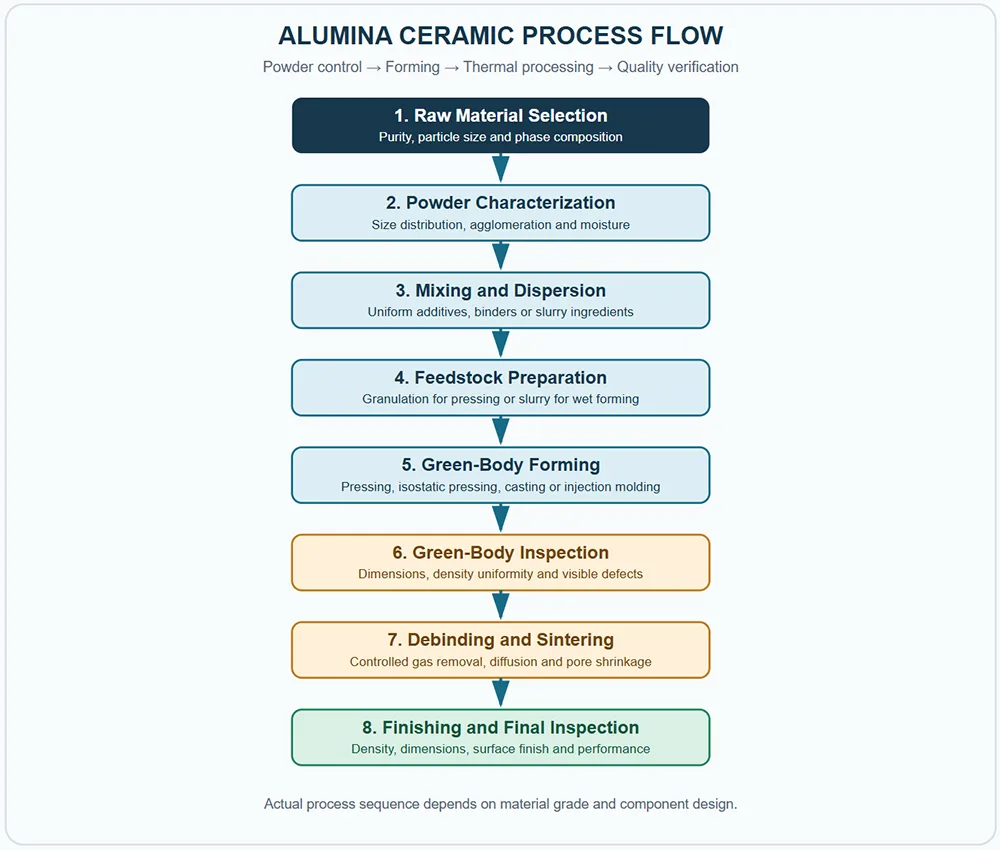
Importantly, this flowchart presents a general manufacturing route rather than a mandatory sequence for every part. For example, some pressed components do not require the same feedstock preparation as injection-molded components, while selected products may need additional machining or specialized inspection after sintering.
5. Six Sintering Methods for Dense Alumina Ceramics
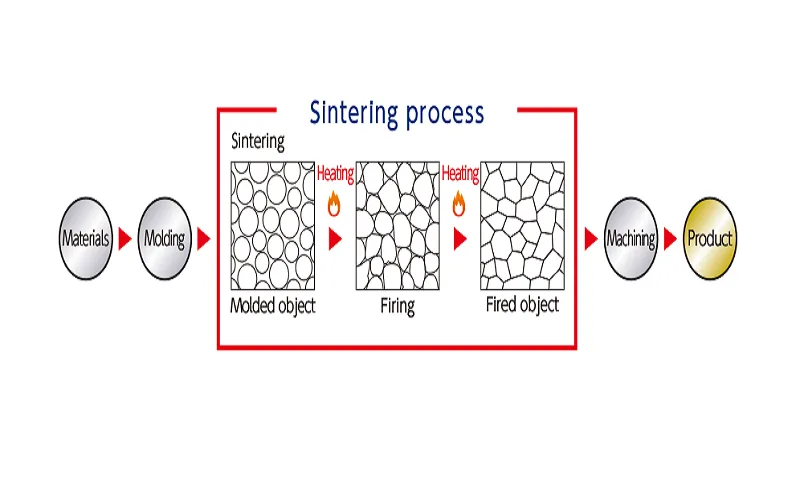
Sintering transforms a shaped green body into a stronger ceramic by promoting particle bonding, mass transport, and pore reduction at elevated temperatures. Depending on the chosen process, manufacturers may rely mainly on thermal energy or combine heat with externally applied pressure and, in some technologies, an electric field.
Nevertheless, no single method suits every alumina component. Instead, process selection should balance achievable density, grain-size control, dimensional accuracy, equipment cost, batch size, component geometry, and the required material properties.
5.1 Hot Press Sintering
Hot pressing combines elevated temperature with uniaxial mechanical pressure, which promotes particle rearrangement, deformation, and mass transport while the body densifies. For suitable alumina compositions, applied pressures commonly fall within an approximate range of 10-40 MPa, although the actual process window depends on equipment, tooling, temperature, and component geometry.
Because pressure assists densification, hot pressing can achieve high density at conditions that differ from those required for pressureless sintering. Furthermore, carefully controlled cycles can limit the time needed at elevated temperature and help retain a relatively fine microstructure.
However, the method generally relies on specialized tooling and constrains component geometry, so it may not suit every complex or large-scale production requirement. Consequently, engineers often reserve hot pressing for components that justify the added tooling and process cost.
5.2 Vacuum Sintering
Vacuum sintering heats a ceramic body under reduced pressure, which can support the removal of certain gaseous species and volatile contaminants. Depending on the powder chemistry and furnace conditions, this environment may also influence defect evolution and grain growth.
Nevertheless, vacuum does not automatically guarantee higher density or finer grains. Because pore closure, gas diffusion, furnace design, temperature, and dwell time interact, process engineers must validate the complete thermal cycle for the specific alumina formulation.
Additionally, manufacturers should distinguish vacuum sintering from hot isostatic pressing, because the former primarily controls the surrounding pressure environment whereas HIP applies high gas pressure at elevated temperature.
5.3 Hot Isostatic Pressing (HIP)
Hot isostatic pressing applies elevated temperature and high gas pressure around a component, creating approximately equal pressure in all directions. As a result, HIP can close suitable residual pores and improve density uniformity when the material and initial pore structure support effective consolidation.
For example, manufacturers may use HIP as part of a pressure-assisted densification route or as a post-sintering treatment for compatible ceramic bodies. However, the effectiveness of the process depends on whether the remaining pores can respond to external pressure and whether the component contains defects that prevent full closure.
Although HIP can improve density and reduce residual porosity, it requires high-pressure equipment and careful process validation. Therefore, manufacturers should compare its performance benefits against cycle time, cost, and component requirements before choosing it.
5.4 Controlled-Atmosphere Sintering
Controlled-atmosphere sintering uses a selected gas environment to manage chemical reactions, oxidation state, volatile species, or other atmosphere-sensitive mechanisms. Depending on the furnace setup, the atmosphere may contain air, oxygen-controlled gas, inert gas, or another suitable mixture.
For alumina, however, an inert or reducing atmosphere does not universally improve densification. Because aluminum oxide is already a stable oxide, the benefits depend on the formulation, impurity chemistry, and intended functional properties; therefore, engineers should validate atmosphere selection experimentally rather than assume that a reducing environment always works better.
Moreover, controlled gas flow and exhaust management can influence the removal of binder-decomposition products. Consequently, manufacturers should coordinate atmosphere design with debinding, pore evolution, and furnace safety requirements.
5.5 Microwave Sintering
Microwave sintering uses electromagnetic energy to heat suitable ceramic systems, potentially enabling rapid heating and shorter processing cycles. Under properly designed conditions, this method can reduce thermal gradients or alter the balance between heating rate and grain growth.
Nevertheless, alumina interacts with microwave energy differently according to temperature, frequency, composition, and microstructure. Because alumina may couple weakly with microwaves at some conditions, hybrid heating or a suitable susceptor may be necessary to achieve stable heating.
Accordingly, microwave sintering offers potential process advantages, but uniform temperature distribution and repeatable density require careful equipment design and process control. Manufacturers should also verify the properties of the final component rather than assume that faster heating always improves performance.
5.6 Spark Plasma Sintering (SPS)
Spark plasma sintering, also known in many research and manufacturing contexts as field-assisted sintering technology, combines uniaxial pressure with rapid electrical heating through a conductive die and the surrounding tooling system. Consequently, the process can achieve rapid heating rates and short dwell times for suitable materials.
Because SPS can limit prolonged exposure to high temperatures, it may help preserve fine grain structures while promoting high density. However, the exact mechanisms depend on the equipment configuration and material system; therefore, engineers should not assume that plasma formation or a single electrical effect explains every densification result.
Despite these advantages, SPS usually requires specialized equipment and relatively constrained tooling geometries. Thus, the technique is particularly attractive for selected high-performance materials, research programs, and components whose value justifies the process cost.
5.7 Comparing the Six Sintering Methods
| Method | Main Mechanism | Potential Advantages | Main Considerations |
|---|---|---|---|
| Hot pressing | Heat plus uniaxial pressure | High density and potential grain-growth control | Tooling constraints and directional geometry limitations |
| Vacuum sintering | Thermal processing under reduced pressure | Potential control of volatile species and atmosphere-sensitive reactions | Results depend on pore closure, gas transport, and furnace conditions |
| HIP | Heat plus high isostatic gas pressure | Can close suitable residual pores and improve density | High equipment cost and dependence on initial pore structure |
| Controlled atmosphere | Thermal processing in a selected gas environment | Control of chemistry and atmosphere-sensitive defects | The atmosphere must match the specific alumina formulation |
| Microwave sintering | Electromagnetic heating | Potential rapid heating and shorter processing cycles | Microwave coupling and temperature uniformity need validation |
| SPS | Field-assisted heating plus uniaxial pressure | Rapid cycles and potential fine-grain densification | Specialized tooling, geometry limits, and higher equipment costs |
Importantly, this comparison describes general process tendencies rather than guaranteed outcomes. In many production settings, conventional pressureless sintering remains a practical baseline, while pressure-assisted or field-assisted routes become attractive when standard processing cannot meet the required density, microstructure, or performance targets.
6. How to Improve Alumina Densification and Reduce Defects
Successful densification requires coordinated control of powder characteristics, green-body structure, gas removal, temperature, time, and grain growth. Rather than raising the furnace temperature without diagnosis, manufacturers should identify the limiting mechanism and adjust the relevant process variable.
6.1 Establish a Uniform Green-Body Density
First, control powder flow, granule strength, mold filling, forming pressure, and tool design to reduce local density variation. Because different regions may shrink at different rates, an uneven green body can produce warpage, cracks, or dimensional errors during sintering.
Consequently, manufacturers should measure green-body density where practical and inspect critical sections before committing a batch to high-temperature processing.
6.2 Optimize Debinding and Gas Removal
For binder-containing feedstocks, a controlled debinding cycle helps remove organic components before the ceramic structure becomes too dense for gases to escape. Meanwhile, heating rate, holding stages, airflow, and part thickness influence how effectively decomposition products leave the body.
If gas release occurs too rapidly, internal pressure may produce blisters, cracks, or delamination; therefore, the debinding schedule should match the binder chemistry and component geometry.
6.3 Balance Sintering Temperature and Holding Time
As temperature rises, diffusion and grain-boundary transport generally accelerate, which can increase densification rates. However, excessive temperature or prolonged holding can also promote grain coarsening, dimensional distortion, and abnormal microstructural growth.
Accordingly, process development should identify the shortest practical thermal cycle that achieves the required density and properties without creating unacceptable grain growth or defects.
6.4 Select Additives and Atmosphere by Evidence
Additives can modify grain-boundary chemistry, inhibit grain growth, or assist densification in suitable formulations. Nevertheless, excessive additions may reduce chemical purity, change electrical properties, or create secondary phases, so each formulation requires experimental validation.
Likewise, vacuum and controlled-atmosphere conditions should address a specific process requirement rather than serve as automatic substitutes for powder preparation and temperature control.
6.5 Verify Density and Microstructure
After sintering, manufacturers should evaluate bulk density, dimensional shrinkage, visible defects, and relevant mechanical or electrical properties. Where the application requires closer microstructural control, microscopy, grain-size assessment, or pore analysis can help identify the causes of inconsistent performance.
For example, a density measurement may reveal incomplete densification, whereas microstructural inspection can distinguish residual pores from abnormal grain growth or local secondary phases. Ultimately, combining these methods provides a more reliable basis for process improvement than density alone.
Important Process Note
Although higher sintering temperatures can accelerate densification, they do not guarantee a better ceramic. Instead, the target is a suitable balance among density, pore distribution, grain size, dimensional stability, and application-specific performance.
7. AOFE MIMCustom: Custom Alumina Ceramic Manufacturing
For industrial customers, selecting the correct alumina grade is only one part of the engineering process. In addition, component geometry, forming method, shrinkage compensation, machining allowance, surface finish, and inspection criteria must work together to produce a component that meets its intended function.
AOFE MIMCustom can present its custom-manufacturing value around coordinated design review, material selection, forming-process evaluation, tooling development, and dimensional quality planning, provided these services match the company’s actual production capabilities. Furthermore, a structured technical review helps customers identify manufacturing risks before they commit to tooling or volume production.
7.1 Design and Material Selection
At the design stage, the engineering team should review operating temperature, mechanical loads, electrical requirements, corrosion exposure, dimensional tolerances, and expected service life. Consequently, the team can evaluate whether 96%, 99%, or a higher-purity alumina grade best fits the application.
Moreover, early design review can identify thin walls, sharp corners, nonuniform sections, and other geometric features that may complicate forming, shrinkage, or finishing.
7.2 Forming and Tooling Optimization
Depending on component geometry and order volume, the appropriate manufacturing route may include pressing, isostatic pressing, casting, or ceramic injection molding. Therefore, process selection should consider achievable green-body uniformity, tooling complexity, production efficiency, and the cost of subsequent finishing.
For injection-molded parts, binder formulation, gate location, mold filling, debinding, and sintering shrinkage deserve particular attention because each stage can affect the final dimensions and defect rate.
7.3 Process Control and Quality Verification
A reliable custom-manufacturing workflow should define measurable acceptance criteria before production begins. For example, the inspection plan may include dimensional checks, surface inspection, density verification, and material-property testing when those tests are relevant to the application.
Additionally, customers should confirm the available equipment, inspection methods, traceability arrangements, production capacity, and quality certifications directly with AOFE MIMCustom rather than assume that every service or certification applies to every project.
Discuss Your Alumina Ceramic Project
If your application requires custom alumina components, prepare a drawing, target material grade, operating conditions, annual quantity, and critical tolerances. With these details, the manufacturing team can assess process suitability and identify the main technical questions before quotation.
8. Alumina Ceramic Sintering FAQ
Q1. What does densification mean in alumina ceramic sintering?
Densification refers to the increase in bulk density as particles bond, pores shrink, and material transport changes the microstructure. Although gas removal can contribute to this process, diffusion, pore evolution, and grain-boundary movement also play important roles.
Q2. Which alumina powder particle size is suitable for high-density ceramics?
Submicron alumina powder, often around 0.1-1 μm, can provide useful sintering activity for many high-performance formulations. However, the optimum range depends on particle-size distribution, agglomeration, purity, additives, forming method, and the required final microstructure.
Q3. Does higher sintering temperature always increase alumina density?
Increasing temperature can accelerate diffusion and densification within a suitable process window. Nevertheless, excessive temperature may cause abnormal grain growth, deformation, or other defects, so manufacturers must optimize both temperature and holding time.
Q4. Why does high-purity alumina powder matter?
High-purity powder helps reduce unwanted secondary phases and contamination that may affect mechanical strength, electrical insulation, chemical stability, or optical quality. However, purity alone cannot eliminate agglomeration, forming defects, or unsuitable sintering conditions.
Q5. What is the difference between dry and wet alumina forming?
Dry forming methods, such as pressing, generally suit powder-based production of regular shapes, while wet methods use a liquid suspension and can support complex geometries or carefully controlled particle dispersion. Nevertheless, the best choice depends on component dimensions, production volume, material formulation, and tooling requirements.
Q6. What is the difference between hot pressing and HIP?
Hot pressing applies pressure mainly along one axis through a pressing tool, whereas HIP uses high-pressure gas to apply pressure approximately uniformly in all directions. Therefore, the two methods differ in tooling, geometry constraints, pressure distribution, and their suitability for specific densification tasks.
Q7. Can microwave sintering produce dense alumina ceramics?
Yes, microwave sintering can densify suitable alumina formulations when the heating system provides appropriate energy coupling and temperature control. However, alumina’s microwave response varies with conditions, so some systems require hybrid heating or a susceptor to improve process stability.
Q8. How does spark plasma sintering improve densification?
SPS combines electrical heating with mechanical pressure and can achieve rapid heating and short dwell times for suitable material systems. Consequently, it may help achieve high density while limiting grain growth, although results depend on equipment configuration, composition, and process parameters.
Q9. Why can alumina ceramic parts crack during sintering?
Cracking can result from uneven green density, trapped gas, rapid binder removal, nonuniform heating, differential shrinkage, or unsuitable cooling conditions. Therefore, manufacturers should investigate powder preparation, forming, debinding, furnace loading, and thermal-cycle design together rather than changing only one parameter without diagnosis.
Q10. How can manufacturers verify the density of sintered alumina?
Manufacturers can measure bulk density using an appropriate standardized method and compare the result with the theoretical density of the specific composition. Additionally, microscopy or other porosity-analysis techniques can help identify residual pores and distinguish density issues from grain-growth or microstructural problems.
Q11. Can dense alumina ceramics transmit visible light?
Highly densified alumina can exhibit translucency when manufacturers control residual porosity, grain structure, impurities, and optical scattering. However, transparent or translucent performance depends on the specific material and processing route, so not every dense alumina grade can replace sapphire in optical applications.
Q12. Which sintering method should a manufacturer choose?
The correct method depends on required density, grain size, component shape, production volume, tolerances, cost, and functional performance. Accordingly, manufacturers should compare conventional sintering, hot pressing, HIP, controlled-atmosphere processing, microwave sintering, and SPS against actual engineering requirements before selecting a route.
Conclusion: Dense Alumina Requires Integrated Process Control
Ultimately, producing dense alumina ceramics requires coordinated decisions across the entire manufacturing chain, from raw-material purity and particle-size distribution to forming, debinding, sintering, and final inspection. Although advanced methods such as hot pressing, HIP, microwave sintering, and SPS can offer specific advantages, their value depends on the material system and component requirements.
Therefore, manufacturers should optimize densification through measurable process controls rather than temperature alone. By combining suitable powder preparation, uniform green-body density, validated thermal cycles, and microstructural verification, engineers can produce alumina components with more predictable density, strength, electrical performance, and dimensional stability.
Key Takeaways
- High-purity alumina powder and controlled particle-size distribution provide a reliable foundation for densification.
- Uniform mixing and green-body density help reduce differential shrinkage and residual defects.
- Hot pressing, HIP, controlled-atmosphere sintering, microwave sintering, and SPS offer different process advantages.
- Excessive temperature or holding time can promote grain growth and compromise dimensional stability.
- Density measurements, dimensional inspection, and microstructural analysis help verify final quality.