
Introduction to Silicon Nitride
Silicon nitride (Si₃N₄) is a synthetic covalent ceramic compound composed of silicon (Si) and nitrogen (N) atoms in a 3:4 ratio. First reported in 1857 by Henri Étienne Sainte-Claire Deville and Friedrich Wöhler, and successfully synthesized in pure form by Ludwig Weiss and Theodor Engelhardt in 1910, silicon nitride has evolved from a laboratory curiosity into one of the most important advanced engineering materials of the 21st century.
Among all advanced ceramic materials – including alumina (Al₂O₃), zirconia (ZrO₂), silicon carbide (SiC), and boron nitride (BN) – silicon nitride is widely recognized as offering the best overall comprehensive performance. It uniquely combines exceptional mechanical strength, the highest fracture toughness among common engineering ceramics, extreme temperature resistance, outstanding thermal shock resistance, superb chemical inertness, and excellent electrical insulation in a single material system.
Since the 1950s, when industrial-scale production began, silicon nitride has been deployed in increasingly demanding applications – from thermocouple protection tubes and rocket nozzles in the early days, to high-speed precision bearings, semiconductor processing equipment, electric vehicle power electronics, and aerospace turbine components today. The global market for silicon nitride components continues to grow at double-digit rates, driven by the accelerating demands of the automotive, semiconductor, energy, and medical industries.
Key Insight: Silicon nitride is not just a ceramic – it is a platform material that enables engineers to solve problems that no metal, polymer, or other ceramic can address simultaneously. When an application demands high strength and low weight, high temperature and corrosion resistance, hardness and toughness, electrical insulation and thermal conductivity – silicon nitride is often the only viable solution.
Material Composition & Crystal Structure
Chemical Composition
Silicon nitride has the chemical formula Si₃N₄, consisting of:
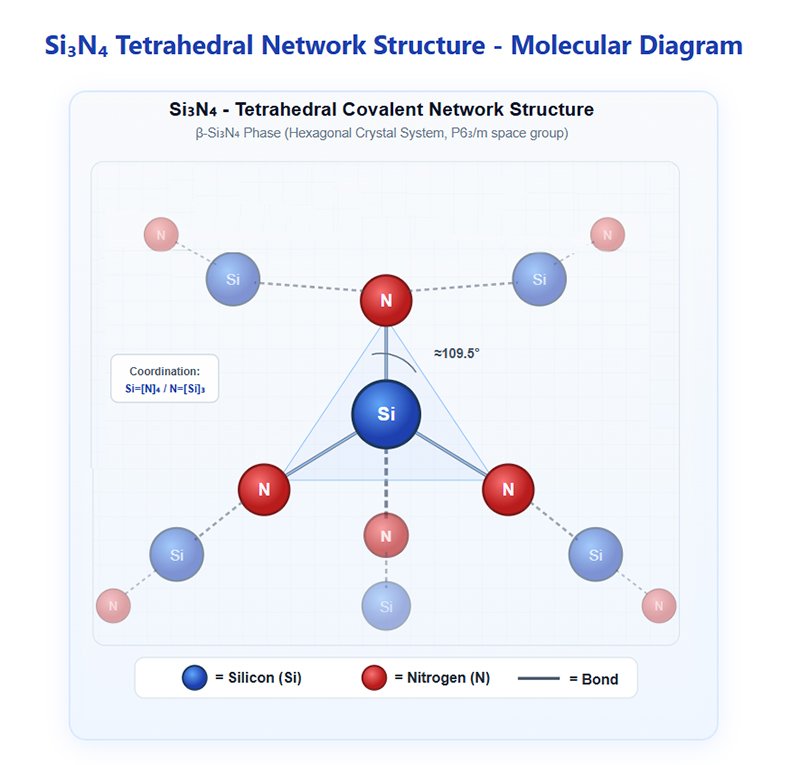
The fundamental structural unit of silicon nitride is the [SiN₄]⁴⁻ tetrahedron, where a central silicon atom is covalently bonded to four nitrogen atoms at the vertices. These tetrahedra share nitrogen atoms at their corners (co-vertex sharing), forming a continuous, rigid three-dimensional network. This strong covalent bonding architecture is the structural foundation of silicon nitride’s remarkable properties.
Crystal Phases: α-Si₃N₄ vs β-Si₃N₄
Silicon nitride exists in two primary crystalline forms, both belonging to the hexagonal crystal system. A third high-pressure phase (γ-Si₃N₄, cubic spinel structure) exists but is rarely encountered in engineering applications.
| Characteristic | α-Si₃N₄ (Alpha Phase) | β-Si₃N₄ (Beta Phase) |
|---|---|---|
| Crystal Morphology | Needle-like / equiaxed | Elongated / rod-like grains |
| Formation Temperature | 1200–1300°C | ~1450°C and above |
| Stability | Low-temperature metastable | Thermodynamically stable |
| Role in Ceramics | Primary phase in raw powder | Final phase in sintered product |
| Phase Transformation | α → β is irreversible, occurs during liquid-phase sintering via dissolution–diffusion–precipitation mechanism | |
During the sintering process, the α-phase powder irreversibly transforms into elongated β-Si₃N₄ grains. These interlocking, rod-like β-grains create a self-reinforced microstructure – analogous to fiber-reinforced composites – which is the primary reason silicon nitride achieves fracture toughness values (6-8 MPa·m1/2) far exceeding those of other engineering ceramics such as alumina (3-4 MPa·m1/2).
Sintering Additives
Because Si₃N₄ is a strongly covalent compound with very low self-diffusion coefficients, it cannot be sintered to full density without additives. Common sintering aids include:
- Yttrium oxide (Y₂O₃) – promotes liquid-phase sintering and grain boundary engineering
- Aluminum oxide (Al₂O₃) – facilitates densification and forms SiAlON solid solutions
- Magnesium oxide (MgO) – classic sintering aid for pressureless sintering
- Rare earth oxides (Lu₂O₃, Yb₂O₃, etc.) – for high-thermal-conductivity grades
The choice and ratio of sintering additives directly influence the grain boundary phase composition, which in turn controls critical properties such as thermal conductivity, high-temperature strength, and oxidation resistance. This is a key area of expertise at AOFE, where proprietary additive formulations are optimized for each specific application.
Key Material Properties of Silicon Nitride
Silicon nitride’s unique combination of properties sets it apart from all other engineering materials. Below is a comprehensive overview of its performance characteristics:
Technical Data Sheet – Sintered Si₃N₄ Ceramic
| Property | Unit | Typical Value |
|---|---|---|
| Density | g/cm³ | 3.2 – 3.3 |
| Vickers Hardness (HV) | GPa | 14 – 17 |
| Flexural Strength (4-point) | MPa | 700 – 1,000 |
| Fracture Toughness (KIC) | MPa·m1/2 | 6.0 – 8.0 |
| Young’s Modulus | GPa | 300 – 320 |
| Poisson’s Ratio | — | 0.27 |
| Compressive Strength | MPa | 3,000 – 4,000 |
| Thermal Expansion Coefficient (CTE) | ×10⁻⁶/°C | 3.0 – 3.5 |
| Thermal Conductivity | W/m·K | 20 – 90 |
| Specific Heat Capacity | J/kg·K | 680 – 760 |
| Volume Resistivity | Ω·cm | >10¹⁴ |
| Dielectric Constant | — | 8.0 – 9.5 |
| Dielectric Loss (tan δ) | ×10⁻⁴ | 1 – 5 |
| Melting Point (under pressure) | °C | ~1,900 |
| Max. Continuous Service Temp. | °C | 1,200 – 1,400 |
Property Highlights
Ultra-Low Density
At 3.2 g/cm³, Si₃N₄ is approximately 60% lighter than steel (7.8 g/cm³) and 40% lighter than tungsten carbide. This dramatically reduces rotational inertia in bearing and high-speed applications.
Extreme Heat Resistance
Mechanical strength is maintained above 1200°C. At 800°C, hardness and strength are virtually unchanged from room temperature values – a feat no metal alloy can match.
Exceptional Toughness
Fracture toughness of 6–8 MPa·m1/2 is roughly 2× that of alumina, making Si₃N₄ the toughest common engineering ceramic. The elongated β-grain microstructure provides crack-bridging toughening.
Superior Thermal Shock Resistance
Low CTE (3.2 ×10⁻⁶/°C) combined with moderate thermal conductivity enables survival of rapid quenching from 1000°C into cold water without cracking.
Electrical Insulation
Volume resistivity >10¹⁴ Ω·cm with low dielectric loss makes Si₃N₄ an excellent insulator for power electronics substrates and semiconductor fixtures.
Chemical Inertness
Resistant to virtually all acids and alkalis (except HF and hot concentrated NaOH). Does not react with most molten metals including aluminum, copper, and zinc.
Si₃N₄ vs Other Engineering Ceramics
| Property | Si₃N₄ | Al₂O₃ | ZrO₂ | SiC |
|---|---|---|---|---|
| Density (g/cm³) | 3.2-3.3 | 3.9 | 5.6-6.0 | 3.1-3.2 |
| Flexural Strength (MPa) | 700-1000 | 300-400 | 900-1100 | 400-600 |
| Fracture Toughness (MPa·m1/2) | 6.0-8.0 | 3.0-4.0 | 5.0-10.0 | 3.0-4.5 |
| Max. Service Temp. (°C) | 1200-1400 | 1500-1700 | ~800 | 1400-1600 |
| Thermal Shock Resistance | ★★★★★ | ★★★☆☆ | ★★☆☆☆ | ★★★★☆ |
| Tribological Performance | ★★★★★ | ★★★☆☆ | ★★☆☆☆ | ★★★★☆ |
| Overall Rating | 🏆 Best | Good | Good | Very Good |
Components Made from Silicon Nitride
Thanks to its versatility, silicon nitride can be precision-manufactured into a remarkably wide range of components. Here are the major product categories:
Ceramic Bearing Balls
Precision-ground Si₃N₄ balls (Ø0.5 mm – 100+ mm) for hybrid and full-ceramic bearings. The single largest application of silicon nitride, accounting for ~30% of global high-performance Si₃N₄ production. Enables 2-5× higher speed ratings vs steel balls.
Ceramic Dowel Pins & Alignment Pins
High-precision cylindrical locating pins for fixturing, alignment, and assembly in high-temperature, corrosive, and electrically sensitive environments. Available in diameters from 1 mm to 25+ mm with ±0.002 mm tolerances.
Ceramic Substrates (DCB/AMB)
High-thermal-conductivity Si₃N₄ substrates for power electronics – IGBT modules, SiC MOSFET packages, EV inverter modules, and wind power converters. The preferred substrate for next-gen power devices due to unmatched thermal cycling reliability.
Cutting Tool Inserts
Si₃N₄-based cutting inserts for high-speed machining of cast iron, superalloys, and hardened steels. Enable cutting speeds 3–10× faster than conventional carbide tools with superior crater wear resistance.
Nozzles & Orifices
Precision nozzles for abrasive waterjet cutting, sandblasting, chemical spraying, and molten metal handling. Extreme wear resistance provides 10-50× longer service life compared to tungsten carbide or steel nozzles.
Thermocouple Protection Tubes
High-temperature sheaths for thermocouples in molten metal baths, furnaces, and combustion environments. Withstand thermal shock from rapid immersion into molten aluminum, copper, and zinc.
Weld Positioning Pins & Fixturing
Heat-resistant locating and clamping pins for welding jigs, soldering fixtures, and brazing assemblies. Non-sparking, electrically insulating, and resistant to weld spatter adhesion.
Crucibles & Melt Handling
Crucibles, ladles, and pouring tubes for non-ferrous metal melting and casting. Si₃N₄ does not wet with aluminum, copper, or zinc melts, preventing contamination and buildup.
Turbocharger Rotors
Ceramic turbine rotors for automotive turbochargers – leveraging Si₃N₄’s low density (30% of superalloys) and high-temperature strength for dramatically reduced turbo lag and faster spool-up.
Seal Rings & Valve Components
Mechanical seal faces, valve seats, and valve trim components for corrosive fluid handling. Self-lubricating tribological performance enables dry-running or minimal-lubrication designs.
Rods, Tubes & Plates
Standard and custom rods, threaded rods, hollow tubes, flat plates, and discs as structural building blocks for custom fixture designs, furnace furniture, and prototype development.
Custom-Shaped Structural Parts
Complex geometry components – gears, armatures, brackets, insulators, guides – precision-machined from Si₃N₄ blanks or near-net-shape formed via injection molding (CIM) for high-volume production.
Industry Applications of Silicon Nitride Components
The unique performance profile of silicon nitride makes it indispensable across virtually every advanced industry sector:
Aerospace & Defense
- Turbine blade fixturing and alignment
- Rocket nozzle and thruster components
- Satellite mechanism bearings and pivots
- Jet engine hot-section fasteners
- Radar-transparent radome structures
- Missile guidance system components
Automotive & Transportation
- Turbocharger ceramic rotors
- Engine valve train components (tappets, rocker arm tips)
- Hybrid ceramic bearings for transmissions
- EV motor bearings (electrical insulation to prevent EDM damage)
- Glow plug and injector fixturing pins
- Diesel particulate filter (DPF) components
Semiconductor & Electronics
- Wafer handling and alignment pins
- CVD/PVD/etch chamber fixture components
- Lithography equipment precision dowels
- IC packaging and die-bond fixtures
- Power module ceramic substrates (DCB/AMB)
- Electrostatic chuck (ESC) components
Energy & Power Generation
- Wind turbine main shaft hybrid bearings
- Gas turbine hot-section components
- Solar cell manufacturing equipment
- Fuel cell stack structural components
- Nuclear reactor internal fixturing
- Geothermal drilling equipment
Medical & Biotech
- Spinal fusion implants and interbody cages
- Surgical instrument components
- Diagnostic equipment precision fixturing
- Pharmaceutical processing fixtures
- Dental implant abutments
- Laboratory automation equipment
Industrial Manufacturing
- CNC machining fixture locating pins
- Welding jig alignment components
- High-speed cutting tool inserts
- Die casting and forging die alignment
- Abrasive waterjet cutting nozzles
- Furnace rollers and kiln furniture
Metallurgy & Materials
- Molten metal handling (crucibles, ladles, tubes)
- Continuous casting components
- Thermocouple protection sheaths
- Hot isostatic pressing (HIP) tooling
- Powder metallurgy die components
- Thermal spray fixturing
Food, Beverage & Chemical
- Food processing equipment alignment
- Beverage filling machine fixturing
- Chemical pump seal faces and bearings
- Corrosive fluid valve components
- Sanitary processing fixtures
- FDA-compliant wear parts
AOFE – Your Silicon Nitride Component Partner
AOFE is a specialized manufacturer dedicated to the design, development, and precision production of silicon nitride (Si₃N₄) ceramic components. With deep expertise in Si₃N₄ powder metallurgy, advanced sintering technologies, and precision CNC machining, AOFE delivers high-performance ceramic solutions that enable our customers to push the boundaries of what’s possible in extreme environments.
Our product portfolio encompasses the full spectrum of silicon nitride components – from precision bearing balls and ceramic dowel pins, to custom-shaped structural parts, ceramic substrates, and complex assemblies. Every component we produce benefits from our vertically integrated manufacturing process, where raw powder formulation, forming, sintering, precision grinding, and quality inspection are all performed in-house under rigorous quality management systems.
Our Core Product Lines
Si₃N₄ Ceramic Balls
Bearing-grade precision
Si₃N₄ Dowel Pins
Micron-level accuracy
Si₃N₄ Substrates
Power electronics grade
Si₃N₄ Nozzles
Ultra-wear resistant
Si₃N₄ Rods & Tubes
Standard & custom sizes
Custom Components
Per customer drawing
Why Choose AOFE for Silicon Nitride Components?
Vertically Integrated Manufacturing
From raw Si₃N₄ powder formulation through forming, sintering (HIP/GPS/pressureless), CNC grinding, to final inspection – every step performed in-house for full traceability and quality control.
Micron-Level Precision
Advanced CNC cylindrical grinding, centerless grinding, and lapping capabilities achieve diameter tolerances down to ±0.002 mm and surface finishes as smooth as Ra 0.05 μm.
Material Science Expertise
In-house ceramic materials laboratory continuously optimizes powder formulations, sintering additive ratios, and thermal profiles for maximum performance in each specific application.
Full Customization
Custom diameters, lengths, profiles, tolerances, end configurations, and surface finishes. Engineering team collaborates directly with customers on application-specific optimization.
Comprehensive QA
ISO-certified quality management. Every shipment includes dimensional reports, material certificates (CoC), density/hardness/toughness test data, and SEM microstructure analysis on request.
Rapid Turnaround
Dedicated prototyping line for fast sample delivery. Standard products ship within 5-10 days; custom orders in 2-4 weeks. Expedited manufacturing available for urgent needs.
Competitive Value
Efficient manufacturing processes, optimized sintering cycles, and high-yield production deliver premium Si₃N₄ components at highly competitive prices with lower total cost of ownership.
Global Service
Serving customers in 30+ countries with reliable logistics, responsive technical support, and dedicated account management for long-term engineering partnerships.
Frequently Asked Questions About Silicon Nitride
Q1: What is silicon nitride (Si₃N₄) and why is it important?
A: Silicon nitride (Si₃N₄) is an advanced covalent ceramic compound composed of silicon and nitrogen atoms in a 3:4 ratio, arranged in [SiN₄] tetrahedral units forming a hexagonal crystal structure. It is important because it offers the best comprehensive performance among all engineering ceramics – uniquely combining high strength, exceptional fracture toughness, extreme temperature resistance (1200°C+), outstanding thermal shock resistance, chemical inertness, electrical insulation, low density, and biocompatibility in a single material system. This makes it irreplaceable in applications where no metal or other ceramic can perform adequately.
Q2: What are the two crystal phases of silicon nitride (α and β)?
A: Si₃N₄ exists in two primary crystalline forms, both hexagonal: α-Si₃N₄ (alpha phase, needle-like crystals formed at 1200–1300°C, metastable) and β-Si₃N₄ (beta phase, elongated rod-like crystals formed above ~1450°C, thermodynamically stable). In manufacturing, α-phase powder is used as the starting material. During liquid-phase sintering, the α-phase irreversibly transforms into β-phase via a dissolution-diffusion-precipitation mechanism. The resulting interlocking elongated β-grains create a self-reinforced microstructure that gives sintered Si₃N₄ its exceptional fracture toughness of 6-8 MPa·m1/2.
Q3: What is the maximum operating temperature of silicon nitride?
A: Silicon nitride maintains its mechanical strength at continuous operating temperatures exceeding 1200°C (2192°F). In inert or nitrogen atmospheres, it can withstand temperatures up to 1400°C (2552°F). Remarkably, at 800°C, Si₃N₄ retains virtually the same hardness and strength as at room temperature. Its melting point is approximately 1900°C under pressure. This thermal performance far exceeds that of any metal alloy and most other ceramic materials.
Q4: What types of components can be made from silicon nitride?
A: Silicon nitride can be manufactured into an extensive range of precision components, including: ceramic bearing balls (the largest application, ~30% of global Si₃N₄ production), dowel pins and alignment pins, ceramic substrates for power electronics (DCB/AMB), cutting tool inserts, nozzles and orifices, thermocouple protection tubes, weld positioning pins, crucibles and melt handling components, turbocharger rotors, seal rings and valve components, rods, tubes, and plates, and virtually any custom-shaped structural part. AOFE manufactures all of these component types.
Q5: How does silicon nitride compare to alumina and zirconia?
A: Si₃N₄ offers the best overall performance among common engineering ceramics. Compared to alumina (Al₂O₃): Si₃N₄ has ~2× higher fracture toughness (6-8 vs 3-4 MPa·m1/2), significantly better thermal shock resistance, lower density (3.2 vs 3.9 g/cm³), and superior tribological properties. Compared to zirconia (ZrO₂): Si₃N₄ maintains strength at far higher temperatures (1200°C+ vs ~800°C for ZrO₂), does not undergo phase transformation aging, has lower density (3.2 vs 5.6-6.0 g/cm³), and is more chemically stable. While alumina is less expensive and zirconia has higher room-temperature toughness, Si₃N₄ dominates in applications requiring sustained high-temperature performance, thermal cycling, or long-term reliability.
Q6: Is silicon nitride electrically insulating or conductive?
A: Silicon nitride is an excellent electrical insulator with volume resistivity exceeding 10¹⁴ Ω·cm, a high dielectric constant (8.0-9.5), and low dielectric loss. This makes Si₃N₄ components ideal for applications requiring electrical isolation – such as EV motor bearings (preventing electrical discharge machining damage), semiconductor processing fixtures, and power electronics substrates. Note: specialized conductive or anti-static Si₃N₄ grades can be engineered for specific applications.
Q7: Is silicon nitride safe for medical and food applications?
A: Yes. Silicon nitride is inherently biocompatible and non-toxic. Research has shown that Si₃N₄ even exhibits antibacterial surface properties and promotes osteointegration (bone cell attachment), making it an emerging material for spinal implants and dental applications. It does not leach harmful substances, can withstand repeated sterilization cycles (autoclave, gamma, chemical), and is suitable for food-grade, pharmaceutical, and sanitary processing applications.
Q8: How are silicon nitride components manufactured?
A: Si₃N₄ components are produced through a multi-stage process: (1) Powder preparation – high-purity Si₃N₄ powder is blended with sintering additives; (2) Forming – cold isostatic pressing (CIP), dry pressing, extrusion, or ceramic injection molding (CIM); (3) Debinding – careful thermal removal of organic binders; (4) Sintering – hot isostatic pressing (HIP), gas pressure sintering (GPS), or pressureless sintering at 1700–1850°C to achieve >99% theoretical density; (5) Precision CNC machining – diamond grinding, lapping, and polishing to final dimensions; (6) Quality inspection – CMM, profilometry, density, hardness, and microstructure verification.
Q9: Can AOFE produce custom silicon nitride components?
A: Absolutely. AOFE specializes in both standard catalog products and fully custom-engineered Si₃N₄ components. Provide your engineering drawing, dimensional specifications, tolerance requirements, and application details – our engineering team will collaborate with you to optimize material grade, geometry, and manufacturing process for the best performance-to-cost ratio. Prototyping samples are available for evaluation before full production commitment.
Q10: What is the typical lead time for AOFE silicon nitride products?
A: Standard catalog sizes (bearing balls, dowel pins, rods) typically ship within 5–10 business days from stock or production. Custom-engineered components generally require 2-4 weeks depending on complexity, quantity, and current production schedule. Expedited manufacturing is available for urgent requirements. Contact our sales team for specific lead time quotations.
Discover What Silicon Nitride Can Do for Your Application
Whether you need a standard Si₃N₄ component or a fully custom-engineered ceramic solution, AOFE’s materials science and precision manufacturing expertise is at your service.