ENGINEERING CERAMICS · MATERIALS SCIENCE
7 Fundamental Properties of Silicon Nitride
Silicon nitride (Si₃N₄) brings together high-temperature strength, low thermal expansion, thermal-shock resistance, wear performance, chemical stability and relatively low density. Consequently, engineers use this advanced structural ceramic in demanding bearings, precision machinery, thermal systems and selected aerospace or automotive components.
Quick answer: why does silicon nitride matter?
In engineering terms, silicon nitride earns its reputation through a useful balance rather than one record-breaking number: it combines a low coefficient of thermal expansion with good thermal conductivity, high strength, a useful level of fracture toughness for a ceramic, and excellent wear capability. However, performance still depends on the grade, forming and sintering route, microstructure, surface finish, load, atmosphere and operating temperature, so designers should qualify the actual grade against the application.
Silicon Nitride Structure: The Foundation of Its Performance
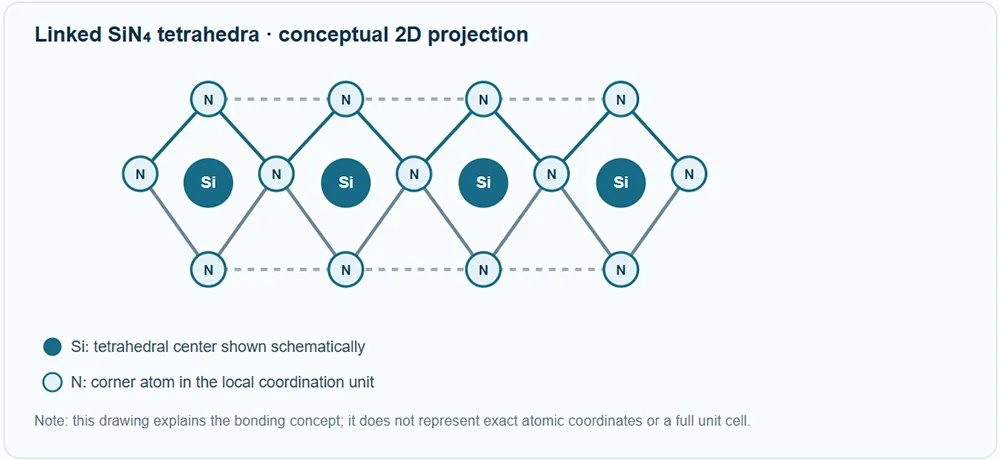
At the atomic level, silicon nitride is a covalently bonded ceramic compound with the chemical formula Si₃N₄. In its common α and β crystalline forms, silicon atoms sit within tetrahedral coordination environments, while nitrogen atoms occupy the surrounding corners; moreover, linked SiN₄ tetrahedra build a three-dimensional network that resists easy atomic displacement. This strong bonding helps explain the material’s hardness, high elastic modulus, high-temperature stability and relatively low thermal expansion.
Importantly, the term “silicon nitride” describes an engineering material family rather than a single microstructure with one fixed property set. The α and β phases have different crystallographic arrangements, and processing can influence their relative amounts, grain shape, grain-boundary phases and porosity. During liquid-phase sintering, elongated β-Si₃N₄ grains can develop within a finer-grained matrix; consequently, crack paths may deflect around those grains and grain bridging or pull-out may contribute to a useful increase in fracture resistance.
By contrast, the same strong covalent bonding that supports strength also makes densification difficult compared with many oxide ceramics. Manufacturers therefore select an appropriate powder chemistry, forming route, sintering aids and thermal cycle to reach the required density and microstructure. As a result, two parts carrying the same Si₃N₄ label may show different strength, thermal conductivity, fracture toughness and wear behavior.
1. High-Temperature Capability and Strength Retention
First, silicon nitride stands out because it can retain useful mechanical strength at temperatures where many conventional metals lose stiffness or strength rapidly. Strong Si-N bonds resist thermally activated deformation, and a well-designed microstructure can provide good creep resistance under sustained loading. Therefore, engineers consider the material for hot gas components, furnace hardware, molten-metal handling equipment, turbocharger rotors and other components that face heat alongside mechanical stress.
Nevertheless, “high-temperature capable” does not mean that every grade maintains room-temperature properties indefinitely. For example, the NIST Structural Ceramics Database reports representative flexural strength values at 25°C and 1,350°C for several grades, and those values differ substantially by processing route; pressureless-sintered or hot-pressed grades can retain useful strength while still showing a reduction as temperature rises. Consequently, designers must use temperature-dependent strength data rather than extrapolate from a room-temperature datasheet.
In an oxidizing atmosphere, surface chemistry also changes as temperature rises, which can influence long-term behavior. Depending on the grade and environment, silicon nitride develops a silica-rich surface scale that may slow further oxidation over part of the operating range. However, protective-scale stability depends on temperature, exposure duration, water vapor, gas velocity and the chemistry of grain-boundary phases; therefore, service-temperature limits should come from representative oxidation and creep tests.
For design approval, specify the peak and continuous temperatures, atmosphere, stress level and expected life, then verify grade-specific strength, creep, oxidation and thermal-cycling data rather than using one universal service-temperature limit.
2. Low Thermal Expansion and Excellent Thermal-Shock Resistance
Second, silicon nitride has a low coefficient of thermal expansion (CTE), commonly near 3.0-3.2 × 10⁻⁶ K⁻¹ for representative dense grades across a broad temperature interval. Because thermal expansion describes how much a material changes dimension as temperature changes, a low CTE helps components preserve fit and alignment during heating and cooling. In addition, this behavior can reduce thermal mismatch when engineers combine silicon nitride with other low-expansion ceramics or carefully designed metal assemblies.
By comparison, the linear CTE of common alumina grades is around 8.2 × 10⁻⁶ K⁻¹, silicon carbide is often reported near 4.5-5.0 × 10⁻⁶ K⁻¹, and austenitic stainless steel 304 can be near 17.3 × 10⁻⁶ K⁻¹ over the temperature interval used in a given datasheet. Thus, silicon nitride expands less than many oxide ceramics and common steels for the same temperature rise. Even so, engineers should compare values over matching temperature intervals, because average CTE changes with temperature and grade.
Comparison chart A: representative linear thermal expansion
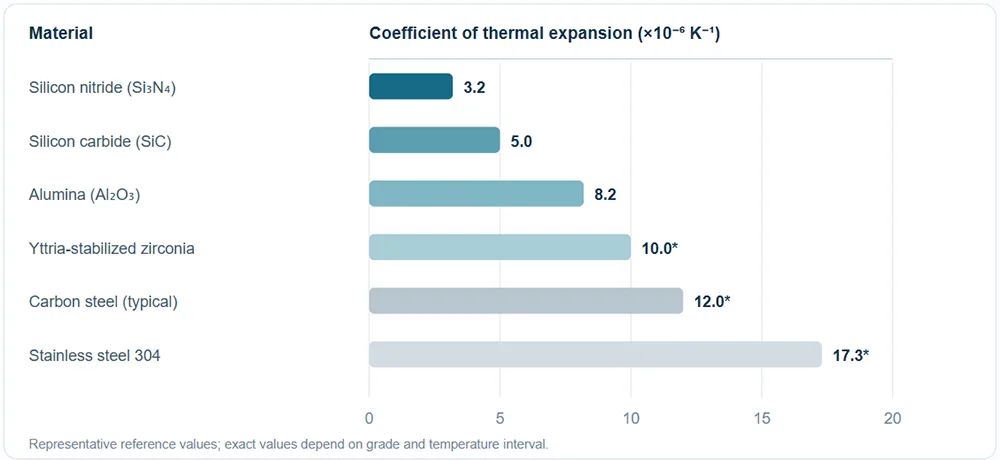 Figure 2. A lower CTE usually means less dimensional change for the same temperature change. Values are representative, not a substitute for the grade-specific data sheet; steel and ceramic values may use different reference intervals.
More importantly, low expansion works together with relatively good thermal conductivity and a high elastic modulus to reduce some thermal-shock risks. A sudden temperature gradient can make the hot surface and cooler interior expand by different amounts, generating stress; when that stress exceeds the local strength, a crack may initiate. Silicon nitride’s combination of low CTE, useful strength and heat transport can reduce that stress build-up compared with many ceramics of higher expansion.
Still, no ceramic is immune to thermal shock; geometry, edge defects, porosity, wall thickness, heating rate and cooling medium all affect the outcome. Therefore, qualification should reproduce the real temperature gradient and cycle rate.
3. Useful Thermal Conductivity and Heat-Flow Control
Third, silicon nitride conducts heat more effectively than many structural oxide ceramics, although its thermal conductivity varies greatly with grade and processing. The NIST Structural Ceramics Database lists representative room-temperature values of about 10 W·m⁻¹·K⁻¹ for reaction-bonded silicon nitride, about 23 W·m⁻¹·K⁻¹ for some pressureless-sintered grades, and around 36 W·m⁻¹·K⁻¹ for certain hot-pressed material. Consequently, a designer should not treat “thermal conductivity of silicon nitride” as a single guaranteed number.
At the microstructural level, phonons carry most of the heat in this electrically insulating ceramic. Grain-boundary phases, impurities, lattice defects and porosity can scatter phonons; therefore, powder purity, sintering aids, densification and grain-boundary chemistry strongly influence heat transport. In practice, material suppliers can tailor the balance between thermal conductivity, strength, dielectric behavior and manufacturability to suit a specific component.
For example, engineers may consider silicon nitride in insulating heat spreaders, power-electronics substrates, high-temperature fixtures and components that need both mechanical reliability and electrical insulation. However, aluminum nitride and beryllium oxide can offer higher thermal conductivity in some applications, while silicon nitride can offer a useful balance of toughness and strength. Therefore, selection must consider total thermal resistance, joining method, dielectric requirements, mechanical cycling and cost rather than thermal conductivity alone.
During design, specify the measurement temperature and minimum conductivity after processing. Additionally, assess metallization, braze layers and bonded interfaces, which can dominate total heat transfer; for cycling assemblies, expansion compatibility and fracture resistance may matter as much as conductivity.
4. Low Friction Potential, Wear Resistance and Tribological Stability
Fourth, silicon nitride can perform well in sliding and rolling contacts because it combines high hardness, low density, good surface finish potential and resistance to adhesive wear in suitable material pairs. Under selected contact conditions, engineers can achieve relatively low friction and low wear, which makes the ceramic attractive for bearing balls, rollers, valve components, seals, guide elements and precision mechanisms. Nevertheless, “self-lubricating” should be used cautiously: silicon nitride does not supply an oil film by itself, and friction remains a property of the complete tribological system.
Specifically, the coefficient of friction depends on the counterface material, lubrication, surface roughness, load, sliding speed, temperature, atmosphere, humidity and running-in behavior. A value near 0.1 can occur in particular systems, but it should not be presented as a universal coefficient for all silicon nitride components. In the NIST ring-on-ring dataset, for example, one hot-pressed Si₃N₄ grade produced reported coefficients from approximately 0.17 to 0.40 across the listed sliding speeds, while a reaction-bonded silicon carbide grade produced values around 0.20 to 0.49 in the same broader test program.
Comparison chart B: reported friction coefficients in a ring-on-ring study
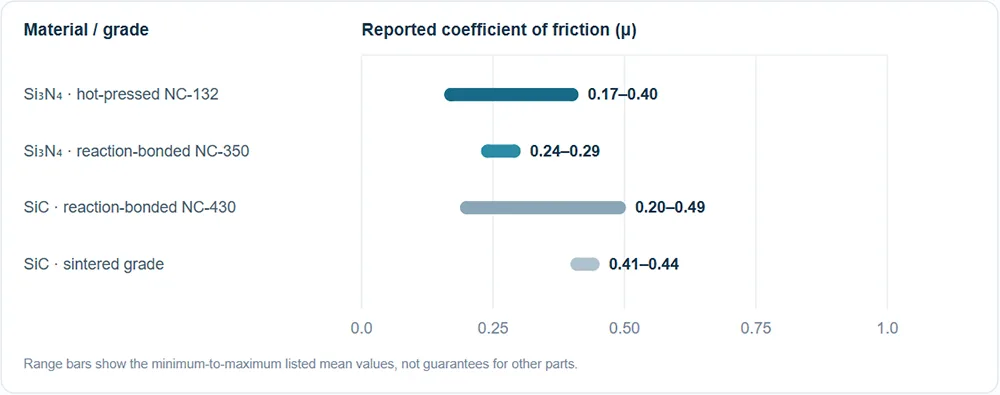 Figure 3. NIST’s cited ring-on-ring test program reports grade- and speed-dependent friction values for self-mated ceramic rings. The ranges summarize selected entries; the underlying data also report scatter, and different test systems may produce different results.
Accordingly, the chart compares selected reported values from a defined test program rather than universal material constants. It also illustrates why grade and test speed matter: two silicon nitride grades can show different friction behavior, and silicon carbide’s range can overlap some silicon nitride results. Therefore, tribological qualification should measure the proposed material pair under realistic pressure, speed, temperature, lubrication and contamination conditions.
In rolling-element bearings, silicon nitride’s low mass can also reduce centrifugal loading at high rotational speed, while its electrical insulation can help interrupt certain electrical-current paths through the rolling elements. Even so, bearing design still requires suitable steel raceways, controlled internal clearance, proper lubrication, surface quality and correct mounting. For seals and valves, the designer should additionally assess leakage, contact stress, corrosion, impact and thermal cycling rather than select material on friction coefficient alone.
5. Chemical Stability and Oxidation Resistance
Fifth, silicon nitride offers useful chemical stability in a wide range of industrial environments. Its covalent network resists many forms of chemical attack, and manufacturers use suitable grades in abrasive powder-handling equipment, selected chemical-processing components, pump parts, molten-metal tooling and other wear-resistant hardware. Nevertheless, chemical compatibility always depends on the actual medium, concentration, temperature, pressure, exposure time and microstructure of the chosen ceramic.
In aqueous and acidic environments, it is inaccurate to claim that silicon nitride resists every inorganic acid except hydrofluoric acid under all conditions. Hot phosphoric acid, strong alkalis, high-pressure aqueous systems and corrosive mixtures can attack silicon nitride or its grain-boundary phases under particular conditions. Therefore, engineers should request immersion, corrosion-rate or application-specific compatibility data whenever the component contacts a chemically aggressive process stream.
Under oxidizing conditions, silicon nitride can develop a silica-rich surface scale that may act as a diffusion barrier. However, the rate and stability of that scale depend on temperature, gas composition, water vapor, thermal cycling and additives used during sintering. If the application involves long exposure near the upper service-temperature limit, material selection should consider oxidation kinetics, scale adherence, section thickness and any effect of the scale on dimensions or friction.
For procurement, document the chemical species, concentration, temperature, exposure duration, cleaning agents and any simultaneous erosion. Those details help the supplier compare silicon nitride with silicon carbide, alumina, zirconia or corrosion-resistant metals.
6. High Hardness, Stiffness, Strength and Fracture Behavior
Sixth, dense engineering grades of silicon nitride combine high hardness with high elastic modulus and substantial flexural strength. A representative commercial grade listed by NTK CERATEC has a density near 3.2 g/cm³, elastic modulus around 290 GPa, flexural strength around 720 MPa, hardness around 14 GPa and fracture toughness around 5 MPa·m½. Those figures give engineers a sense of the material’s capability, but they belong to a particular product and test method rather than every grade of Si₃N₄.
At the component level, hardness supports resistance to indentation and abrasive wear, while stiffness limits elastic deflection under load. In addition, fracture toughness provides a measure of resistance to crack extension; silicon nitride often offers a useful toughness level for a structural ceramic because elongated grains and carefully controlled grain boundaries can deflect or bridge cracks. Consequently, the material can tolerate some demanding mechanical service conditions better than many brittle oxide ceramics of similar hardness, although it does not behave like a ductile metal.
Nevertheless, silicon nitride remains flaw-sensitive. A pore, machining scratch, edge chip or inclusion can create a local stress concentration, so actual component strength depends on flaw population, geometry, surface finish, residual stress, volume under tension and statistical variability. For that reason, engineers should evaluate strength using appropriate test standards and consider Weibull statistics for reliability-critical parts rather than rely on a single maximum strength figure.
Furthermore, machining requires diamond tooling and careful control because aggressive grinding can introduce subsurface damage or tensile residual stress. Edge radii, transitions, surface finish, grinding direction and inspection criteria can have a large effect on component life. For precision bearings, seals and structural parts, process control and inspection often matter as much as nominal material strength.
Finally, hardness makes machining difficult and brittle fracture limits tensile strain and impact tolerance. Accordingly, avoid sharp internal corners, abrupt thickness changes, unsupported impact surfaces and excessive local tensile stress where possible.
7. Low Density and High Specific Performance-with Processing Trade-Offs
Seventh, silicon nitride has a relatively low density, commonly around 3.2-3.3 g/cm³ for dense engineering grades, compared with roughly 7.8-8.0 g/cm³ for common steels. As a result, a silicon nitride rolling element can weigh considerably less than a same-volume steel element, which may reduce inertial loads and help high-speed rotating systems. The lower mass can also benefit moving components when the design can exploit the material’s stiffness and strength.
For a simple equal-volume comparison, a material density near 3.2 g/cm³ is approximately 41% of a steel density near 7.85 g/cm³. This ratio does not mean that a complete ceramic bearing or machine assembly automatically weighs 59% less, because races, cages, retainers, housings and other components may remain metallic. Therefore, system-level mass savings should be calculated from the actual component design rather than inferred from one material’s density alone.
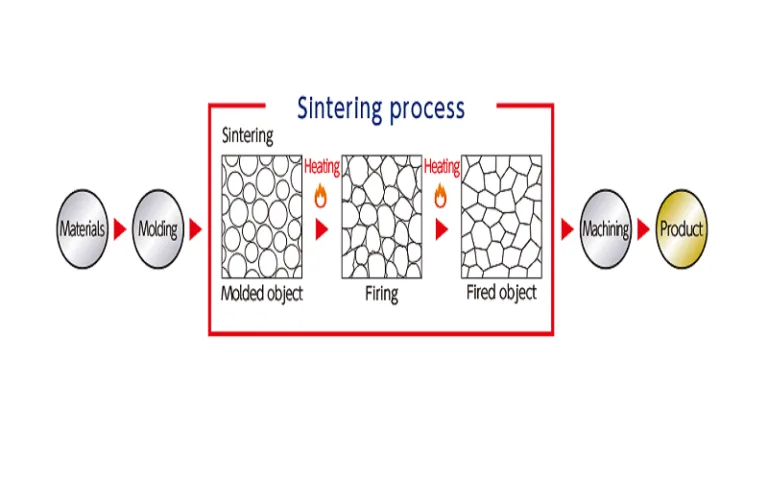
In addition, strong covalent bonding makes full densification challenging, so manufacturers use forming and sintering routes such as reaction bonding, pressureless sintering, gas-pressure sintering, hot pressing and hot-isostatic pressing. Each route influences density, grain morphology, machining allowance, achievable geometry, property consistency and production cost. For example, reaction-bonded silicon nitride can offer good dimensional stability and useful thermal-shock behavior, while certain pressure-assisted processes can achieve high density and strength at greater equipment and process cost.
Because sintering can change dimensions, designers must account for shrinkage, warpage and tolerance stack-up early in the part-development process. Moreover, thin sections, deep cavities, sharp corners and abrupt section changes can complicate forming or increase defect risk; an early design-for-manufacture review can identify opportunities to simplify geometry, establish datum surfaces and assign tolerances by functional importance. Therefore, the best design is not merely the one that uses the strongest grade, but the one that balances service requirements, manufacturability, inspection and total cost.
In applications involving impact, tensile loading or repeated stress, silicon nitride’s brittleness requires special attention. Material selection should include a safety factor informed by statistical strength, defect inspection, component geometry, load spectrum and consequences of failure. Where the design cannot control these factors, a tougher ceramic, a metal, a composite or a hybrid assembly may be more suitable.
Where Do Engineers Use Silicon Nitride?
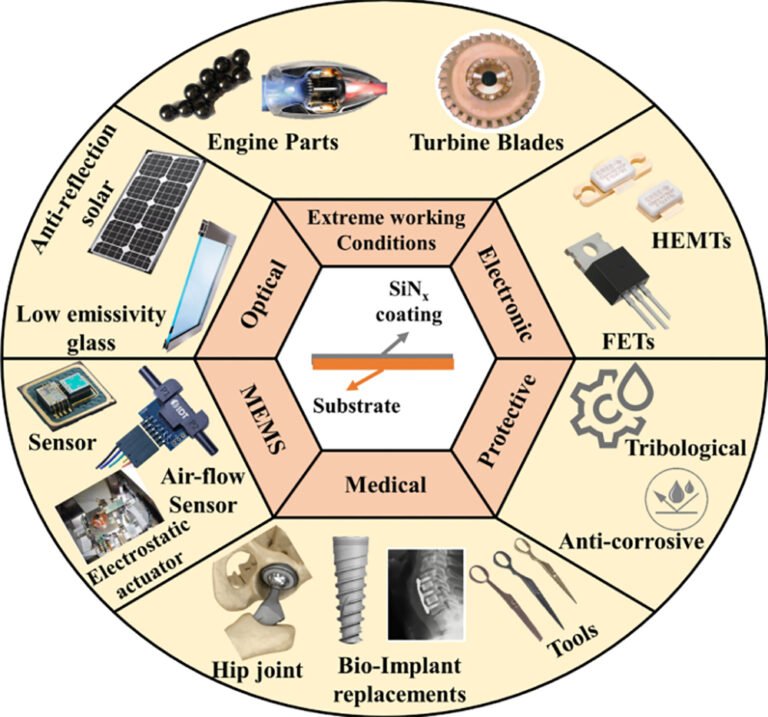
Because the material offers several benefits at once, engineers select silicon nitride for applications in which heat, rolling or sliding contact, corrosion, mass and dimensional stability interact. However, suitability depends on the exact grade and manufacturing process, so the examples below should guide initial screening rather than replace application qualification.
| Application area | Common component examples | Relevant properties | Key design check |
|---|---|---|---|
| Precision bearings | Balls, rollers, hybrid bearing elements | Low density, hardness, wear resistance, electrical insulation | Raceway compatibility, lubrication, preload and fatigue life |
| High-temperature systems | Hot-gas parts, furnace fixtures, selected nozzles | High-temperature strength, oxidation resistance, thermal shock | Creep, oxidation, thermal cycling and atmosphere |
| Pumps, valves and seals | Seal rings, wear sleeves, valve elements | Hardness, chemical stability, wear resistance | Media compatibility, contact stress, leakage and impact |
| Power electronics | Insulating substrates and structural thermal parts | Electrical insulation, thermal conductivity, fracture resistance | Metallization, thermal resistance, dielectric strength and cycling |
| Automotive and aerospace | Selected turbocharger, engine and high-temperature components | Strength-to-weight ratio, heat resistance, wear behavior | Reliability under thermal cycling, impact and complex loading |
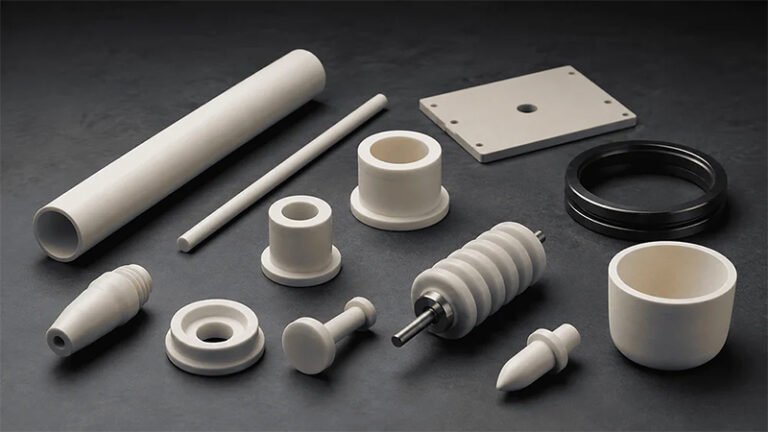
| Industrial wear parts | Powder-handling liners, guides, jigs and slurry components | Hardness, abrasion resistance, low contamination potential | Particle impact, abrasive chemistry and replacement economics |
For bearings, silicon nitride may justify higher material and processing costs when speed, electrical isolation or reduced rolling-element mass matter. Likewise, hot-zone, seal and valve components can benefit from its strength, oxidation resistance or wear performance after the relevant thermal, impact and chemical limits have been qualified.
In electronic assemblies, silicon nitride may balance insulation, structural robustness and heat transfer. Aluminum nitride often provides higher conductivity, while silicon nitride can offer useful fracture resistance and thermal-cycling performance; therefore, compare the full substrate, metallization and joining system.
How to Specify Silicon Nitride for a Real Component
Before requesting a quotation or approving a material change, define the service conditions in measurable terms. At minimum, record the operating temperature and peak temperature, applied loads, impact events, thermal-cycle profile, environment, friction pair, lubrication, target lifetime and permissible failure mode. This information allows the engineering team to identify whether high-temperature strength, thermal conductivity, wear, chemical resistance, dimensional stability or reliability should drive grade selection.
Next, agree on the property verification method and acceptance criteria. For instance, specify density and porosity limits, flexural strength test method, thermal expansion interval, conductivity measurement temperature, surface finish, dimensional tolerances, edge condition and inspection plan where they affect function. Additionally, request the exact grade’s data sheet and clarify whether the published properties represent typical values, guaranteed minima, individual test results or values measured on witness coupons.
Finally, review manufacturing before the drawing becomes fixed. Silicon nitride parts often require diamond grinding for close tolerances, and internal corners or complex features can increase machining time, tool wear or defect risk. By adjusting radii, allowing realistic tolerances on non-critical faces, planning datum surfaces and identifying the most important inspection dimensions, teams can reduce cost without compromising function.
Common Questions About Silicon Nitride
What are the main properties of silicon nitride?
In summary, its main engineering attributes include high hardness and stiffness, good high-temperature strength, low thermal expansion, useful thermal-shock resistance, grade-dependent thermal conductivity, strong wear performance, chemical stability and a density around 3.2-3.3 g/cm³ for many dense grades. However, fracture behavior, oxidation limits and all numerical properties depend on the grade and application conditions.
Is silicon nitride stronger than steel?
Not in every sense. Silicon nitride has high hardness, stiffness and compressive strength, and it can retain useful strength at elevated temperatures; by contrast, steel usually offers much greater ductility and resistance to impact deformation. Therefore, a fair comparison must use the relevant loading mode, temperature, geometry, flaw tolerance and failure criteria.
Why does silicon nitride resist thermal shock?
Primarily, its low coefficient of thermal expansion reduces the strain generated by a temperature change, while useful thermal conductivity can reduce temperature gradients. In addition, high strength and a useful fracture-toughness level help a properly processed grade withstand transient thermal stress. Nevertheless, component geometry and heating or cooling rate still determine the real result.
Does silicon nitride have a friction coefficient of 0.1?
That value may describe a particular material pair and operating condition, but it is not a universal constant. Published measurements vary with the counterface, load, speed, surface finish, humidity, temperature and lubrication. Consequently, engineers should test the actual tribological pair instead of applying a single coefficient to every silicon nitride part.
Does silicon nitride melt at a normal atmospheric pressure?
Silicon nitride does not behave like a simple metal with a convenient atmospheric-pressure melting point; it tends to decompose at very high temperatures, and the behavior depends on gas pressure and nitrogen partial pressure. Therefore, material limits should come from grade-specific data and the real atmosphere, rather than a single universal temperature claim.
What is the biggest limitation of silicon nitride?
Its principal limitation is brittle fracture, which makes flaws, edge damage and tensile stress important design concerns. Moreover, high hardness makes tight-tolerance machining expensive, and the high-temperature properties, conductivity and chemistry vary with processing route. Proper grade selection, design-for-manufacture review and quality control help manage these trade-offs.
Conclusion: Balance the Properties, Not Just One Number
Overall, silicon nitride is a versatile engineering ceramic because it combines several attributes that often conflict in other materials: high-temperature strength, low expansion, thermal-shock resistance, useful thermal conductivity, wear resistance, chemical stability and relatively low density. At the same time, strong covalent bonding and high hardness bring manufacturing complexity, while brittleness requires careful control of geometry, surface damage and service loads.
For that reason, the most reliable selection process begins with the real operating conditions, compares grade-specific data, validates friction or corrosion where relevant, and includes the intended manufacturing and inspection route. When the application values this balanced performance and can manage ceramic fracture risks, silicon nitride can provide a durable solution for demanding precision and high-temperature components.
Technical References and Further Reading
- National Institute of Standards and Technology (NIST), Structural Ceramics Database: Silicon Nitride properties. Includes representative strength, fracture toughness, thermal conductivity, thermal expansion and thermal-shock data by processing route.
- National Institute of Standards and Technology (NIST), Friction and wear properties of monolithic silicon-based ceramics. Includes ring-on-ring friction entries for silicon nitride and silicon carbide grades.
- NTK CERATEC, Silicon Nitride (Si₃N₄) material information. Provides one commercial grade’s representative density, elastic modulus, strength, hardness, fracture toughness and thermal properties.
- CoorsTek, Alumina technical properties. Provides alumina reference properties, including thermal expansion values.
- NIST Structural Ceramics Database, Silicon carbide material data. Includes a representative coefficient of thermal expansion for SiC.
- Nippon Steel, Stainless steel physical properties. Includes representative thermal expansion coefficients for stainless grades.
- H. Lange, “Silicon Nitride-From Powder Synthesis to Ceramic Materials,” Angewandte Chemie International Edition in English, 1991; and M. H. Bocanegra-Bernal and B. Matovic, “Mechanical properties of silicon nitride-based ceramics and its use in structural applications at high temperatures,” Materials Science and Engineering: A, 2010.
Editorial note: The values in this article are representative literature or manufacturer reference values, not universal specifications. Confirm the latest data sheet, test method, grade and operating limits before engineering release.