In modern high-tech engineering, off-the-shelf standard parts often fall short when pushed to the absolute limits of speed, temperature, and chemical exposure. This is where custom ceramic components become mission-critical. Among advanced technical ceramics, Silicon Nitride (Si₃N₄) stands out as the premier material for custom structural, tribological, and electrical applications. Selecting and designing a custom Si₃N₄ component requires a deep understanding of material science, Design for Manufacturability (DFM), and precision processing. This guide will walk you through everything you need to know to successfully specify and source custom Silicon Nitride parts.
1. Requirements for Custom Silicon Nitride (Si₃N₄) Components
Designing a custom component out of Silicon Nitride is fundamentally different from designing with metals. Si₃N₄ is incredibly hard, lightweight, and thermally stable, but it is also a brittle ceramic. To ensure the success of your custom part, several strict engineering requirements must be met during the design phase.
A. Design for Manufacturability (DFM) in Ceramics
- Avoid Sharp Internal Corners: Ceramics are highly susceptible to stress concentrations. All internal corners and shoulders must feature generous fillets (radii) to prevent crack initiation during the sintering shrinkage phase or under operational mechanical loads.
- Uniform Wall Thickness: Sudden changes in cross-sectional thickness can lead to uneven shrinkage and warping during the 1700°C sintering process. Designs should aim for uniform mass distribution.
- Minimize Deep, Narrow Holes: Drilling deep, small-diameter holes into fully sintered Si₃N₄ (which is nearly as hard as diamond) is extremely costly and prone to tool breakage. Holes should be formed in the “green” (unsintered) state whenever possible.
B. Tolerance and Surface Finish Specifications
Unlike metal casting or injection molding, ceramic sintering involves a volumetric shrinkage of approximately 15% to 20%. Therefore, “net-shape” sintering cannot achieve tight dimensional tolerances. Engineers must specify which critical dimensions require post-sintering CNC diamond grinding and lapping. Standard as-sintered tolerances are typically ±0.5 mm, whereas precision-machined custom Si₃N₄ parts can achieve tolerances as tight as ±0.002 mm with surface finishes of Ra < 0.05 μm.
C. Operational Environment Requirements
Before finalizing the custom design, the operational environment must be clearly defined to select the correct Si₃N₄ grade:
High-Speed / Dynamic
Requires high fracture toughness and rolling contact fatigue (RCF) resistance. Ideal for custom bearing races and spindle shafts.
High-Temperature / Thermal Shock
Requires low thermal expansion and high thermal conductivity. Crucial for custom furnace fixtures and engine components.
Semiconductor / Vacuum
Requires ultra-high purity and zero outgassing. Essential for custom wafer handling end-effectors and plasma focus rings.
2. The Custom Ceramic Manufacturing Process
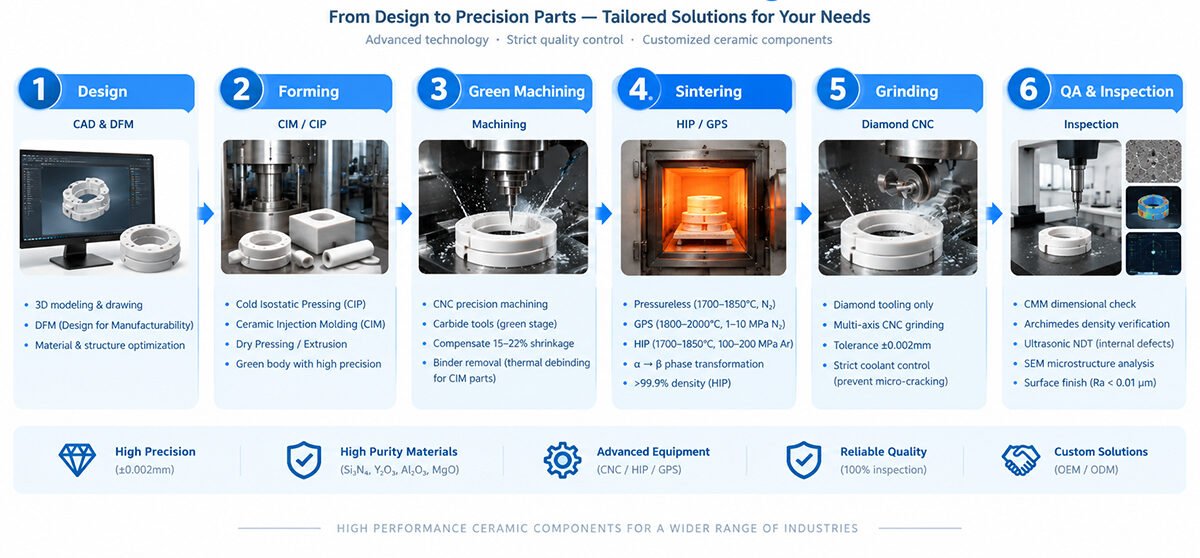
Transforming raw chemical powder into a precision custom Si₃N₄ component is a multi-disciplinary engineering feat. Below is the step-by-step flowchart and detailed explanation of the custom manufacturing lifecycle.
Custom Si₃N₄ Component Manufacturing Process
Detailed Process Breakdown:
- Powder Preparation: High-purity α-Si₃N₄ powder is blended with specific sintering aids (Y₂O₃, Al₂O₃) tailored to the custom part’s end-use. The mix is ball-milled to sub-micron sizes to ensure homogeneity and reactivity.
- Custom Forming: Depending on the geometry, the powder is shaped into a “green body.” Complex custom shapes often utilize Ceramic Injection Molding (CIM), while larger, simpler custom blanks use Cold Isostatic Pressing (CIP). The green body is machined to account for the ~18% sintering shrinkage.
- Sintering (HIP/GPS): The green body is placed in a high-temperature furnace. Hot Isostatic Pressing (HIP) applies simultaneous heat (1700°C+) and immense argon gas pressure (200 MPa), eliminating all internal porosity and ensuring maximum structural integrity.
- Precision Machining: The fully densified “white body” is extremely hard. Custom features, tight tolerances, and surface finishes are achieved using multi-axis CNC machines equipped with specialized diamond grinding wheels and lapping plates.
- Quality Inspection: The final custom component undergoes Non-Destructive Testing (NDT), including ultrasonic scanning and X-ray radiography, to guarantee zero sub-surface micro-cracks or porosity before shipping.
3. Industries That Require Custom Ceramic Components
While standard ceramic bearings and balls are widely available, many cutting-edge industries require highly specialized, custom-engineered Si₃N₄ geometries to solve unique engineering bottlenecks.
Semiconductor & Electronics
Custom Parts: Wafer handling end-effectors, plasma etch focus rings, heater plates, and vacuum chamber isolators.
Why Si₃N₄: Zero particle outgassing in ultra-high vacuum, high plasma erosion resistance, and excellent thermal stability during rapid heating/cooling cycles.
Electric Vehicles (EV) & E-Mobility
Custom Parts: Custom motor shaft insulators, specialized hybrid bearing races, and power electronics cooling substrates.
Why Si₃N₄: Prevents electrical arcing (fluting) from inverter currents, reduces rotor weight for faster acceleration, and manages extreme thermal loads.
Medical & Surgical Devices
Custom Parts: MRI-safe surgical instrument tips, custom prosthetic joint articulations, and micro-pump check valves.
Why Si₃N₄: 100% non-magnetic, highly biocompatible, radiolucent (invisible to X-rays), and naturally resistant to harsh sterilization chemicals.
Aerospace & Defense
Custom Parts: Turbine blade shrouds, custom gyroscope gimbals, and high-temperature sensor housings.
Why Si₃N₄: Survives extreme thermal shock, maintains dimensional stability at 1000°C+, and reduces overall aircraft weight due to low density.
Chemical & Fluid Processing
Custom Parts: Mechanical seal faces, custom valve seats, metering pump plungers, and thermocouple protection tubes.
Why Si₃N₄: Total chemical inertness against highly corrosive acids, alkalis, and abrasive slurries where metals and polymers rapidly degrade.
4. AOFE: Your Dedicated Partner for Custom Si₃N₄ Parts
Specialization is Our Strength
While many ceramic manufacturers offer a broad catalog of alumina, zirconia, and silicon carbide, AOFE is exclusively focused on Silicon Nitride (Si₃N₄). This laser-focused specialization means our metallurgists, process engineers, and machinists understand the nuances of Si₃N₄ better than anyone else in the industry. When you bring a complex custom design to AOFE, you aren’t just getting a machine shop; you are partnering with a dedicated Si₃N₄ materials science laboratory.
From the initial CAD review and Design for Manufacturability (DFM) feedback, to the formulation of custom powder blends and the final nano-level polishing, AOFE manages the entire lifecycle of your custom component in-house. This vertical integration ensures strict quality control, protects your intellectual property, and dramatically reduces lead times compared to outsourced supply chains.
5. The AOFE Advantage in Custom Manufacturing
Advanced DFM Engineering
Our engineering team reviews every custom CAD model to optimize it for ceramic manufacturing. We identify potential stress risers, suggest geometric modifications to reduce machining costs, and ensure your part will survive the sintering process flawlessly.
State-of-the-Art HIP Sintering
AOFE utilizes advanced Hot Isostatic Pressing (HIP) technology. By applying 200 MPa of isostatic pressure at 1700°C+, we guarantee >99.9% theoretical density, ensuring your custom part has zero internal porosity and maximum fatigue life.
5-Axis Diamond Machining
Sintered Si₃N₄ is notoriously difficult to cut. AOFE’s facility is equipped with specialized 5-axis CNC grinders, ultrasonic machining centers, and precision lapping tables to achieve complex custom geometries with mirror finishes and micron-level tolerances.
Aerospace-Grade Traceability
Every custom component shipped by AOFE comes with a comprehensive data package: raw material certificates, sintering cycle logs, CMM dimensional reports, and NDT (ultrasonic/X-ray) flaw detection results.
6. Custom Ceramic Components FAQ
Have a Complex Custom Ceramic Design?
Send us your CAD files or sketches. AOFE’s engineering team will provide a free DFM review and a comprehensive manufacturing quote within 48 hours.