Advanced Ceramics | Welding Automation | Precision Components
How Silicon Nitride Ceramic Locating Pins Are Applied in Automated Spot Welding
In automated resistance spot welding, accurate workpiece positioning directly affects joint consistency, production repeatability, and equipment uptime. Therefore, silicon nitride ceramic locating pins offer a potential solution for demanding alignment applications where wear resistance, low component mass, and thermal stability matter.
Key Takeaways
- First, a locating pin establishes a repeatable position for a workpiece, fixture, or tooling component.
- Additionally, silicon nitride (Si₃N₄) combines relatively low density with high hardness, strength, and resistance to thermal shock.
- Meanwhile, the pin’s actual service life depends on contact geometry, side loading, impact, contamination, and operating temperature.
- Furthermore, manufacturers can tailor pin diameter, length, head geometry, mounting features, and surface finish to suit specific welding fixtures.
- Ultimately, application testing and dimensional inspection should confirm whether a ceramic pin outperforms the existing metal component in a particular production line.
1. What Is a Silicon Nitride Ceramic Locating Pin?
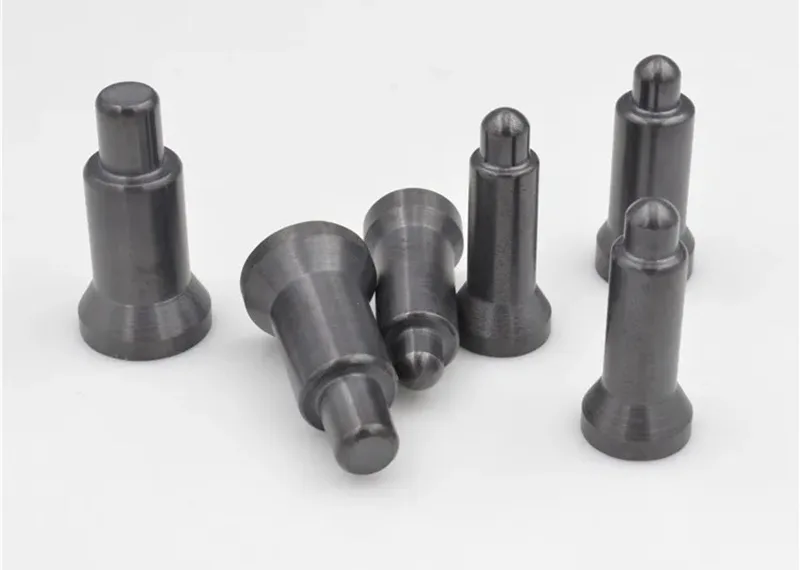
A silicon nitride ceramic locating pin is a precision component manufactured from silicon nitride engineering ceramic, a material known for its combination of mechanical strength, hardness, low density, and thermal-shock resistance. In an automated welding fixture, the pin helps establish a defined position or reference point for a workpiece or tooling element.
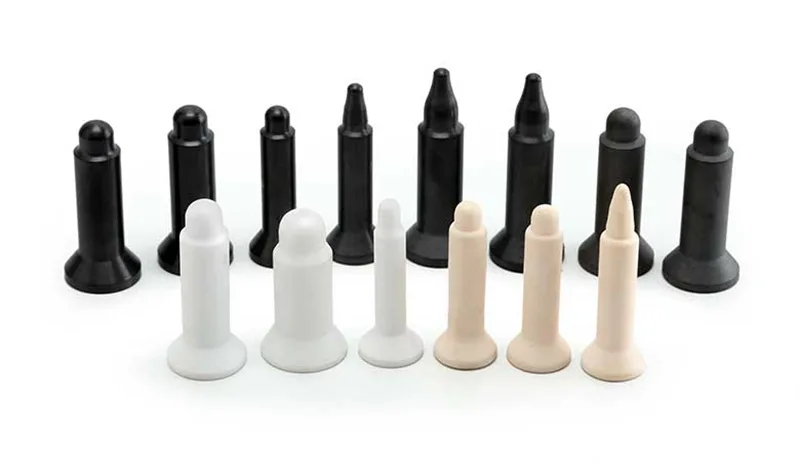
Unlike a welding electrode, which conducts current and delivers the heat required for resistance spot welding, a locating pin primarily performs a mechanical positioning function. Consequently, engineers should not treat a ceramic locating pin as an electrode or assume that every fixture design benefits from a ceramic replacement.
In suitable applications, the pin engages a locating hole, references an edge, or guides a component into a repeatable position. As a result, the fixture can maintain a consistent geometric relationship between the workpiece and the welding gun throughout repeated production cycles.
Typical Component Functions
2. Why Automated Spot Welding Requires Reliable Locating Pins
During resistance spot welding, two or more metal sheets meet between electrodes that apply force and electrical current. Therefore, the welding system depends on stable fixture geometry to position the workpieces consistently before the electrodes close.
However, repetitive movement, fixture vibration, workpiece variation, metal spatter, and abrasive contamination can gradually affect locating components. If a pin wears, bends, or loses its dimensional accuracy, the fixture may allow excessive workpiece movement or inconsistent positioning.
For that reason, engineers should evaluate a locating pin according to its actual contact conditions rather than selecting it by material hardness alone. Although silicon nitride offers strong wear and thermal properties, impact loading, edge contact, and bending stress can still cause ceramic fracture.
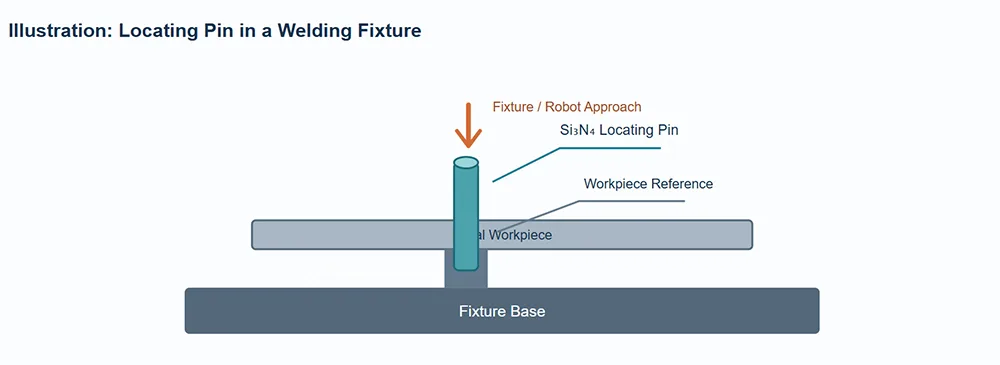
Schematic only: actual pin geometry, mounting method, workpiece contact, and welding-gun clearance depend on the fixture design.
3. Silicon Nitride Ceramic Properties and Technical Data
Silicon nitride belongs to the advanced structural ceramic family. In addition to its high hardness, the material provides a useful balance of strength, fracture toughness, thermal-shock resistance, and relatively low density.
Nevertheless, silicon nitride properties vary with powder chemistry, sintering additives, manufacturing route, microstructure, and final machining. Accordingly, the values below serve as indicative engineering references rather than guaranteed specifications for every locating pin.
| Property | Typical Reference Range | Engineering Relevance |
|---|---|---|
| Chemical Formula | Si₃N₄ | Defines the ceramic material family. |
| Density | Approximately 3.2-3.3 g/cm³ | Reduces moving mass compared with many steel components. |
| Flexural Strength | Approximately 600-800 MPa for some grades | Indicates resistance to bending under specified test conditions. |
| Hardness | Often around 1,400-1,800 HV | Supports resistance to abrasive surface wear. |
| Fracture Toughness | Often around 5-8 MPa·m1/2 | Helps assess crack propagation resistance; actual values depend on grade and test method. |
| Thermal Conductivity | Approximately 20-90 W/(m·K), depending on grade and microstructure | Influences heat flow through the component. |
| Thermal Expansion Coefficient | Approximately 2.8-3.2 × 10⁻⁶/K | Supports dimensional stability as temperature changes. |
| Maximum Service Temperature | Grade- and atmosphere-dependent; some grades support service around 1,000-1,200°C or higher in suitable conditions | Requires consideration of oxidation, load, exposure time, and thermal cycling. |
| Electrical Behavior | Generally electrically insulating | May benefit fixtures where electrical isolation is required, subject to system design. |
Data note: the ranges above are general material references, not certified values for a particular product. Therefore, request the actual grade datasheet and inspection report before using these figures for design approval.
3.1 High Hardness and Wear Resistance
Because silicon nitride offers high hardness, it can resist abrasive wear in applications involving repeated contact with fixtures or workpieces. Consequently, a correctly designed pin may retain its locating geometry longer than a softer material under suitable operating conditions.
3.2 Low Density and Reduced Moving Mass
At approximately 3.2-3.3 g/cm³, silicon nitride has a substantially lower density than steel. Therefore, a ceramic pin may reduce moving mass in robot-mounted tooling or other mechanisms where component inertia affects motion.
3.3 Thermal-Shock Resistance
Silicon nitride combines relatively low thermal expansion with useful fracture toughness and thermal-shock resistance. As a result, suitable grades can tolerate rapid temperature changes better than many brittle ceramics, although the actual result depends on geometry, thermal gradients, and mechanical stress.
3.4 Chemical Stability
In many industrial environments, silicon nitride resists oxidation and chemical attack better than numerous conventional metals. However, welding fumes, molten spatter, cleaning chemicals, and elevated temperatures create application-specific conditions that still require compatibility testing.
3.5 Important Limitation: Ceramic Fracture
Although silicon nitride offers high strength, it does not deform plastically like steel before failure. Therefore, engineers should avoid sharp corners, severe impact, excessive bending, and poorly supported mounting arrangements; instead, they should use suitable radii, contact geometry, and installation procedures.
4. How Ceramic Locating Pins Improve Automated Spot Welding
4.1 Repeatable Workpiece Positioning
First, a locating pin provides a defined mechanical reference for a workpiece or fixture. When the pin geometry matches the locating hole and fixture datum scheme, the system can reduce unwanted positional variation during repeated loading cycles.
4.2 Resistance to Abrasive Wear
Next, high hardness helps the pin withstand sliding contact and abrasive particles. Over time, reduced wear may help preserve the original contact geometry, although actual performance depends on the mating material, surface finish, lubrication, and contamination level.
4.3 Lower Inertia in Moving Tooling
Additionally, lower density can reduce the mass of moving fixture assemblies. In a suitably designed robotic cell, that reduction may support faster movement or lower inertial loading, but the overall effect depends on the total tool mass and robot motion profile.
4.4 Dimensional Stability During Thermal Cycling
Meanwhile, the combination of low thermal expansion and thermal-shock resistance can help a pin retain its geometry under suitable temperature fluctuations. Engineers should still evaluate direct exposure to welding spatter and heat because fixture position determines the actual thermal load.
4.5 Potential Maintenance Benefits
Finally, a wear-resistant locating pin may reduce replacement frequency in a compatible application. Nevertheless, manufacturers should compare measured wear, downtime, replacement cost, and fracture risk before claiming a longer service life or lower total operating cost.
5. Silicon Nitride Ceramic Locating Pin Specifications
Rather than using one universal pin size, manufacturers normally design the component around the fixture drawing, workpiece geometry, contact load, and installation method. Consequently, a technical quotation should define the dimensions and tolerances that directly affect locating accuracy.
| Specification | Design Consideration |
|---|---|
| Pin Diameter | Define the nominal diameter and tolerance from the mating hole and required clearance. |
| Overall Length | Specify the working length, mounting depth, and available clearance. |
| Tip Geometry | Choose a cylindrical, tapered, rounded, chamfered, or custom profile according to insertion and contact requirements. |
| Mounting Feature | Specify a straight shank, shoulder, stepped body, or compatible holder arrangement. |
| Surface Finish | Set a suitable finish for the locating surface, sliding contact, and cleaning requirements. |
| Dimensional Tolerance | Specify critical tolerances on diameter, length, concentricity, runout, and position where required. |
| Material Grade | Identify the silicon nitride grade and its certified mechanical and thermal properties. |
| Inspection Requirements | Define dimensional inspection, surface checks, material certification, and sampling criteria. |
Important specification note:
The table defines the information needed for a custom part; it does not represent a confirmed standard size range or guaranteed manufacturing tolerance. Therefore, provide a drawing or sample when requesting a production quotation.
6. Eight Application Areas for Silicon Nitride Ceramic Locating Pins
Although automated spot welding provides the primary example, ceramic locating pins may also serve in other precision positioning systems. However, engineers must confirm that the contact load, geometry, and operating environment suit a brittle structural ceramic.
1. Automotive Body-in-White Welding
For example, pins can locate sheet-metal panels, brackets, and structural parts in compatible robotic welding fixtures.
2. Automotive Seat and Frame Assembly
Similarly, precision locating components can reference frame members and formed metal parts during automated joining.
3. Battery Enclosure Manufacturing
Where the fixture design permits, pins can help position selected enclosure components before joining or inspection operations.
4. Electrical Cabinet Fabrication
In suitable production cells, locating pins can reference brackets, covers, and sheet-metal assemblies.
5. Appliance Sheet-Metal Production
Additionally, fixtures for appliance housings and internal frames may use pins to improve repeatable part positioning.
6. Robotic Fixture and Gripper Systems
In moving tooling, the lower density of silicon nitride may help reduce component mass when the mounting arrangement protects the ceramic from impact.
7. Precision Assembly Stations
For repeatable assembly, ceramic pins can provide reference points in tooling that requires dimensional stability and wear resistance.
8. Industrial Inspection Fixtures
Finally, suitable ceramic pins can help locate components during dimensional inspection or automated quality-control operations.
Application note: these eight areas describe potential uses of locating pins in suitable fixtures. They do not imply that silicon nitride is appropriate for every fixture or that each listed application has been validated for a specific supplier’s product.
7. Manufacturing Process for Silicon Nitride Ceramic Locating Pins
Producing a precision silicon nitride pin requires control of powder quality, forming, sintering, grinding, and inspection. Because the material is hard and brittle, manufacturers must also plan the final geometry around the capabilities of ceramic machining and the component’s service loads.
Silicon Nitride Locating Pin Production Flow
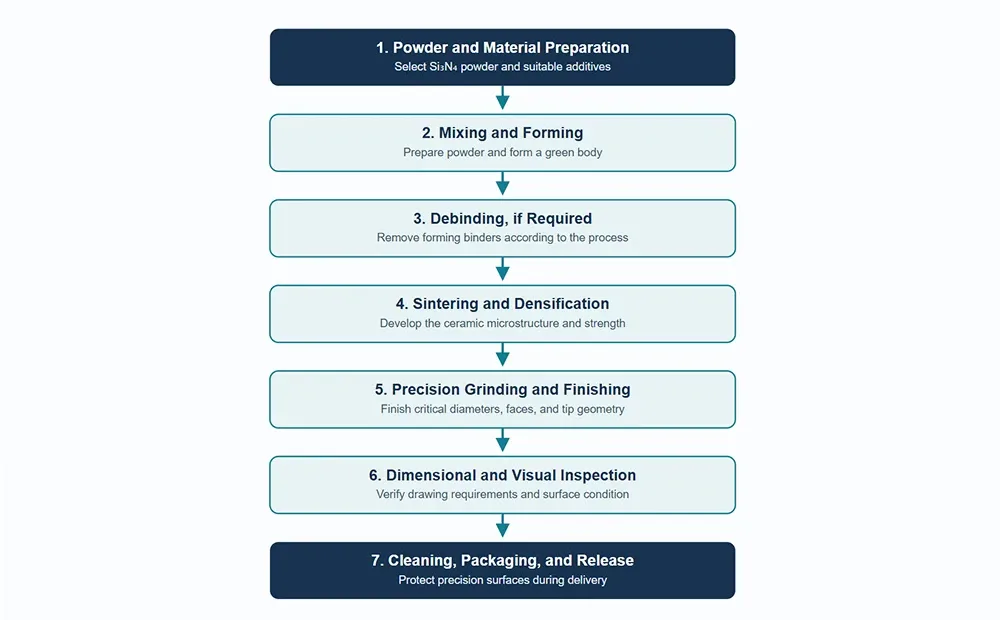
Manufacturing note: the exact forming, debinding, sintering, and finishing route depends on the selected ceramic grade and part geometry.
7.1 Powder Preparation
Initially, the manufacturer selects silicon nitride powder and any required sintering additives. Controlled mixing helps create a consistent feedstock, while powder quality influences densification, microstructure, and final mechanical properties.
7.2 Forming the Green Body
Next, a suitable forming method shapes the powder into a preliminary pin. Depending on geometry and production volume, the process may use uniaxial pressing, cold isostatic pressing, ceramic injection molding, or another suitable forming route.
7.3 Debinding and Sintering
Subsequently, the process removes temporary binders when necessary and sinters the shaped body under a controlled atmosphere. During sintering, particle bonding and densification develop the ceramic’s final microstructure; therefore, process control helps limit porosity and dimensional variation.
7.4 Precision Grinding
After sintering, diamond grinding and suitable finishing methods establish critical diameters, flatness, concentricity, and tip geometry. Since ceramic machining can introduce surface damage if poorly controlled, the manufacturer must choose suitable grinding conditions and inspection methods.
7.5 Final Quality Inspection
Finally, dimensional inspection checks the features identified on the drawing. Depending on customer requirements, quality control may also include visual inspection, surface-condition checks, material certification, and documented sampling or acceptance criteria.
8. Working with AOFE MIMCustom for Custom Ceramic Locating Pins
For an automation project, selecting a supplier involves more than choosing a ceramic material. Instead, the engineering team should evaluate drawing interpretation, material traceability, machining capability, dimensional inspection, communication, and the ability to support application-specific requirements.
When discussing a silicon nitride ceramic locating pin with AOFE MIMCustom, buyers can use the following checklist to define the project and assess the supplier’s capabilities. Each item should be confirmed directly with the company before it becomes a purchase commitment.
Drawing-Based Customization
Provide the component drawing, critical dimensions, tolerance requirements, and mounting details to determine whether the supplier can manufacture the required geometry.
Material Selection
Request the proposed silicon nitride grade, material datasheet, and relevant property information before approving the design.
Precision Machining Review
Confirm that the supplier can achieve the required diameter, length, tip geometry, surface finish, and dimensional tolerances.
Quality Documentation
Discuss dimensional reports, inspection methods, material traceability, and acceptance criteria appropriate for the project.
Prototype and Validation
Where feasible, evaluate sample parts in the actual fixture before moving to larger production quantities.
Project Communication
Clarify lead time, production quantity, packaging, change control, and the process for resolving dimensional or material questions.
Information to Include in an RFQ
- 2D engineering drawing or 3D CAD file.
- Required silicon nitride grade or material-performance targets.
- Critical dimensions, tolerances, and surface-finish requirements.
- Contact loads, insertion conditions, expected duty cycle, and operating temperature.
- Annual demand, prototype quantity, and target delivery schedule.
- Required inspection documents, certificates, and packaging specifications.
Ultimately, the best supplier relationship combines accurate technical communication with documented manufacturing capability. Therefore, buyers should verify AOFE MIMCustom’s actual material options, equipment, inspection resources, certifications, and delivery commitments during the quotation process.
Need a Custom Silicon Nitride Locating Pin?
Share your drawing, material requirements, and application conditions to start a technical review.
9. Frequently Asked Questions
Q1. What is a silicon nitride ceramic locating pin?
A silicon nitride ceramic locating pin is a precision positioning component made from Si₃N₄ engineering ceramic. In suitable fixtures, it provides a mechanical reference for workpiece alignment while offering high hardness, relatively low density, and resistance to wear and thermal shock.
Q2. Why choose silicon nitride instead of steel?
Compared with many steel components, silicon nitride offers lower density, high hardness, electrical insulation, and strong thermal-shock resistance. However, steel generally tolerates impact and bending differently, so engineers should compare the complete load case and failure risks before selecting the material.
Q3. Can a ceramic locating pin withstand welding spatter?
Silicon nitride offers useful thermal and chemical stability, so it may perform well in certain welding environments. Nevertheless, direct spatter impact, local thermal gradients, and accumulated deposits can damage or interfere with the pin; therefore, engineers should assess the pin’s actual location and exposure.
Q4. Does silicon nitride guarantee more accurate welding?
No material alone guarantees weld accuracy. Instead, the pin’s geometry, fit, wear rate, mounting rigidity, fixture design, robot calibration, and welding process all influence positioning and weld consistency.
Q5. What dimensions are available?
Dimensions depend on the manufacturer’s forming and machining capabilities, the selected grade, and the component geometry. Accordingly, submit a drawing or sample to confirm feasible diameter, length, tip shape, tolerance, and mounting features rather than assuming a universal standard size.
Q6. Can silicon nitride pins be manufactured to custom drawings?
Many advanced ceramic components use drawing-based manufacturing and precision grinding. However, the supplier must review the geometry, tolerance, material grade, and production quantity to confirm feasibility before accepting the order.
Q7. What information should I provide when requesting a quotation?
Provide the engineering drawing, required material properties, critical tolerances, contact conditions, operating temperature, expected production quantity, and inspection requirements. In addition, describe the current failure mode or performance target so the supplier can assess the application more accurately.
Q8. How should engineers prevent ceramic pin fracture?
Engineers should minimize impact and bending, provide adequate support, avoid sharp stress concentrations, and use a suitable fit and installation procedure. Additionally, they should inspect the contact surfaces regularly and validate the design under representative operating loads.
Q9. How can I confirm the service life of a ceramic locating pin?
A controlled production trial provides the most useful application-specific evidence. Therefore, record initial dimensions, monitor wear and breakage, track replacement intervals, and compare downtime and total operating cost against the existing component.
Q10. Is silicon nitride suitable for every welding fixture?
No, because a ceramic pin may not suit fixtures with severe impact, unsupported bending, or difficult replacement access. Instead, engineers should compare the ceramic option with steel and other materials against operating loads, environmental conditions, maintenance practices, and lifecycle cost.
10. Conclusion
Silicon nitride ceramic locating pins can support accurate positioning in automated spot welding fixtures when their material properties and geometry match the operating conditions. In particular, high hardness, relatively low density, useful fracture toughness, and thermal-shock resistance make Si₃N₄ a candidate for selected precision alignment applications.
Nevertheless, ceramic performance depends on more than material data. Therefore, engineers should define the pin’s critical dimensions, control its mounting and contact loads, and validate wear and fracture behavior under actual production conditions.
For a custom locating pin, the most effective next step is to provide the engineering drawing and operating details to AOFE MIMCustom, then confirm the proposed grade, manufacturing feasibility, inspection requirements, and performance targets before placing a production order.
Technical Summary
A silicon nitride ceramic locating pin is a precision mechanical positioning component used in compatible automation fixtures. Its main material advantages include a density of approximately 3.2-3.3 g/cm³, high hardness, high flexural strength, relatively low thermal expansion, and useful thermal-shock resistance. Manufacturers determine pin diameter, length, tip geometry, mounting features, and tolerances from the engineering drawing. Production commonly involves powder preparation, forming, sintering, precision grinding, and final inspection. Before selecting the component for automated spot welding, engineers should assess workpiece alignment, wear, impact loading, thermal exposure, dimensional stability, and lifecycle cost.