Advanced Ceramics | Semiconductor Materials
Why Are Silicon Nitride Ceramics Suitable for High-Reliability Semiconductor Components?
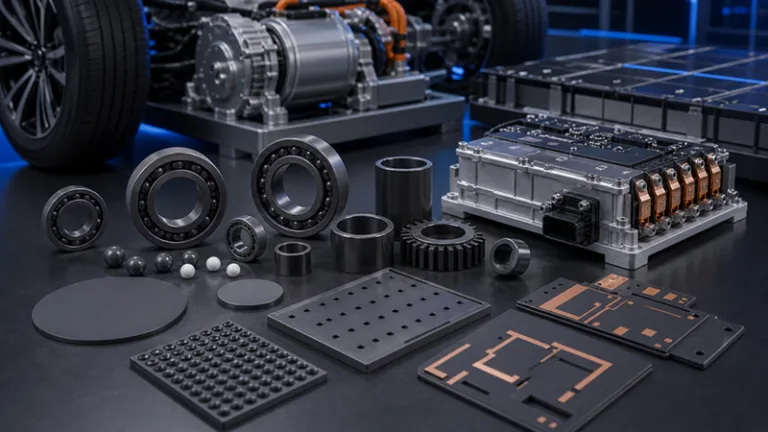
In semiconductor manufacturing, precision components must maintain dimensional stability, resist wear, and withstand demanding operating environments. Among advanced engineering ceramics, silicon nitride offers a valuable combination of strength, fracture toughness, thermal-shock resistance, and relatively low density.
At a Glance
In short, silicon nitride (Si₃N₄) is a high-performance structural ceramic that combines low density, high strength, high elastic modulus, fracture toughness, wear resistance, and thermal-shock resistance.
Consequently, engineers can consider it for semiconductor equipment components that experience repeated thermal cycles, high-speed movement, mechanical loads, or demanding wear conditions.
However, the final material choice still depends on the component geometry, operating temperature, chemical environment, cleanliness requirements, assembly method, and service-life target.
1. What Is Silicon Nitride Ceramic?
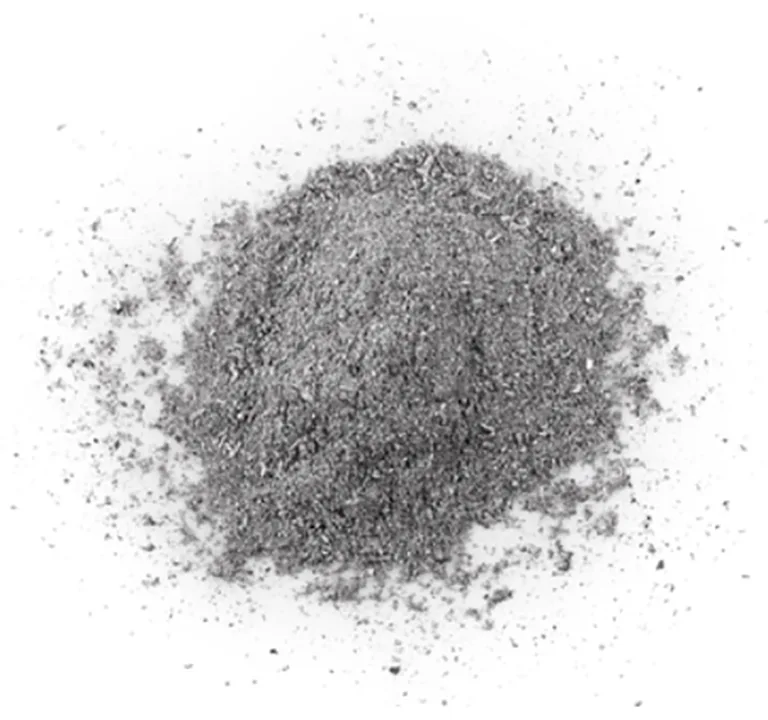
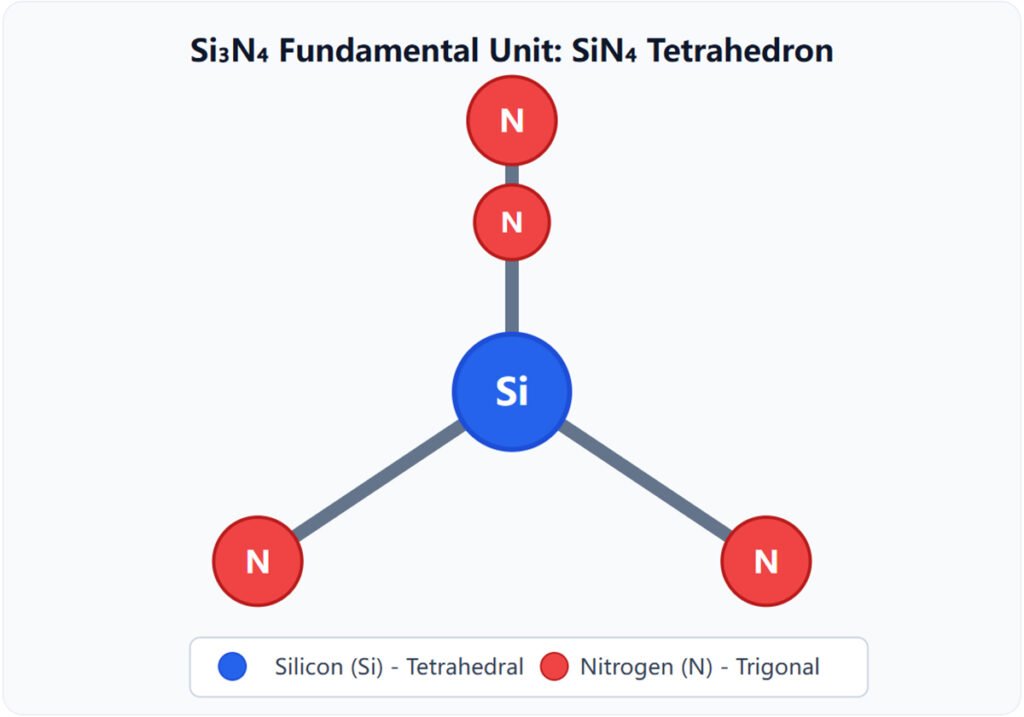
Silicon nitride, chemically represented as Si₃N₄, is a covalent compound formed from silicon and nitrogen. Unlike conventional metallic materials, this ceramic develops a strong covalent bonding structure that contributes to its mechanical strength, thermal stability, and resistance to wear.
Historically, researchers identified silicon nitride in 1857, while large-scale production as a ceramic material developed around 1955. Since then, improvements in powder preparation, forming, sintering, and precision machining have expanded its industrial applications.
Furthermore, silicon nitride has attracted sustained research because it combines properties that engineers do not often find together in a single material. These properties include relatively low density, high strength, high fracture toughness for a structural ceramic, self-lubricating behavior, and good resistance to thermal shock.
For semiconductor equipment, this combination matters because components may need to withstand mechanical loads, temperature fluctuations, friction, and demanding environmental conditions without compromising equipment accuracy.
2. Key Material Properties of Silicon Nitride
Although no single property determines component reliability, silicon nitride offers several complementary characteristics that can help engineers address multiple operating challenges at the same time.
High Strength
In load-bearing applications, silicon nitride can provide high mechanical strength and help components maintain structural integrity under demanding service conditions.
Fracture Toughness
Compared with many conventional structural ceramics, silicon nitride offers relatively high fracture toughness, which helps it tolerate local stress and mechanical impact more effectively.
Thermal-Shock Resistance
During heating, cooling, and repeated temperature changes, silicon nitride can better resist thermal-shock damage than many conventional brittle ceramics.
Relatively Low Density
For moving equipment structures, lower component mass can reduce moving inertia and support faster motion while maintaining the required structural stiffness.
Wear Resistance and Self-Lubricating Behavior
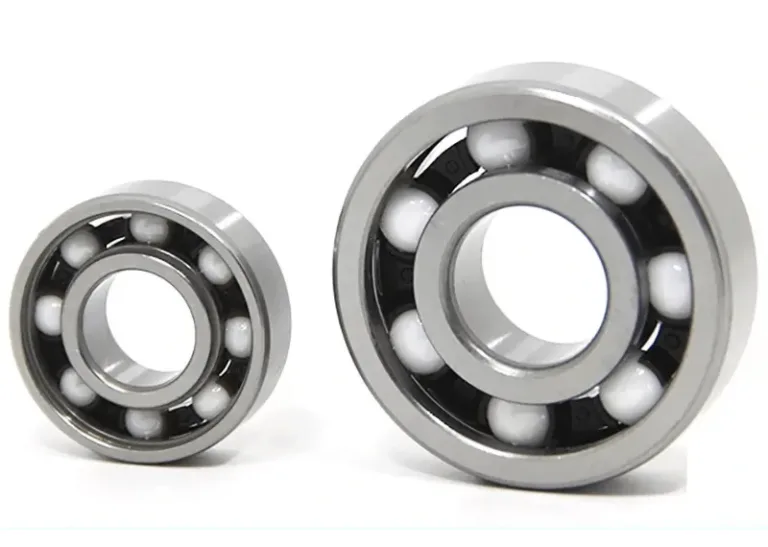
In sliding or rolling applications, suitable silicon nitride grades can provide good wear resistance and friction performance, particularly where conventional lubrication remains limited.
Chemical Resistance
Depending on the grade and process environment, silicon nitride can resist many corrosive media and support use in demanding industrial environments.
High-Temperature Capability
Because silicon nitride retains useful mechanical properties at elevated temperatures, engineers can evaluate it for components exposed to thermal cycling and high-temperature service.
High Elastic Modulus
In precision structures, a high elastic modulus helps limit elastic deformation under load and can contribute to dimensional stability when engineers design the support and mounting structure correctly.
Engineering note: Actual strength, fracture toughness, hardness, thermal properties, and chemical resistance vary with powder quality, additives, sintering route, porosity, microstructure, and product geometry. Therefore, engineers should use the supplier’s grade-specific technical data rather than assume one universal property value for all silicon nitride ceramics.
3. Why Semiconductor Equipment Needs High-Reliability Ceramic Components
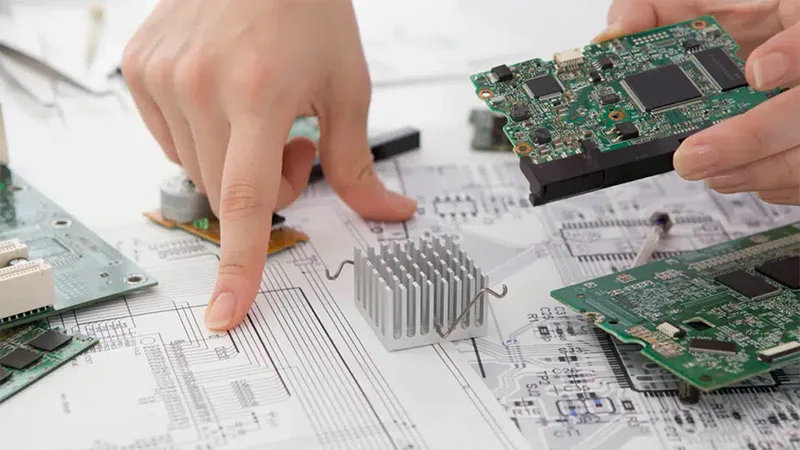
Semiconductor manufacturing equipment operates under tightly controlled conditions, yet its internal components may face several demanding factors at once. For example, some systems involve high or ultra-high vacuum, repeated temperature changes, plasma exposure, corrosive process gases, and continuous precision movement.
Under these conditions, a component must do more than simply support a mechanical load. It must also maintain dimensional accuracy, control particle generation, resist wear, and remain stable throughout repeated operating cycles.
Compared with many metal components, silicon nitride offers lower density and better resistance to many corrosive environments. In addition, it avoids some metal-related concerns, such as magnetic response in susceptible material systems and certain forms of electrochemical corrosion.
Compared with some oxide ceramics, silicon nitride can offer advantages in high-temperature strength, fracture toughness, and thermal-shock resistance. As a result, engineers can consider it for precision structures that experience high loads, rapid movement, or repeated temperature changes.
Nevertheless, silicon nitride does not automatically outperform every other material in every semiconductor application. Instead, engineers should match its properties to the component’s actual operating conditions and cleanliness requirements.
4. Typical Semiconductor Applications of Silicon Nitride Ceramics
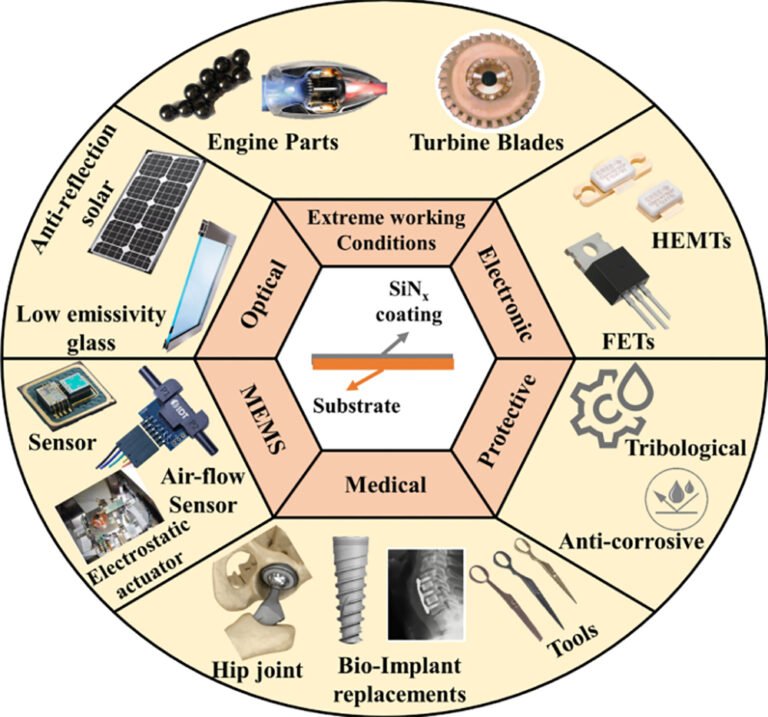
Across semiconductor equipment, silicon nitride can serve as a structural, guiding, sealing, or wear-resistant material. The following examples illustrate where its material characteristics may provide practical value.
4.1 Precision Guide Rails, Guide Blocks, and Crossbeams
For precision motion systems, guide rails, guide blocks, and crossbeams need sufficient stiffness while keeping moving mass under control. Silicon nitride’s relatively low density can help reduce moving inertia, while its high elastic modulus supports structural rigidity.
Furthermore, its thermal-shock resistance can help these components cope with temperature changes during equipment start-up, shutdown, and operation. Engineers should still assess mounting loads, dimensional tolerances, and the thermal expansion behavior of the complete assembly.
4.2 Sealing Rings and Wear-Resistant Components
In sealing and wear interfaces, friction, surface condition, and chemical compatibility strongly influence service life. Silicon nitride’s wear resistance and friction characteristics can make it suitable for selected sealing rings, wear sleeves, and mating components.
Additionally, engineers can evaluate it for applications where oil-based lubrication creates contamination concerns or where the operating environment limits conventional lubrication. However, the mating material, surface roughness, clearance, and process particles must all inform the final design.
4.3 Plungers, Valve Cores, and Reciprocating Parts
For metering systems, valve assemblies, and reciprocating mechanisms, components may experience repeated contact, friction, and exposure to process media. Silicon nitride can provide a useful combination of wear resistance, mechanical strength, and chemical stability for selected designs.
Even so, the designer must check the working clearance, contact pressure, surface finish, and compatibility with the actual process medium before specifying the ceramic grade.
4.4 High-Vacuum Structural Supports
In high-vacuum systems, structural components must maintain their shape while meeting strict material and cleanliness requirements. Silicon nitride’s high-temperature mechanical performance and low density make it a candidate for selected support and load-bearing structures.
Moreover, engineers should verify material purity, densification, surface condition, and outgassing behavior for the actual vacuum specification. Porosity, microcracks, and residual contamination can undermine reliability even when the base material appears suitable.
4.5 Other Precision Equipment Components
Depending on the design and process environment, engineers may also evaluate silicon nitride for guiding elements, wear bushings, precision supports, and selected load-bearing components. Nevertheless, each application requires a separate review of geometry, material grade, surface quality, and assembly conditions.
5. Silicon Nitride vs. Alumina, Zirconia, and Silicon Carbide
Although all four materials belong to the advanced ceramics family, they offer different performance profiles. Therefore, the best choice depends on which properties matter most in the component’s operating environment.
| Material | Main Characteristics | Potential Application Focus |
|---|---|---|
| Silicon Nitride (Si₃N₄) | High strength, relatively high fracture toughness, thermal-shock resistance, wear resistance, self-lubricating behavior, and relatively low density. | High-speed movement, wear-resistant structures, seals, and load-bearing components. |
| Alumina (Al₂O₃) | Good electrical insulation, wear resistance, chemical resistance, and relatively favorable material cost. | Insulators, general structural supports, and conventional wear-resistant parts. |
| Zirconia (ZrO₂) | High mechanical strength, relatively high fracture toughness for a ceramic, and thermal expansion closer to many metals. | Impact-resistant parts, wear components, and selected metal-mating applications. |
| Silicon Carbide (SiC) | High specific stiffness, high thermal conductivity, low thermal expansion, and high-temperature capability. | Lightweight structures, guide systems, crossbeams, and thermally stable components. |
For example, alumina may be the more economical choice when electrical insulation is the main requirement. By contrast, silicon carbide deserves consideration when thermal conductivity and low thermal expansion dominate the design. Meanwhile, zirconia may suit applications that prioritize toughness and thermal expansion compatibility with metal. However, silicon nitride becomes particularly attractive when a component needs a balanced combination of strength, toughness, wear resistance, low density, and thermal-shock resistance.
6. How to Select Silicon Nitride for Semiconductor Components
Before selecting a silicon nitride grade, engineers should define the actual operating conditions rather than rely on a general material description. In practice, the following factors provide a useful starting point.
- Mechanical load and movement: First, identify whether the component experiences bending, compression, impact, cyclic loading, sliding, or rolling contact. Then, evaluate strength, fracture toughness, hardness, friction, and wear requirements according to the loading mode.
- Temperature and thermal cycling: Next, record the maximum operating temperature, heating and cooling rates, temperature differences, and number of thermal cycles. Together, these factors determine the thermal stresses that the component may experience.
- Process media and chemical exposure: In addition, identify any corrosive gases, liquids, plasma exposure, or chemical cleaning processes. Subsequently, confirm that the selected grade and surface condition can tolerate the actual environment.
- Cleanliness and particle control: For high-cleanliness equipment, specify surface roughness, particle-release limits, cleaning methods, and acceptable residue levels. Furthermore, consider how machining damage or surface defects could affect particle generation during service.
- Vacuum requirements: Where vacuum operation applies, verify material purity, porosity, surface condition, cleaning procedures, and outgassing requirements. Therefore, do not assume that every silicon nitride grade automatically meets every vacuum specification.
- Assembly and thermal expansion: Finally, assess the thermal expansion difference between the ceramic and its metal housing, together with fastening force, contact stress, support geometry, and operating temperature. These factors can strongly influence component life after installation.
7. Structural Design: Why Ceramic Parts Need Different Engineering Rules
Unlike ductile metals, silicon nitride behaves as a brittle ceramic and does not accommodate large plastic deformation before fracture. Consequently, a design copied directly from a metal component may introduce unnecessary stress concentrations.
For this reason, engineers should use rounded transitions wherever practical and avoid sharp internal corners, abrupt section changes, and excessively thin walls. Likewise, threaded features and pin holes require careful design because local tensile stress can initiate cracks.
Additionally, designers should distribute loads across suitable support surfaces instead of concentrating force at a small contact area. During assembly, they must also prevent metal housings or fasteners from applying excessive compression as temperatures change.
For production assemblies, it is advisable to verify ceramic-to-metal tolerances, preload, thermal expansion, and contact stress together. Subsequently, prototype testing can confirm dimensions, vibration behavior, wear, and temperature rise before a project enters volume production.
8. Precision Machining Challenges of Silicon Nitride Ceramics
Silicon nitride’s high hardness makes precision machining technically demanding, while its brittle behavior increases the risk of edge chipping, microcracks, and subsurface damage. Therefore, machining quality depends on more than achieving the required external dimensions.
In most precision applications, manufacturers use diamond grinding tools and carefully controlled machining parameters. Meanwhile, stable workholding helps reduce local stress, and a suitable machining allowance gives the process enough room to achieve the final dimensions without unnecessary material removal.
For slender components, thin-wall structures, and parts with holes, grinding forces may create additional challenges. Accordingly, manufacturers should consider part geometry, fixture design, machining sequence, and allowance distribution before production begins.
After machining, dimensional inspection should cover the features that control actual performance. For example, coordinate measuring machines can verify key dimensions, while roundness, cylindricity, and surface-roughness measurements can assess important geometric and surface characteristics.
Most importantly, load-bearing and moving components require attention to surface integrity and internal defects, not just nominal dimensions. As a result, the inspection plan should reflect the component’s function, risk level, and agreed acceptance criteria.
9. From Silicon Nitride Powder to Precision Ceramic Components
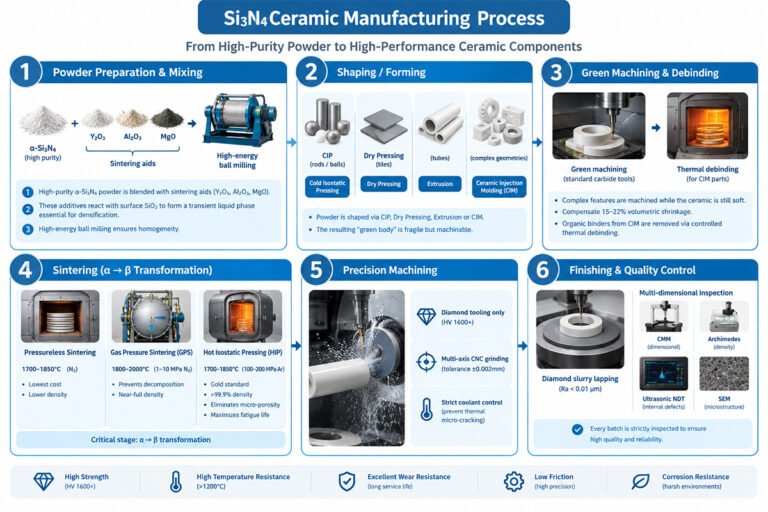
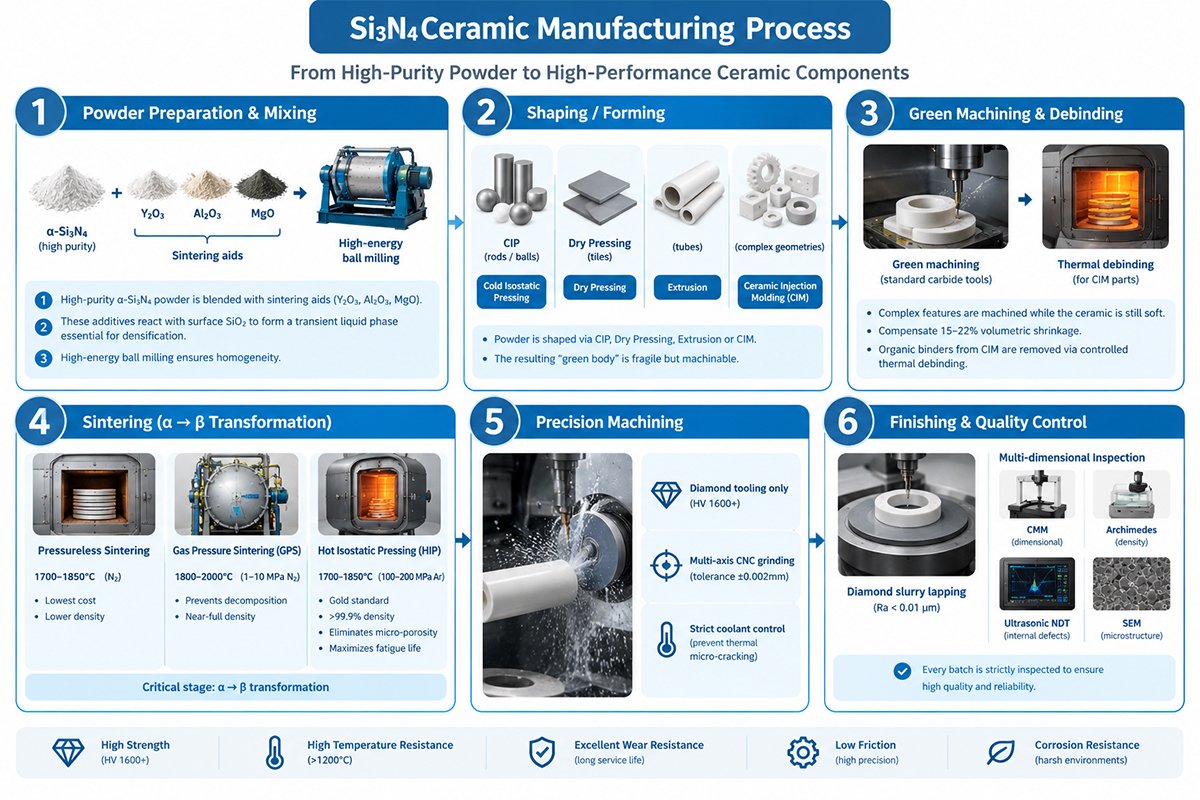
Producing a reliable silicon nitride component requires coordinated control of material preparation, forming, sintering, machining, and inspection. Although the exact process depends on the part geometry and material grade, a typical manufacturing route follows the stages below.
STEP 01
Powder Preparation
First, select silicon nitride powder and suitable sintering additives according to the target material properties.
STEP 02
Mixing and Forming
Next, prepare the powder mixture and form the required blank through a suitable shaping process.
STEP 03
Sintering
Then, use a suitable sintering route to develop the required density and microstructure.
STEP 04
Precision Machining
After sintering, apply appropriate grinding and finishing operations to achieve the required geometry.
STEP 05
Quality Inspection
Finally, inspect critical dimensions, geometric tolerances, surface finish, and other agreed quality characteristics.
Depending on the component design, forming may involve dry pressing, cold isostatic pressing, tape casting, or another suitable technique. Similarly, manufacturers may consider hot pressing, gas-pressure sintering (GPS), hot isostatic pressing (HIP), or spark plasma sintering (SPS) according to the required material properties and production conditions.
Custom Advanced Ceramic Manufacturing
10. Silicon Nitride Ceramic Components from AOFE MIMCustom
For semiconductor equipment manufacturers, choosing a suitable ceramic material is only one part of the engineering process. Equally important are component geometry, forming feasibility, sintering behavior, machining allowances, dimensional tolerances, and assembly conditions.
AOFE MIMCustom provides silicon nitride ceramic component manufacturing for industrial and precision engineering applications. In addition, the company can work with customer drawings and application requirements to evaluate component geometry, material selection, manufacturing considerations, and suitable production routes.
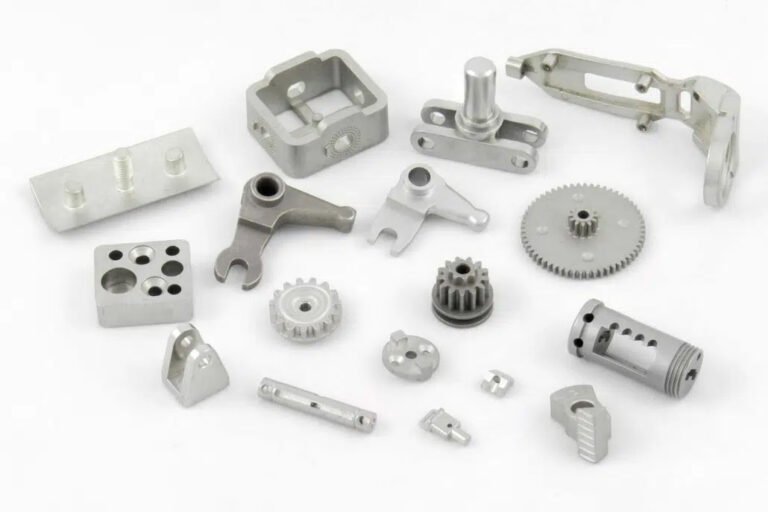
For semiconductor-related projects, potential component designs include ceramic guide rails, crossbeams, guide blocks, sealing rings, plungers, wear-resistant parts, and other custom structural components. However, the suitability of each design depends on the required material grade, operating environment, dimensions, and inspection criteria.
To support a more accurate technical evaluation, customers can provide a 2D drawing, 3D model, operating temperature, mechanical load, process medium, and cleanliness requirements. Subsequently, the project team can review the information and discuss sample validation before any production commitment.
Ultimately, AOFE MIMCustom aims to connect material selection with practical component manufacturing, helping customers evaluate whether silicon nitride offers a suitable solution for their equipment requirements.
11. Frequently Asked Questions About Silicon Nitride Ceramics
Q1. Why do semiconductor equipment manufacturers use silicon nitride ceramics?
Primarily, silicon nitride combines high strength, relatively high fracture toughness, thermal-shock resistance, wear resistance, and relatively low density. Therefore, engineers can evaluate it for precision components exposed to mechanical loads, temperature changes, and repeated movement.
Q2. Is silicon nitride stronger than alumina?
Generally, many silicon nitride grades offer higher fracture toughness and better thermal-shock resistance than conventional alumina grades. However, the actual comparison depends on grade, microstructure, processing route, test method, and component design.
Q3. Can silicon nitride ceramic components operate in high-vacuum environments?
Yes, selected silicon nitride grades may suit high-vacuum applications. Nevertheless, engineers must verify material purity, porosity, surface condition, cleaning procedures, and outgassing performance against the actual vacuum specification.
Q4. Does silicon nitride resist thermal shock?
Compared with many conventional brittle ceramics, silicon nitride generally offers good thermal-shock resistance because of its combination of mechanical strength and thermal properties. Even so, component thickness, geometry, temperature gradient, heating rate, and mounting conditions remain important.
Q5. Which semiconductor components can use silicon nitride?
Depending on the equipment design, potential applications include guide rails, guide blocks, crossbeams, sealing rings, plungers, wear sleeves, and selected structural supports. However, each component requires an application-specific material and design assessment.
Q6. Is silicon nitride suitable for components that require low particle generation?
Potentially, yes, because a properly manufactured and finished silicon nitride component can provide good wear resistance and surface stability. However, particle performance also depends on material purity, surface finish, edge quality, contact conditions, cleaning, and the operating environment.
Q7. What makes silicon nitride ceramic machining difficult?
Because silicon nitride combines high hardness with brittle fracture behavior, machining can cause edge chipping, microcracks, and subsurface damage. Therefore, precision manufacturers need suitable diamond grinding tools, stable workholding, controlled parameters, and appropriate inspection methods.
Q8. Can AOFE MIMCustom manufacture custom silicon nitride ceramic parts?
Yes, AOFE MIMCustom provides silicon nitride ceramic component manufacturing. In addition, customers can submit drawings and application details so the team can review material suitability, component geometry, manufacturing considerations, and project requirements.
Q9. What information should I provide when requesting a silicon nitride component quotation?
To begin, provide a 2D drawing or 3D model, target quantity, critical dimensions, tolerances, operating temperature, mechanical load, process medium, and cleanliness requirements. Furthermore, photographs of the installation environment or details of the mating components can help clarify the application.
12. Conclusion: A Strong Candidate for Demanding Semiconductor Applications
Ultimately, silicon nitride ceramics stand out because they balance strength, fracture toughness, wear resistance, low density, and thermal-shock performance. This combination makes them worth evaluating for semiconductor equipment components that face high loads, repeated temperature changes, precision movement, or demanding wear conditions.
Nevertheless, reliable performance depends on more than the material name. Engineers must coordinate material grade, component geometry, forming and sintering, precision machining, surface quality, inspection, and assembly. With these factors properly evaluated, AOFE MIMCustom can support customers seeking custom silicon nitride ceramic components for demanding industrial applications.
Key Topics Covered
Silicon nitride ceramics; Si₃N₄ material properties; semiconductor equipment ceramics; high-reliability ceramic components; thermal-shock resistance; fracture toughness; precision ceramic guide rails; ceramic sealing rings; wear-resistant ceramic parts; silicon nitride machining; custom silicon nitride manufacturing; AOFE MIMCustom.