Technical Guide | Advanced Ceramic Bearings
Why Ceramic Bearings Are the Best Choice for Air-Driven Dental Handpieces?
In modern dentistry, air-driven dental handpieces rely on precision miniature bearings to support the turbine rotor and dental bur at extremely high rotational speeds. At speeds approaching 400,000 rpm in some models, even small changes in rolling-element mass, bearing geometry, lubrication, or assembly accuracy can influence vibration, noise, temperature, and operating stability.
Consequently, manufacturers increasingly consider hybrid ceramic bearings with silicon nitride (Si₃N₄) balls when designing high-speed dental handpieces. However, ceramic material alone does not guarantee superior performance, because the complete bearing system must match the handpiece’s speed, load, lubrication, sterilization, and service requirements.
Quick Answer: Why Choose Ceramic Bearings?
For many high-speed air-driven dental handpieces, silicon nitride ceramic balls offer a useful combination of low density, high hardness, wear resistance, and favorable high-speed rolling behavior. In particular, their lower mass compared with steel balls can reduce centrifugal forces acting on the bearing system at high rotational speeds.
- Lower rolling-element mass: Consequently, silicon nitride balls can reduce centrifugal loading in appropriately designed hybrid bearings.
- High hardness and wear resistance: Additionally, suitable ceramic grades resist surface damage under compatible operating conditions.
- Potentially lower frictional losses: Therefore, a properly engineered bearing may reduce friction-related heating and improve rotational stability.
- Electrical insulation: Furthermore, silicon nitride generally provides high electrical resistivity, although this feature is not the primary selection factor for most air-driven handpieces.
- Precision engineering: Ultimately, the best results depend on ceramic-ball quality, raceway finish, cage design, preload, lubrication, and accurate assembly.
1. What Materials Are Used in Ceramic Bearings?
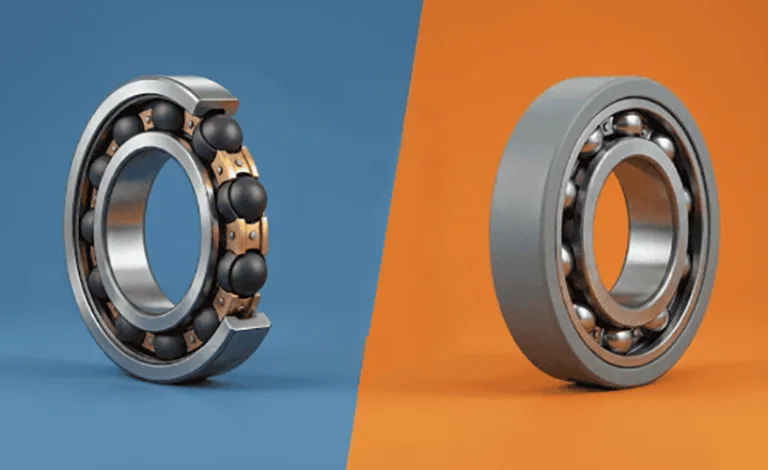
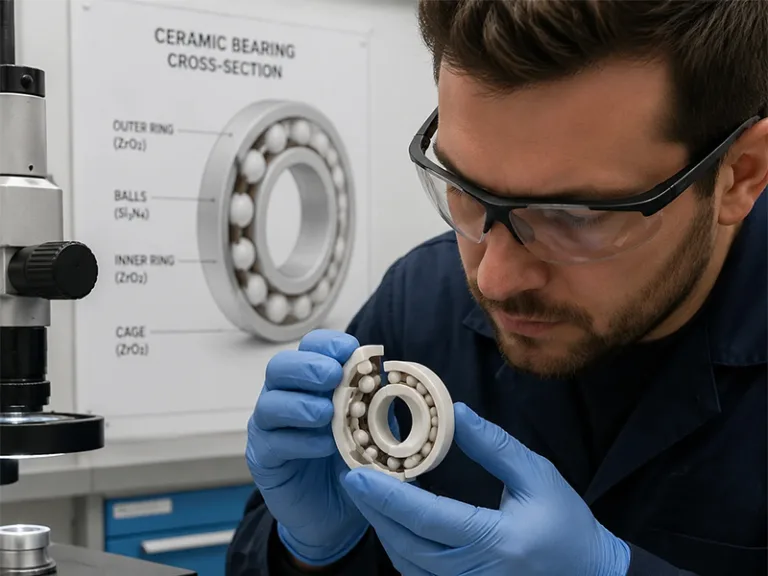
First, it is important to distinguish the bearing’s rolling elements from its rings and cage. In a hybrid ceramic bearing, manufacturers typically combine silicon nitride balls with precision steel inner and outer rings, while a suitable cage maintains ball spacing during rotation.
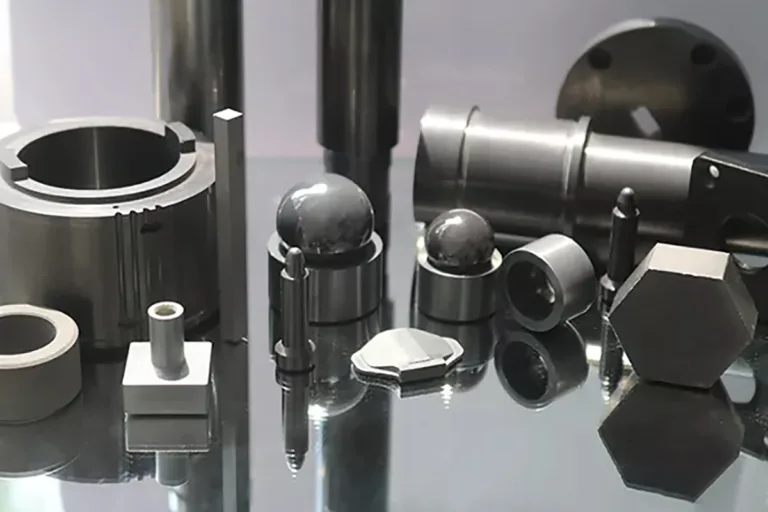
By contrast, a full ceramic bearing uses ceramic materials for both the balls and rings, although its cage, seals, and other components may still contain nonceramic materials. Depending on the application, manufacturers may consider silicon nitride, zirconia, alumina, or silicon carbide, but these materials do not offer interchangeable properties.
1.1 Comparison of Common Ceramic Bearing Materials
For engineering selection, the following table summarizes representative material properties. Because ceramic composition, manufacturing route, porosity, test method, and material grade affect the results, treat these figures as approximate reference ranges rather than guaranteed specifications for a finished bearing.
| Material | Typical Density | Hardness (Approx.) | Key Characteristics | Potential Bearing Applications |
|---|---|---|---|---|
| Silicon Nitride (Si₃N₄) | 3.2-3.3 g/cm³ | Approximately 1,400-1,800 HV | Low density, high hardness, good wear resistance, relatively low thermal expansion, and good thermal shock resistance. | Premium rolling elements for high-speed hybrid bearings, including suitable dental handpiece designs. |
| Zirconia (ZrO₂) | Approximately 5.6-6.1 g/cm³ | Approximately 1,100-1,400 HV | Good toughness for a ceramic, corrosion resistance, electrical insulation, and relatively low thermal conductivity. | Selected specialty bearings and corrosion-resistant components where the design suits its greater density. |
| Alumina (Al₂O₃) | Approximately 3.7-3.95 g/cm³ | Approximately 1,400-1,800 HV | Excellent electrical insulation, chemical stability, high hardness, and comparatively limited fracture toughness. | Specialty bearing components and applications that prioritize insulation or chemical resistance over impact tolerance. |
| Silicon Carbide (SiC) | Approximately 3.1-3.2 g/cm³ | Approximately 2,200-2,800 HV | Very high hardness, excellent wear resistance, high thermal conductivity, and strong chemical resistance in suitable environments. | Specialty bearings, chemical equipment, and demanding wear applications where its material characteristics justify its use. |
Note: Hardness values depend on the grade and test method; manufacturers may report different values using different scales. Moreover, bearing performance depends on finished-component quality and operating conditions, not hardness alone.
1.2 Why Silicon Nitride Is Particularly Suitable for High-Speed Dental Bearings
Among these materials, silicon nitride is a leading choice for high-performance ceramic rolling elements because it combines low density with high hardness and good resistance to wear. Consequently, a silicon nitride ball can generate less centrifugal force than a comparable steel ball at the same rotational speed and ball diameter.
For a simplified rotating-ball model, centrifugal force is proportional to ball mass and the square of angular velocity. Therefore, reducing ball mass becomes increasingly valuable as rotational speed rises, although the actual contact forces also depend on bearing geometry, preload, ball motion, and operating loads.
Engineering Principle: Centrifugal Force
F = m × r × ω²
Here, F represents centrifugal force, m represents the rotating ball’s mass, r represents its effective radius of rotation, and ω represents angular velocity.
Accordingly, at a fixed speed and effective radius, a lighter ball produces a lower centrifugal force. However, this equation alone cannot predict bearing temperature, friction torque, service life, or the maximum safe speed of a complete dental handpiece.
1.3 Hybrid Ceramic Bearings vs. Full Ceramic Bearings
For many high-speed dental handpieces, hybrid bearings provide a practical balance between ceramic rolling-element performance and the established manufacturing precision of steel raceways.
| Comparison Factor | Hybrid Ceramic Bearing | Full Ceramic Bearing |
|---|---|---|
| Rolling elements | Typically silicon nitride ceramic balls. | Ceramic balls, selected according to the design. |
| Inner and outer rings | Typically precision bearing steel. | Ceramic materials such as silicon nitride or zirconia. |
| High-speed potential | Often attractive because of the low-mass balls and established steel-ring designs. | Depends on material, geometry, cage, lubrication, and mounting design. |
| Corrosion resistance | Ceramic balls resist corrosion, but steel rings may remain vulnerable. | Can offer greater corrosion resistance when every exposed component uses a compatible material. |
| Typical selection consideration | High-speed precision, suitable cost, and proven bearing architecture. | Special environments where all-ceramic construction offers a clear advantage. |
Ultimately, the most appropriate configuration depends on the actual dental handpiece design. For example, a hybrid bearing may suit a high-speed air turbine, whereas a full ceramic bearing may be appropriate for a different application with stricter corrosion or electrical requirements.
2. Ceramic Bearing Manufacturing Process
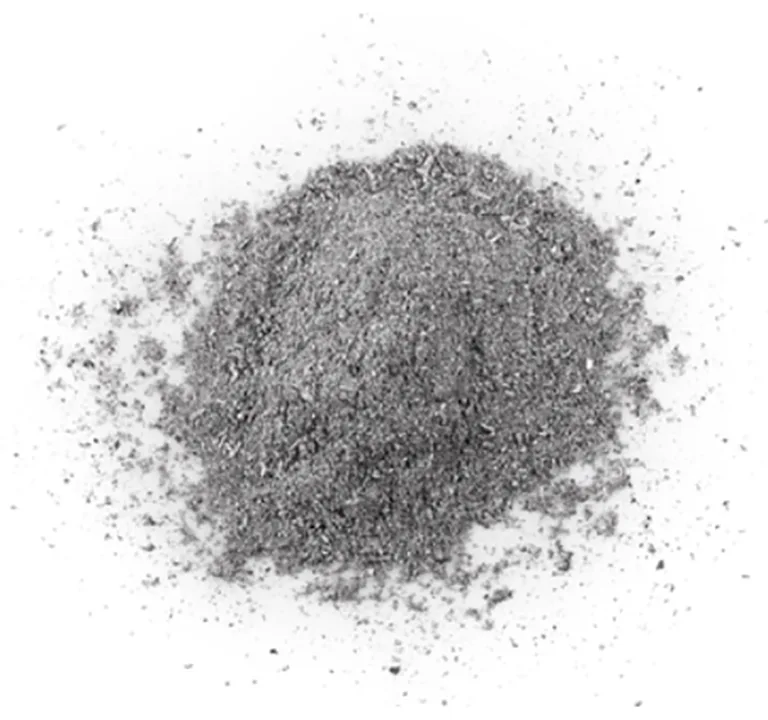
First, precision ceramic balls require more than selecting a suitable powder. Manufacturers must control material preparation, forming, sintering, grinding, lapping, dimensional inspection, and final cleaning to achieve consistent geometry and surface integrity.
Meanwhile, bearing rings follow a separate manufacturing route, particularly in hybrid designs that use steel raceways. Therefore, the following diagram illustrates the typical ceramic rolling-element route and its integration into final bearing assembly rather than suggesting that ceramic balls and steel rings share an identical production process.
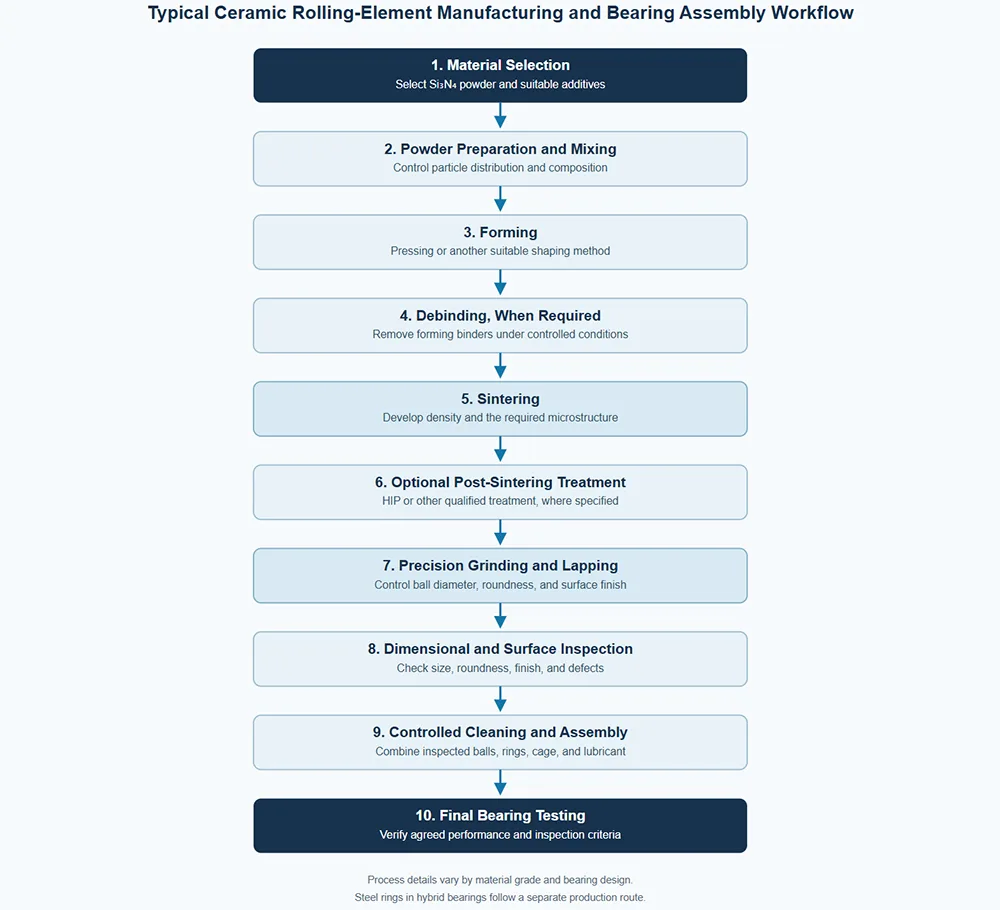
2.1 Critical Manufacturing Controls for High-Speed Dental Bearings
Material consistency: First, manufacturers need suitable ceramic powder and a controlled composition because impurities, agglomeration, or inconsistent processing can affect the final microstructure and reliability.
Sintering control: Additionally, the sintering process must produce the required density and microstructure while limiting defects that could compromise the rolling element under repeated contact loading.
Grinding and lapping: Subsequently, precision finishing controls ball diameter, roundness, and surface quality, which influence rolling contact, vibration, and noise in a high-speed miniature bearing.
Contamination prevention: Furthermore, clean handling helps prevent abrasive particles and foreign matter from entering the bearing during assembly, because even small contaminants can damage raceways or rolling surfaces.
Final inspection: Finally, manufacturers should verify the agreed dimensional, surface, and performance criteria instead of relying solely on a material certificate or a visual inspection.
3. How Ceramic Bearings Improve Air-Driven Dental Handpiece Performance
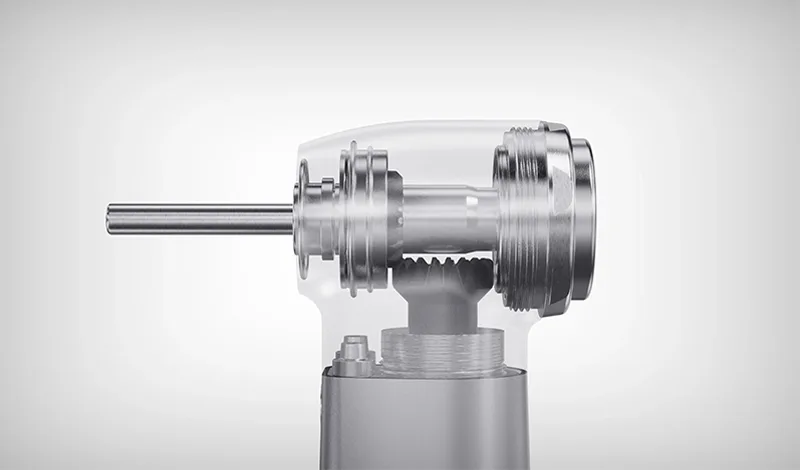
An air-driven dental handpiece converts compressed air into rotor motion, while miniature bearings support the rotor and help maintain the alignment of the dental bur. At very high speeds, therefore, the bearing must balance low friction, precise rotation, adequate load capacity, and resistance to wear.
In this application, a hybrid bearing with silicon nitride balls can provide several engineering advantages when the bearing geometry, cage, raceways, and lubrication system work together.
3.1 Lower Ball Mass and Centrifugal Loading
Because silicon nitride has a much lower density than bearing steel, a ceramic ball of comparable volume weighs considerably less. Consequently, its lower mass can reduce centrifugal loading at high rotational speeds, potentially improving the operating conditions at the ball–raceway contacts.
3.2 Potentially Lower Frictional Heating
With suitable geometry, surface finish, preload, and lubrication, ceramic balls can support efficient high-speed operation. As a result, a well-designed hybrid bearing may reduce friction-related heating, although actual temperature depends on the complete bearing and handpiece system.
3.3 High Hardness and Wear Resistance
Additionally, silicon nitride offers high hardness and good wear resistance, which can help maintain rolling-element surface integrity when the material grade and contact conditions are appropriate. Nevertheless, ceramic balls remain vulnerable to impact damage and surface defects.
3.4 Vibration and Noise Control
Moreover, precise ball geometry, consistent dimensions, clean raceways, and correct preload help control vibration and operating noise. However, ceramic material alone cannot guarantee a quieter handpiece because rotor balance, cage behavior, air supply, and bearing condition also matter.
3.5 Reduced Corrosion Risk for Ceramic Balls
Unlike many steels, silicon nitride resists corrosion in a wide range of environments. Therefore, the ceramic rolling elements can retain their surface integrity where moisture or compatible cleaning conditions challenge metal surfaces, although steel rings and other components still require appropriate protection.
3.6 Consistent Precision at High Speed
Finally, a correctly specified miniature bearing helps maintain rotor alignment and predictable motion. Consequently, manufacturers should evaluate bearing grade, internal clearance or preload, cage design, fit, and lubrication together rather than selecting a bearing solely by its maximum advertised speed.
3.7 Radial-Contact vs. Angular-Contact Bearings
For dental handpiece designers, bearing contact geometry is another important selection factor. In general, radial-contact bearings primarily support radial loads, while angular-contact designs can support combined radial and axial loads according to their contact angle and mounting arrangement.
However, an angular-contact bearing does not automatically carry a greater load in every direction or configuration. Therefore, engineers should evaluate the direction of cutting forces, axial thrust, rotor arrangement, preload, and available installation space before choosing a bearing type.
| Design Factor | Radial-Contact Bearing | Angular-Contact Bearing |
|---|---|---|
| Primary loading | Primarily radial loading. | Combined radial and axial loading, subject to design. |
| Axial-load behavior | Axial capacity depends on bearing geometry and arrangement. | Often supports axial load more deliberately in the intended direction. |
| Mounting considerations | Check clearance, fits, and any axial loading requirements. | Check contact angle, orientation, preload, and paired-bearing requirements. |
| Dental handpiece selection | Suitable when the load and rotor arrangement match the design. | Suitable when the design requires controlled combined-load support. |
3.8 Lubrication, Sterilization, and Service Life
Although ceramic balls can reduce certain friction-related stresses, most high-speed miniature bearings still require a lubrication strategy appropriate to their design. Therefore, manufacturers should not assume that a ceramic bearing can run indefinitely without lubricant.
Additionally, dental handpieces may experience repeated cleaning and sterilization cycles, depending on the equipment and manufacturer instructions. As a result, bearing selection must account for temperature exposure, moisture, cleaning agents, lubricant stability, cage material, seals, and the condition of the complete assembly.
Ultimately, ceramic bearings may provide longer service life than comparable steel-ball designs in suitable applications, but no universal twofold or threefold lifetime improvement should be assumed without controlled test data. Instead, compare service life under equivalent speeds, loads, lubrication, contamination levels, sterilization cycles, and maintenance practices.
4. Key Applications of Ceramic Bearings in Dental Equipment
Beyond high-speed dental handpieces, ceramic rolling elements can support other precision applications where low rolling-element mass, wear resistance, or electrical insulation matters. Nevertheless, each application requires its own engineering assessment rather than a direct transfer of dental-bearing specifications.
| Application | Typical Components | Relevant Engineering Requirements |
|---|---|---|
| Air-Driven Dental Handpieces | Miniature turbine bearings and rotor support assemblies. | High rotational speed, low vibration, controlled temperature, and repeatable precision. |
| Electric Dental Handpieces | Selected motor and spindle bearing assemblies. | Speed, motor loads, electrical environment, lubrication, and sterilization requirements. |
| Dental Laboratory Equipment | Precision spindles, grinding equipment, and selected rotary tools. | Rotational accuracy, wear resistance, vibration control, and contamination management. |
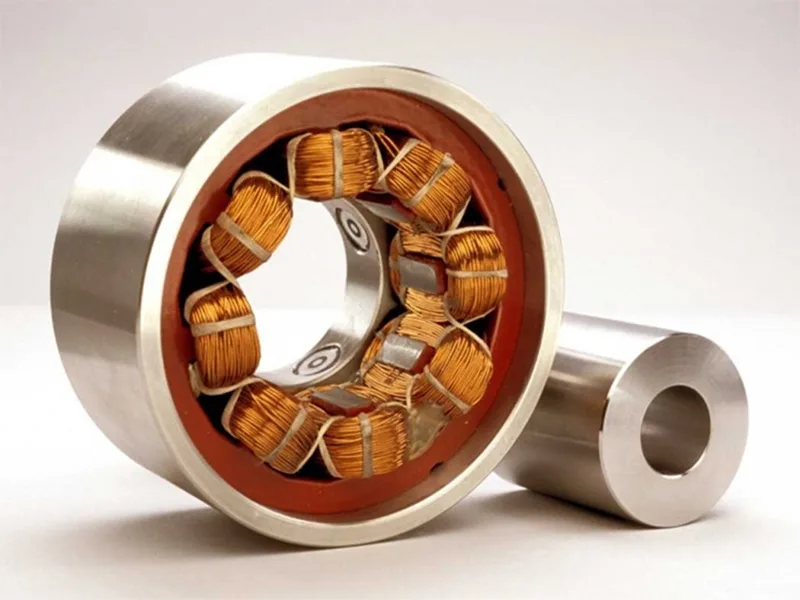
| Precision Electric Motors | Hybrid ceramic rolling-element bearings. | Speed capability, electrical-current paths, lubrication, and rotor dynamics. |
| Medical and Laboratory Instruments | Selected precision rotary assemblies and miniature mechanisms. | Dimensional accuracy, compatible materials, cleanliness, and application-specific validation. |
For medical and dental equipment, material suitability is only one part of the design process. In particular, manufacturers must separately validate cleaning, sterilization, biocompatibility where applicable, device safety, and compliance with relevant product requirements.
5. Why Bearing Quality Matters: Common Failure Risks
Even a high-performance ceramic bearing can fail prematurely when manufacturing defects, contamination, incorrect installation, or unsuitable operating conditions damage its contact surfaces. Consequently, a reliable procurement process should evaluate both material quality and the complete bearing’s manufacturing and inspection controls.
5.1 Contamination and Foreign Particles
First, dust, abrasive particles, and metallic debris can create surface damage, increased vibration, or premature wear. Therefore, controlled cleaning, sealed packaging, careful handling, and appropriate sealing arrangements help reduce contamination risk.
5.2 Incorrect Assembly and Excessive Preload
Additionally, excessive preload, misalignment, poor fits, or installation forces applied through the rolling elements can damage a miniature bearing. For this reason, assembly procedures should follow the bearing and handpiece manufacturer’s specifications, and installers should never use uncontrolled hammering to seat a precision bearing.
5.3 Lubrication Failure and Excessive Temperature
Meanwhile, insufficient lubrication, lubricant degradation, or an incompatible lubricant can increase friction and wear. Accordingly, engineers should verify lubricant compatibility with the operating speed, bearing materials, cage, seals, and intended sterilization process.
5.4 Impact Damage and Ceramic Fracture
Finally, ceramic balls offer high hardness but do not behave like ductile steel under severe impact. Consequently, drops, accidental impacts, improper installation, or sudden overloads can initiate chips or cracks, so ceramic bearings require careful handling and appropriate load limits.
6. AOFE MIMCustom: Custom Ceramic Component Support
For equipment manufacturers and industrial buyers, selecting a ceramic bearing component involves more than comparing material names. Therefore, AOFE MIMCustom can position its custom-component support around technical requirement review, drawing assessment, material-selection discussions, and coordination of suitable manufacturing and inspection requirements, subject to its confirmed production capabilities.
6.1 Drawing and Requirement Review
First, customers can provide drawings, target dimensions, application details, and operating conditions so the team can review the technical requirements and identify questions that need clarification.
6.2 Material Selection Discussion
Additionally, a material discussion can compare silicon nitride, zirconia, alumina, or silicon carbide according to the required properties, component geometry, environment, and manufacturing feasibility.
6.3 Prototype and Sample Coordination
Where the required process and capacity are available, prototype or sample coordination can help customers evaluate dimensional fit, assembly compatibility, and application performance before considering larger production quantities.
6.4 Inspection Requirement Alignment
Furthermore, customers can clarify dimensional tolerances, surface-finish requirements, inspection records, material documentation, and traceability expectations during the quotation stage, subject to the supplier’s available inspection systems.
6.5 What Should Buyers Confirm Before Ordering?
Before placing an order, dental-equipment manufacturers should confirm whether AOFE MIMCustom can supply the exact component or manufacturing service required. In particular, a quotation request should identify the following technical details:
- Required component type, drawing, dimensions, and tolerances.
- Specified ceramic material and material-grade requirements.
- Ball diameter, roundness, surface finish, or bearing precision grade, where applicable.
- Operating speed, radial and axial loads, temperature range, and lubrication requirements.
- Cleaning, sterilization, chemical exposure, and packaging requirements.
- Required material certificates, inspection records, and lot traceability.
- Prototype quantity, expected production volume, and delivery requirements.
Ultimately, a technically complete request helps the supplier assess manufacturing feasibility and helps the buyer compare quotations on equivalent specifications rather than price alone.
Need a Custom Ceramic Component?
Share your drawing, material requirements, and operating conditions to begin a technical review of your application.
7. Frequently Asked Questions About Ceramic Bearings for Dental Handpieces
Q1. Why are silicon nitride ceramic balls used in high-speed dental handpieces?
Primarily, silicon nitride combines low density, high hardness, good wear resistance, and relatively low thermal expansion. Consequently, suitable hybrid bearings can reduce centrifugal loading on their rolling elements and support high-speed operation when the complete bearing design is appropriate.
Q2. What is the difference between a hybrid ceramic bearing and a full ceramic bearing?
In a typical hybrid bearing, ceramic balls run between steel inner and outer rings. By contrast, a full ceramic bearing uses ceramic materials for both the balls and rings, although the cage, seals, or other parts may use different materials. Therefore, buyers should choose the configuration according to speed, loading, corrosion exposure, and equipment design.
Q3. Can ceramic bearings operate at 400,000 rpm?
Potentially, a properly engineered miniature bearing may support speeds approaching 400,000 rpm in a suitable dental handpiece design. However, the ceramic material alone does not establish the allowable speed, because ball size, cage design, preload, lubrication, fits, rotor balance, and the manufacturer’s validated operating limits all influence performance.
Q4. Do ceramic bearings always run cooler than steel bearings?
Not necessarily, because operating temperature depends on friction, lubrication, contact geometry, load, cooling, and assembly conditions. Nevertheless, silicon nitride balls can reduce certain high-speed loading effects, and a suitable hybrid bearing may reduce frictional heating when engineers optimize the complete system.
Q5. Do ceramic bearings require lubrication?
Generally, high-speed dental handpiece bearings require a lubrication strategy specified for their design, even when they use ceramic balls. Therefore, users should follow the handpiece manufacturer’s lubrication and maintenance instructions instead of assuming that ceramic rolling elements eliminate the need for lubricant.
Q6. Do ceramic bearings last longer than steel bearings?
In suitable conditions, ceramic-ball bearings may achieve longer service life than comparable steel-ball designs. However, no fixed lifetime improvement applies to every application, because contamination, lubrication, installation, impact, bearing quality, and sterilization conditions can dominate the result.
Q7. Are ceramic bearings resistant to sterilization and repeated autoclave cycles?
Although silicon nitride itself can tolerate temperatures that exceed those encountered in many ordinary operating environments, the complete bearing may have lower limits. Accordingly, buyers must verify the cage, lubricant, seals, clearances, steel components, and the handpiece manufacturer’s approved sterilization procedure before selecting a bearing.
Q8. Can ceramic bearings withstand impact loads?
Despite their high hardness, ceramic materials generally tolerate severe impact less effectively than ductile bearing steel. Consequently, applications involving sudden shocks, mishandling, or substantial overloads require careful engineering evaluation, and steel bearings may remain the more appropriate choice in some cases.
Q9. How can contamination-related bearing failure be reduced?
First, use clean handling and controlled assembly procedures to prevent dust, abrasive particles, and debris from entering the bearing. Additionally, maintain appropriate seals, follow the specified lubrication procedure, and investigate unusual vibration or noise before continued operation causes further damage.
Q10. What information should I provide when requesting a custom ceramic bearing?
To begin, provide the bearing type, dimensions, drawing, material specification, required precision, operating speed, load, temperature, and lubrication conditions. Furthermore, identify sterilization cycles, environmental exposure, required documentation, target quantity, and any existing performance criteria so the supplier can assess the application more accurately.
Conclusion: Selecting the Right Ceramic Bearing for High-Speed Dental Handpieces
Overall, silicon nitride hybrid ceramic bearings offer an attractive solution for many high-speed air-driven dental handpieces because their low-mass balls, high hardness, and wear resistance can support efficient precision rotation. Additionally, their performance potential makes them worth evaluating when engineers seek to manage centrifugal loading, vibration, friction-related heating, and bearing wear.
Nevertheless, the best bearing is not simply the one made from the hardest ceramic material. Instead, manufacturers should evaluate the ball and raceway geometry, precision grade, cage, preload, lubrication, assembly method, and sterilization requirements as a complete system.
Ultimately, careful material selection, precision manufacturing, contamination control, and application-specific validation provide the foundation for reliable dental handpiece bearing performance. For custom ceramic component projects, AOFE MIMCustom can be approached to discuss drawing requirements, material options, and the manufacturing or inspection capabilities available for the intended application.