Materials Engineering / Technical Blog
Why Is Silicon Nitride Hailed as “the Structural Ceramic with the Best Comprehensive Performance”?
Overall, silicon nitride (Si3N4) stands out because it brings high strength, useful fracture toughness, wear resistance, thermal-shock resistance, oxidation resistance, and low density into one engineering material. Rather than excelling in every single property, it offers a particularly balanced combination for demanding mechanical and thermal service.
What Makes Silicon Nitride a High-Performance Structural Ceramic?
Functionally, structural ceramics serve as load-bearing or wear-facing components where metals may lose stiffness, corrode, deform, or wear too quickly. Therefore, designers consider silicon nitride when a component must manage mechanical loading alongside temperature changes, friction, or aggressive operating media.
More specifically, silicon nitride is a covalently bonded, non-oxide ceramic whose properties depend on both its crystal chemistry and its processed microstructure. Alongside these benefits, its relatively low density can reduce rotating mass, while its combination of strength and fracture resistance helps it handle demanding contact and thermal conditions.
Importantly, the phrase “the structural ceramic with the best comprehensive performance” describes a useful engineering reputation rather than a universal scientific ranking. Indeed, the best material still depends on the application, target property, production route, component geometry, and total cost.
1. Silicon Nitride Crystal Structure: The Foundation of Its Performance
At the atomic scale, silicon nitride has the chemical formula Si3N4 and commonly forms the α and β crystal phases under ordinary pressure conditions. Within each basic structural unit, one silicon atom sits near the center of a tetrahedron and bonds with four nitrogen atoms around it, forming a SiN4 tetrahedron.
Across the crystal, neighboring tetrahedra connect through shared nitrogen corners and build a three-dimensional framework of strong silicon–nitrogen bonds. Consequently, the lattice resists deformation and helps explain the material’s high hardness, stiffness, strength, and ability to retain useful mechanical performance at elevated temperatures.
Although α-Si3N4 and β-Si3N4 both contain linked SiN4 tetrahedra, they differ in how their structural layers stack. During sintering, α-to-β transformation can encourage elongated β-Si3N4 grains to develop; when engineers control grain shape, grain-boundary phases, porosity, and additives, these features can deflect cracks and improve fracture resistance.
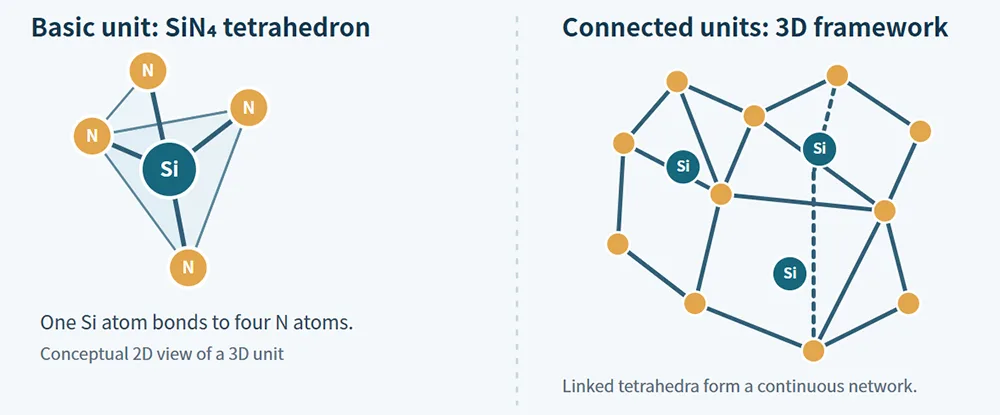 Figure 1. Conceptual schematic of the SiN4 tetrahedral building block and linked network in silicon nitride. The illustration explains connectivity; it does not represent exact atomic coordinates or crystallographic scale.
See also Saint-Gobain’s overview of silicon nitride microstructure for further details about phase development, sintering additives, and the relationship between grain shape and fracture toughness.
2. How Silicon Nitride Balances Strength, Toughness, Heat, and Wear
Mechanically, silicon nitride combines high hardness and elastic stiffness with better fracture resistance than many conventional monolithic ceramics. Furthermore, its elongated β-grain microstructure can help deflect cracks, bridge crack faces, and dissipate energy as cracks grow, although the actual result depends on composition and processing.
High Strength and Stiffness
Because strong Si-N bonds build a rigid framework, a suitable grade can support high contact loads and maintain dimensional stability.
Improved Fracture Resistance
Through microstructure control, elongated grains and carefully managed grain boundaries can slow crack growth instead of allowing a crack to travel along one simple path.
Thermal-Shock Resistance
With relatively low thermal expansion and useful thermal conductivity, silicon nitride can tolerate rapid temperature changes better than many brittle ceramics of comparable use.
Wear and Contact Performance
Under suitable lubrication and contact design, high hardness, low density, and good wear resistance make the material attractive for rolling elements, seal faces, and cutting inserts.
Oxidation and Chemical Stability
Chemically, silicon nitride resists oxidation and corrosion in many hot or chemically challenging environments, silicon nitride resists oxidation and corrosion well; nevertheless, compatibility must be checked against the actual chemical, temperature, and exposure time.
Low Density
Correspondingly, silicon nitride weighs approximately 3.2 g/cm³ for many dense grades, silicon nitride weighs much less than steel, which can reduce centrifugal loading in high-speed rotating systems.
Representative Grade Data – Not Universal Design Values
By way of example, Saint-Gobain reports a representative silicon nitride material with flexural strength around 850 MPa, fracture toughness around 7 MPa·m1/2, and density around 3.17 g/cm³. Separately, Heraeus lists specific silicon nitride power-electronics substrates with thermal conductivity of at least 80 W/(m·K) and grade-dependent flexural-strength specifications of at least 650 or 700 MPa.
3. Where Do Engineers Use Silicon Nitride Ceramics?
Operationally, engineers select silicon nitride when a component needs several benefits at once rather than one record-setting property alone. Below, practical application examples illustrate how designers match the material’s mechanical, thermal, tribological, and electrical characteristics to service conditions.
3.1 Ceramic and Hybrid Bearings
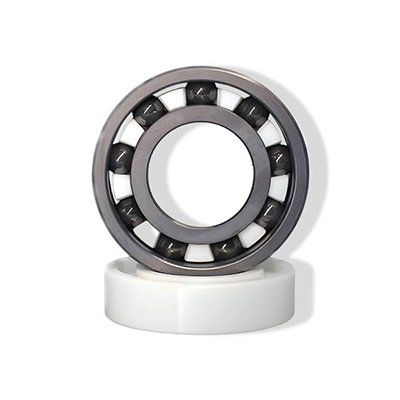
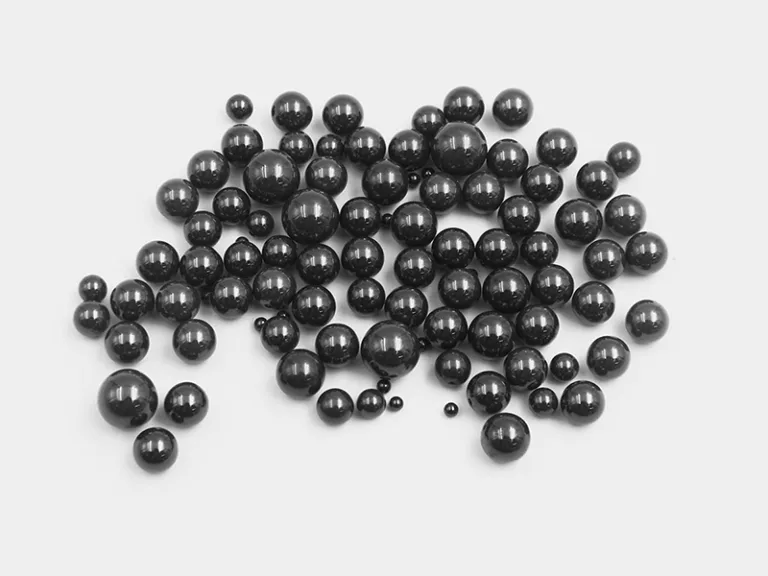
Bearing designers use silicon nitride balls in high-speed machine-tool spindles, precision equipment, selected automotive systems, and demanding industrial machinery, silicon nitride balls can reduce rolling-element mass and withstand high contact stress. Compared with an all-steel design, a hybrid bearing usually combines Si3N4 rolling elements with steel rings, while a full-ceramic bearing uses ceramic rings and rolling elements.
Typical fit: high-speed bearings, precision spindle bearings, selected aerospace bearings, and electrically insulating rolling elements where the bearing system has been designed and validated for the duty cycle.
3.2 Aerospace, Space Systems, and Gas Turbomachinery
Aerospace designers may consider silicon nitride because its low density, high-temperature capability, and thermal-shock resistance suit selected hot-section or high-speed components. Depending on the design and qualified material grade, engineers may evaluate it for turbine-related parts, turbocharger rotors, air bearings, seals, and specialized propulsion hardware.
Potential fit: components where mass reduction and thermal-mechanical performance matter, subject to validation of operating temperature, oxidation, creep, impact risk, joining methods, and certification requirements.
3.3 Automotive Engine and Turbocharger Components
Automotive engineers have used or evaluated silicon nitride for turbocharger rotors and selected high-temperature engine components. Its low density helps reduce rotational inertia, while its heat resistance and wear performance can support rapid operating cycles in a properly engineered assembly.
Representative engine parts: turbocharger rotors, glow-plug and combustion-related components, and wear-resistant engine parts where thermal cycling, reliability, manufacturability, and cost justify ceramic construction.
3.4 Power-Electronics Substrates and Heat Management
Notably, silicon nitride ceramic substrates offer electrical insulation, useful heat transfer, and mechanical strength in electric vehicles, rail traction, renewable-energy converters, and other power-electronics systems. Specifically, qualified active-metal-brazed (AMB) substrates support copper circuitry while the ceramic helps manage heat and thermal cycling.
Best fit: power modules that need robust insulation, thermal conductivity, and resistance to repeated mechanical and thermal stress; designers must select a grade and metallization system that match the assembly process.
3.5 Mechanical Seals, Pumps, Valves, and Corrosion-Resistant Parts
Pumps and fluid-handling systems may use silicon nitride for hard, wear-resistant seal faces, shafts, impellers, and valve components. Moreover, the material’s chemical stability can offer an advantage over some metals in corrosive environments, although aggressive acids, alkalis, molten materials, or process contaminants may attack a particular grade or its secondary phases.
Fluid-system examples: mechanical seal components, pump wear parts, valve trim, and industrial components exposed to abrasion, heat, or chemically demanding media after compatibility testing.
3.6 High-Speed Cutting Tools
When cutting cast irons and selected difficult materials at high speeds, silicon nitride-based grades can perform well. Their hot hardness, wear resistance, and thermal-shock behavior can support high productivity when tool geometry, cutting parameters, workpiece material, and machine rigidity all suit the ceramic insert.
Tooling examples: suitable roughing or finishing of cast iron and selected high-temperature alloys under recommended cutting conditions; application trials should verify tool life and surface quality before production adoption.
3.7 Industrial Process Equipment and Specialized Ceramic Components
Beyond the major categories above, silicon nitride also appears in selected thermocouple protection parts, high-temperature fixtures, non-ferrous-metal processing equipment, and other specialized components. Taken together, its suitability rests on temperature, contact loading, chemical exposure, surface finish, and acceptable manufacturing cost.
Additional fit: engineered components for demanding thermal, wear, or chemical environments where another material’s limitations outweigh the added cost and processing complexity of a technical ceramic.
Application Selection at a Glance
| Application | Key Material Benefit | Design Check |
|---|---|---|
| Bearings | Low density, hardness, wear resistance | Contact stress, lubrication, fit and raceway material |
| Aerospace / turbomachinery | Strength-to-weight balance and thermal resistance | Temperature, creep, oxidation, qualification |
| Power electronics | Electrical insulation, heat transfer, strength | Substrate grade, copper bonding and thermal cycling |
| Seals and valves | Wear resistance and chemical stability | Media compatibility, sealing finish, brittle fracture risk |
| Cutting tools | Hot hardness and high-speed wear performance | Workpiece material, cutting parameters, machine stiffness |
4. What Are the Limitations of Silicon Nitride?
Despite its strong overall performance, silicon nitride remains a ceramic and can fail suddenly if a flaw, impact, tensile stress concentration, or severe thermal gradient exceeds the part’s design limits. Risk control therefore requires engineers to manage edge damage, surface finish, tolerances, fit, mounting stress, and inspection criteria rather than assuming that high strength makes a component immune to fracture.
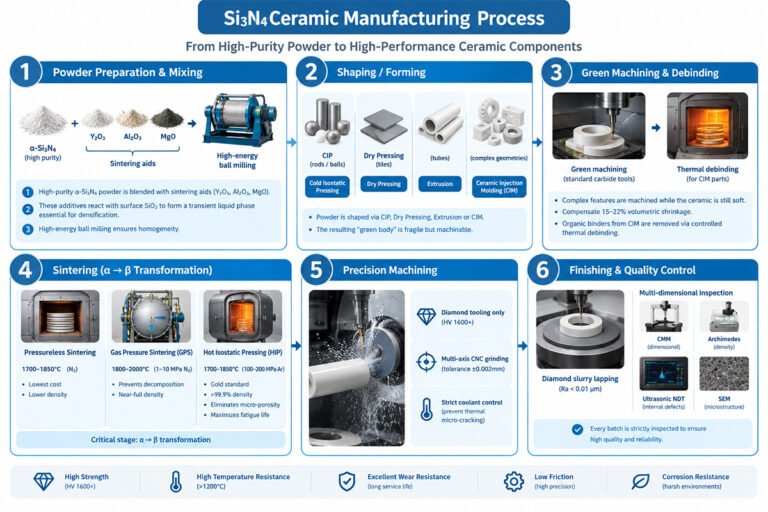
From a manufacturing standpoint, silicon nitride often costs more to produce than common metals because powder preparation, shaping, sintering, grinding, and quality inspection require specialized process control. On the other hand, different grades can vary considerably in strength, toughness, thermal conductivity, electrical behavior, chemical compatibility, and achievable dimensions.
Hence, a sound material-selection process compares the full component requirement-including environment, safety factor, expected lifetime, joining method, production volume, inspection plan, and lifecycle cost-rather than choosing a ceramic based on a single headline property.
5. How AOFE MIMCustom Can Support Custom Component Development
For custom component projects, AOFE MIMCustom supports manufacturers developing small, complex, or repeatable parts through a service scope covering Ceramic Injection Molding (CIM), Metal Injection Molding (MIM), and mold and design support. Early in the development stage, these capabilities can help teams review component geometry, tooling concepts, material-route options, and manufacturability before committing to production.
Crucially, CIM and MIM serve different material systems: CIM shapes ceramic feedstock, whereas MIM shapes metal feedstock. Since silicon nitride requires a suitable ceramic formulation and a qualified sintering route, the project team should confirm AOFE MIMCustom’s current silicon-nitride-specific material, tooling, sintering, tolerance, and testing capabilities before placing a Si3N4 project.
To move from concept to manufacture, provide the component drawing or 3D model, target material and service environment, annual volume, critical tolerances, and inspection requirements so the manufacturing route can be assessed against the actual design brief.
Frequently Asked Questions About Silicon Nitride
Why is silicon nitride considered a high-performance structural ceramic?
Ordinarily, silicon nitride combines high strength, hardness, useful fracture toughness, wear resistance, oxidation resistance, low density, and thermal-shock resistance. Thus, it can serve in demanding systems that need several of these properties at the same time.
How does the crystal structure of silicon nitride influence its properties?
Structurally, linked SiN4 tetrahedra and strong silicon–nitrogen bonds create a rigid three-dimensional framework. Likewise, the phase balance, elongated β-grain morphology, porosity, and grain-boundary chemistry affect the final strength, toughness, and thermal properties.
Is silicon nitride stronger than steel?
There is no universal answer because strength depends on the specific ceramic and steel grades, loading direction, temperature, defects, and test method. Nevertheless, silicon nitride offers high hardness and compressive/contact performance at relatively low density, steel generally provides greater ductility and more warning before many overload failures.
Can silicon nitride tolerate high temperatures?
Yes, selected silicon nitride grades retain useful strength and stiffness at elevated temperatures and resist thermal shock well. However, the maximum design temperature depends on atmosphere, applied stress, creep requirements, exposure time, material grade, and component geometry.
Which industries commonly use silicon nitride ceramics?
Throughout industry, engineers use or evaluate silicon nitride for bearings, turbocharger and selected aerospace components, power-electronics substrates, mechanical seals, pumps, valves, wear parts, and cutting tools. Ultimately, the correct choice depends on the operating environment and application-specific test data.
Technical References
- Saint-Gobain Performance Ceramics & Refractories, “Understanding the Microstructure of Silicon Nitride.”
- Heraeus Electronics, “Silicon Nitride AMB Substrates.”
- “Silicon Nitride Ceramics: Structure, Synthesis, Properties, and Biomedical Applications,” review article available through PubMed Central.
- “Rolling Contact Silicon Nitride Bearing Technology: A Review of Recent Research,” Wear, 2000.