Ceramic Engineering / Manufacturing Technology
9 Sintering Techniques for Silicon Carbide Ceramics
More broadly, silicon carbide (SiC) ceramics combine high-temperature strength, hardness, elastic modulus, wear resistance, thermal conductivity, and chemical resistance. Consequently, the selected sintering route has a major influence on density, grain structure, residual porosity, dimensional change, cost, and the component’s eventual service performance.
Why Does Sintering Matter for Silicon Carbide Ceramics?
Fundamentally, silicon carbide relies on strong covalent bonding, which makes conventional densification difficult and often requires carefully designed powder chemistry, high temperature, pressure, infiltration, or an energy-assisted mechanism. Given that SiC components serve demanding duties, the production route must match the required microstructure rather than simply maximize density.
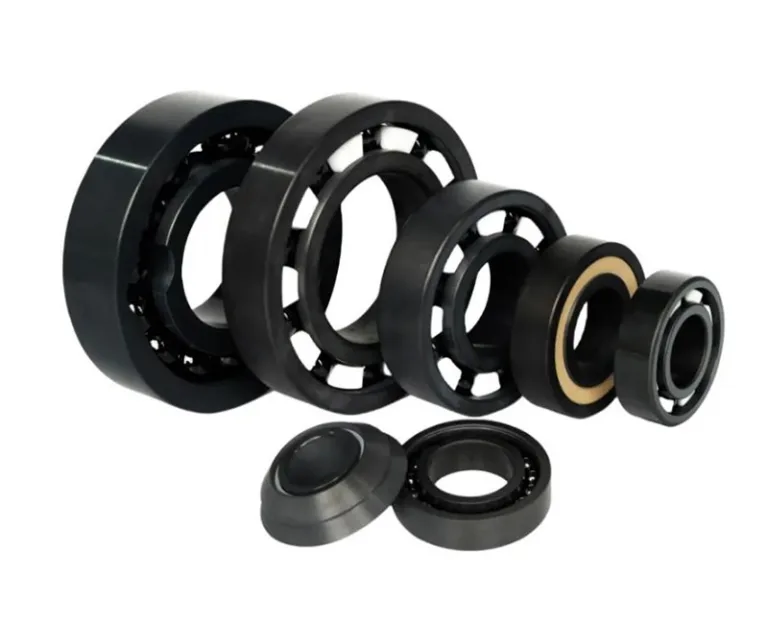
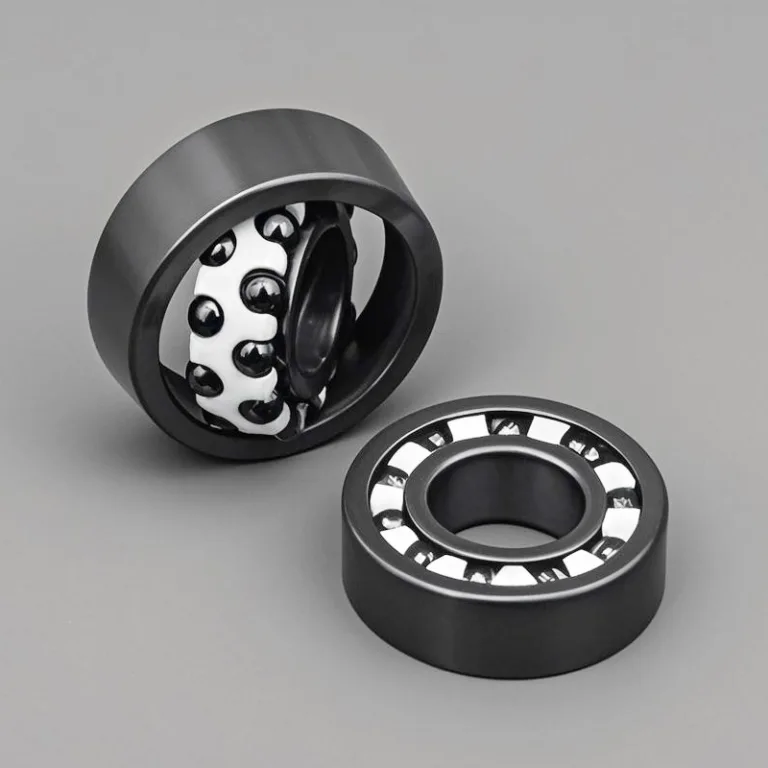
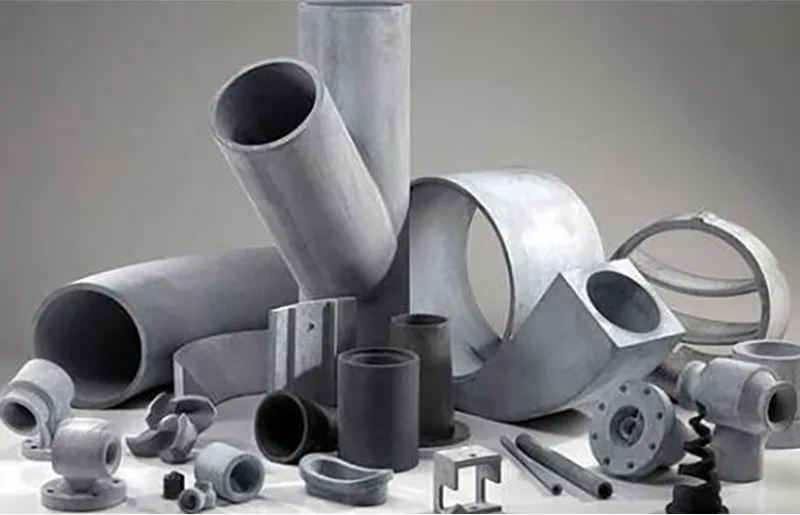
For example, mechanical seals and sliding bearings usually need high density, fine and uniform microstructures, low wear, and dependable dimensional control. Conversely, kiln furniture and burner parts can benefit from thermal-shock resistance and heat transfer, even when a controlled amount of porosity remains useful. Additionally, optical mirrors, semiconductor wafer fixtures, heat exchangers, and armor impose their own combinations of surface finish, stiffness, strength, thermal response, and geometry.
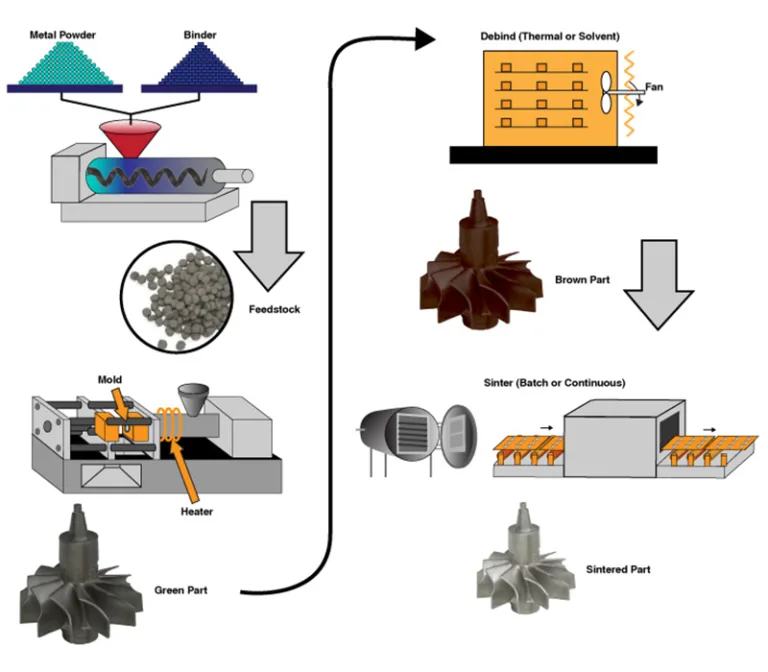
Operationally, the sintering cycle works together with powder particle size, particle-size distribution, green-body forming, additives, atmosphere, tooling, and post-processing. Hence, a route that gives excellent density in a small coupon may not offer the best total cost or yield for a large, thin-walled, or complex component. Engineers therefore evaluate material data, manufacturability, part geometry, repeatability, and life-cycle performance as a connected set.
Nine Silicon Carbide Sintering Techniques at a Glance
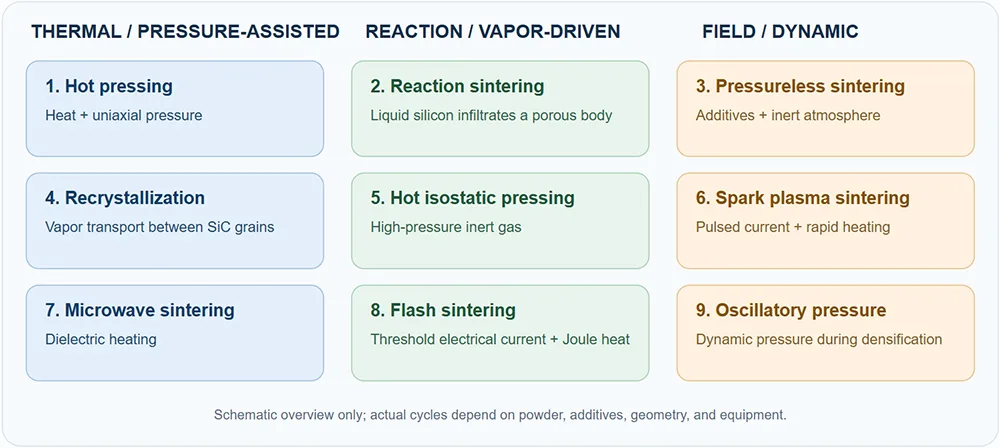
To orient the reader, the following schematic groups the nine techniques by their main densification drivers. While some methods overlap in equipment or physical mechanism, each route emphasizes a different balance of heat, pressure, reaction, electromagnetic energy, or dynamic loading.
1. Hot Pressing: Simultaneous Heat and Uniaxial Pressure
By combining heat with uniaxial pressure, hot pressing consolidates silicon carbide powder into a die, raise the temperature, and apply uniaxial pressure while the powder consolidates. Simultaneously, this combined action promotes particle rearrangement, contact formation, and densification, while the process engineer controls the temperature-pressure-time profile to manage the final microstructure.
Technically, hot pressing can produce highly dense SiC with strong mechanical properties because pressure assists consolidation at high temperature. Although the die constrains the part shape, so the method suits comparatively simple geometries or shapes that can tolerate later machining. Furthermore, high-temperature tooling, demanding process control, energy consumption, and limited throughput can increase production cost.
Under these conditions, manufacturers consider hot pressing when the value of high density and mechanical performance outweighs tooling cost and geometric restrictions. Specifically, candidates include high-performance wear components, armor tiles, and specialist structural parts that need a controlled, dense microstructure.
2. Reaction Sintering: Silicon Infiltration and In-Situ SiC Formation
Within reaction sintering, the manufacturer blends SiC powder with a carbon source, shapes the mixture into a porous green body, and then introduces molten silicon or silicon vapor under vacuum or an inert atmosphere. After the temperature exceeds the melting point of silicon, liquid silicon moves through connected pores by capillary action and reacts with carbon to form additional β-SiC.
Subsequently, newly formed SiC bonds with the original SiC particles and builds a strong ceramic network. Here, the supplied document describes infiltration above 1500°C and highlights a major advantage: reaction-bonded SiC undergoes very little overall dimensional shrinkage compared with many conventional densification routes. Thus, manufacturers can more readily maintain the dimensions of large or intricate components, although they still need to account for the forming stage, reaction behavior, and finishing allowance.
Commercially, lower processing cost and near-net-shape capability make reaction sintering attractive for kiln furniture, burner nozzles, radiant tubes, heat exchangers, desulfurization nozzles, and optical mirror structures. Yet silicon infiltration and the resulting phase composition must suit the service environment, especially where temperature, chemistry, or wear impose strict limits.
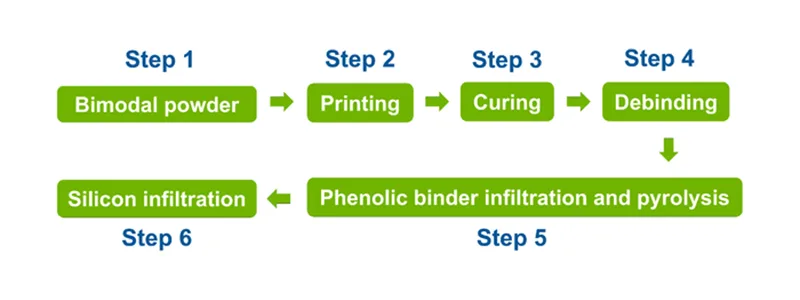
3. Pressureless Sintering: Solid-State and Liquid-Phase Routes
Without external pressure, pressureless sintering densifies SiC without applying external mechanical pressure to the part. Instead, the process uses a suitable powder system, sintering additives, high temperature, and an inert atmosphere; the supplied source reports a typical range of about 2000–2150°C for the described process conditions.
Solid-state pressureless sintering
Solid-state processing relies on carefully selected additives support diffusion and densification while the material remains principally solid during the sintering stage. Reported densities can reach approximately 3.10–3.15 g/cm³, and a microstructure without intergranular glassy phases can retain strong high-temperature mechanical performance. Importantly, excessive temperature or dwell time can drive grain growth and reduce flexural strength, so the schedule needs tight control.
Liquid-phase pressureless sintering
Meanwhile, a suitable additive system can create a transient liquid phase through melting or eutectic formation. Because this liquid offers rapid mass-transport paths, densification can proceed at a lower temperature than in a comparable solid-state route, while controlled grain growth can preserve a finer microstructure. Moreover, selected intergranular phases can change crack propagation and improve flexural strength or fracture toughness; nevertheless, designers must assess whether those phases compromise oxidation resistance, corrosion resistance, or long-term high-temperature stability.
Practically, pressureless sintering offers broad freedom in part shape and a mature industrial base. In turn, manufacturers commonly choose it for dense precision seals, sliding bearings, pump components, wear-resistant parts, semiconductor wafer fixtures, optical components, and armor applications where the target grade supports the required duty.
4. Recrystallization Sintering: Vapor Transport Between SiC Grains
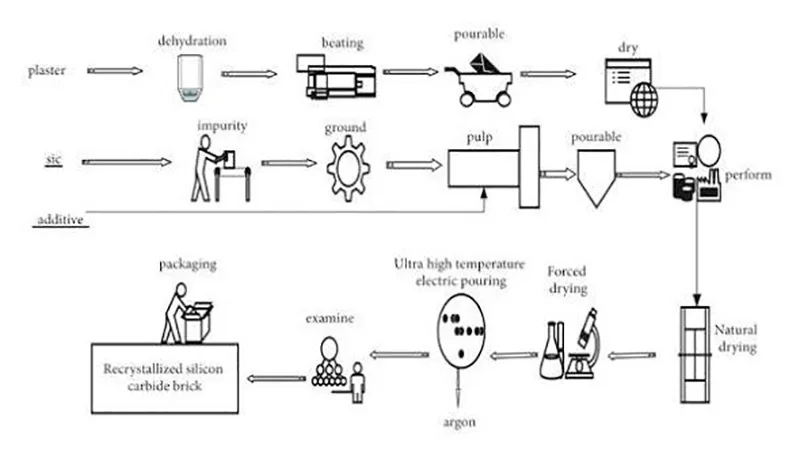
Recrystallization starts with graded coarse and fine SiC particles coarse and fine particles, forms a green body, and heats it above 2100°C in a controlled protective atmosphere. Above 2100°C, fine SiC gradually vaporizes and then condenses near the contact points of coarse particles, creating bridges that connect the larger grains.
Compared with routes driven by substantial bulk diffusion, this vapor-transport mechanism produces very little shrinkage and does not greatly increase the body’s density. Notably, the source document reports a residual porosity range of roughly 10–20%, together with clean grain boundaries and an absence of glassy grain-boundary phases in the described material. This microstructure allows recrystallized SiC to combine high thermal conductivity and thermal-shock resistance with geometric stability, even though it does not target the lowest possible porosity.
On the application side, kiln furniture, high-temperature supports, burner nozzles, and certain heat-exchanger structures can benefit from this balance of low shrinkage and thermal performance. Even with these benefits, engineers must confirm that the remaining pore network and strength level meet the component’s pressure, sealing, and mechanical-load requirements.
5. Hot Isostatic Pressing (HIP): Gas Pressure from All Directions
HIP applies high temperature and isostatic gas pressure to a component or powder compact experiences high temperature and high isostatic gas pressure, commonly using an inert gas such as argon. Vacuum-sealed compacts may use a glass or metal container, as the source document describes, before operators apply pressure; the gas pressure can rise to around 200 MPa in the cited process description.
Isostatic pressure acts from multiple directions; therefore, HIP can compress internal pores more uniformly than a uniaxial press. Overall, this technique can raise density and reduce internal defects when the starting material, encapsulation strategy, and thermal cycle are compatible. Nonetheless, container preparation, high-pressure equipment, cycle duration, and process validation add considerable complexity and cost.
As a process choice, HIP is most attractive when internal porosity strongly limits reliability and when the component’s value justifies the additional process step. First, designers should establish whether the compact contains closed or open porosity, because an open pore network or unsuitable encapsulation may require a different sequence or pre-treatment.
6. Spark Plasma Sintering (SPS): Rapid Current-Assisted Consolidation
Spark plasma sintering (SPS), also known in many industrial contexts, in turn as field-assisted sintering, combines applied pressure with pulsed electrical current to heat a powder compact quickly. Across the short cycle, current-related heating and concentrated heat transfer can accelerate consolidation, while the process may also help disrupt surface contamination or remove adsorbed gases under suitable conditions.
One SiC-specific example in the source document describes rapid sintering of fine powder with Al₂O₃ and Y₂O₃ additives to obtain a dense ceramic. Short dwell times can limit grain growth; therefore, SPS offers researchers a useful way to study fine-grained microstructures and rapid densification. From an equipment perspective, tooling size, die reactions, temperature measurement, part geometry, and batch size can restrict scale-up or increase equipment cost.
Specialized applications therefore often favor SPS for high-value laboratory samples, advanced compositions, specialized wear parts, and material-development programs where microstructure control matters more than large-volume throughput. Production engineers should also validate temperature uniformity and property consistency throughout the complete component rather than relying solely on a small central specimen.
7. Microwave Sintering: Heating Through Dielectric Loss
Microwave processing uses dielectric losses to couple electromagnetic energy with the material and its surroundings, while dielectric losses convert part of that energy into heat. Depending on the SiC composition and temperature range, this coupling can promote rapid heating and mass transport, potentially reducing cycle time or enabling finer grain structures compared with a conventional furnace schedule.
Whereas a surface-heating assumption focuses only on the exterior, microwave processing requires careful attention to electromagnetic penetration, temperature-dependent coupling, insulation, and the way the load absorbs energy. Since SiC electrical and dielectric behavior changes with temperature, engineers must design the system to avoid hot spots, thermal gradients, arcing, or uneven densification.
Against these constraints, microwave sintering remains a process that demands both materials knowledge and equipment expertise. Beyond conventional routes, research teams can evaluate its potential for fine-grained ceramics, complex thermal cycles, and energy-efficient production, while validation should measure density, phase composition, grain size, mechanical properties, and part-to-part repeatability.
8. Flash Sintering: Field-Triggered Joule Heating
Initially, flash sintering places a ceramic specimen in a furnace and applies an electric field while the temperature rises. When the system reaches a critical combination of temperature and electric field, the current can increase nonlinearly; consequently, Joule heating rapidly raises the specimen’s temperature and may trigger densification within seconds.
Measured against a long conventional cycle, this rapid response offers the possibility of lower energy use and much shorter dwell times. Crucially, the narrow processing window makes electrical contact, current limiting, temperature measurement, atmosphere, specimen dimensions, and thermal runaway control especially important.
Evidence in the source document frames flash sintering as an emerging route for SiC research rather than a universal replacement for established industrial methods. Before scale-up, engineers should first demonstrate repeatable density, uniform properties, acceptable phase stability, and scale-appropriate process control before transferring results to production components.
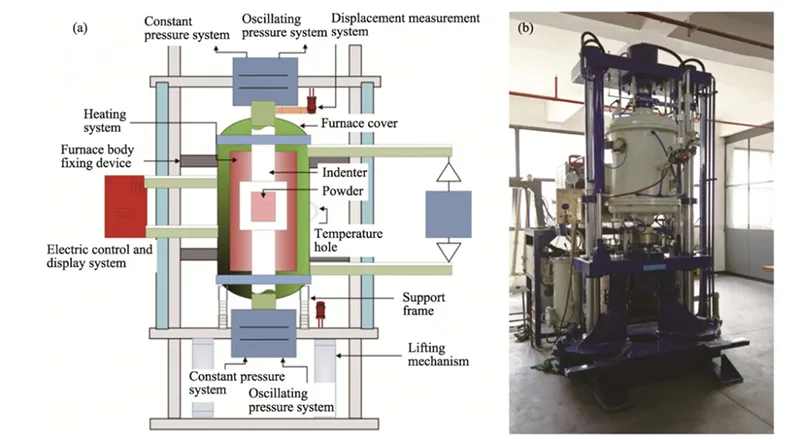
9. Oscillatory Pressure Sintering: Dynamic Loading During Densification
Oscillatory pressure sintering, by contrast, adds a varying pressure profile to the densification cycle instead of relying only on a constant static load. Through each pressure oscillation, particles can rearrange, agglomerated regions can loosen, and grains may rotate or slide; together, these effects can improve packing and create additional driving force for densification.
Later in the sintering cycle, a carefully controlled oscillation may help remove small residual pores near grain boundaries and support a more uniform microstructure. Collectively, these pressure changes aim to combine high density with fine grain size and dependable mechanical performance. Source notes attribute the concept to a research team at Tsinghua University and highlights control of pressure amplitude and frequency as important process variables.
Despite its promise, oscillatory pressure requires equipment able to generate a stable dynamic load and a process window that matches the compact’s geometry, powder condition, and temperature. Manufacturers should therefore view it as a promising specialized route whose industrial value depends on validated gains in density, reliability, cycle time, and cost.
How Should Engineers Select a SiC Sintering Route?
Rather than ranking all nine methods on a single scale, engineers should begin with the component’s geometry, required density, allowable shrinkage, service temperature, corrosion or wear environment, target reliability, and annual volume. Material selection also depends on the powder supplier’s grade, additive package, furnace capability, machining allowance, and inspection method can determine whether a theoretically attractive process performs well in production.
| Technique | Main process driver | Key strength | Main trade-off / typical fit |
|---|---|---|---|
| Hot pressing | Heat + uniaxial pressure | High density and performance | Tooling and shape constraints |
| Reaction sintering | Liquid Si infiltration and reaction | Very low shrinkage; complex shapes | Composition and service limits require checks |
| Pressureless sintering | High temperature + additives | Shape freedom and mature production | High firing temperature; grain growth control |
| Recrystallization | Vaporization and condensation | Low shrinkage; thermal-shock resistance | Residual porosity remains |
| HIP | High isostatic gas pressure | Internal pore reduction | High equipment and encapsulation cost |
| SPS | Pulsed current + pressure | Fast cycles; fine microstructures | Tooling and scale-up limitations |
| Microwave | Dielectric heating | Potentially fast, efficient heating | Coupling and uniformity need control |
| Flash sintering | Electric field and Joule heating | Very short densification event | Narrow process window and scale-up validation |
| Oscillatory pressure | Dynamic mechanical loading | Packing and pore-removal potential | Specialized equipment and process development |
At the outset of route selection, reaction sintering often fits large or complex shapes with strict shrinkage limits, whereas pressureless sintering is attractive for dense precision parts with varied geometries. Comparatively, recrystallized SiC serves porous high-temperature components well, while HIP or SPS may justify their added complexity when defect reduction, fine microstructures, or material development dominate the brief.
Ultimately, process selection should rely on representative specimens and production-relevant qualification. Most importantly, teams should verify density and open porosity, flexural strength, fracture toughness, thermal conductivity, thermal shock, chemical compatibility, dimensional variation, and batch-to-batch consistency as appropriate for the end use.
Frequently Asked Questions
Which SiC sintering techniques see the broadest industrial use?
According to the supplied document, reaction sintering, pressureless sintering, and recrystallization sintering have particularly established industrial roles because they address different needs in shape complexity, densification, thermal performance, and cost.
Which route best controls shrinkage in complex parts?
Reaction sintering stands out as a strong candidate because silicon infiltration and in-situ SiC formation produce very little overall shrinkage in the process described. Regardless, engineers should validate dimensional stability for the exact geometry and reaction-bonded grade.
Does the highest density always mean the best SiC component?
Density alone does not determine the best SiC component, because the application may also require controlled porosity, thermal shock resistance, permeability, or minimal shrinkage. Recrystallized SiC, for example, deliberately retains porosity, which can suit selected high-temperature components.
Are SPS, microwave, flash, and oscillatory-pressure sintering production-ready for every part?
They are not universally production-ready, because each process has equipment, geometry, uniformity, and scale-up limits that depend on the material system. These methods offer valuable opportunities, yet manufacturers should confirm repeatability and economic viability before adopting them for volume production.
Conclusion
Taken together, the nine silicon carbide sintering techniques do not form a simple ladder from inferior to superior; instead, each provides a distinct way to balance densification, porosity, geometry, cost, and performance. The most effective route therefore produces a qualified microstructure that produces a qualified microstructure at a viable cost while meeting the component’s real operating conditions.