Industry News • Powder Metallurgy • Precision Manufacturing
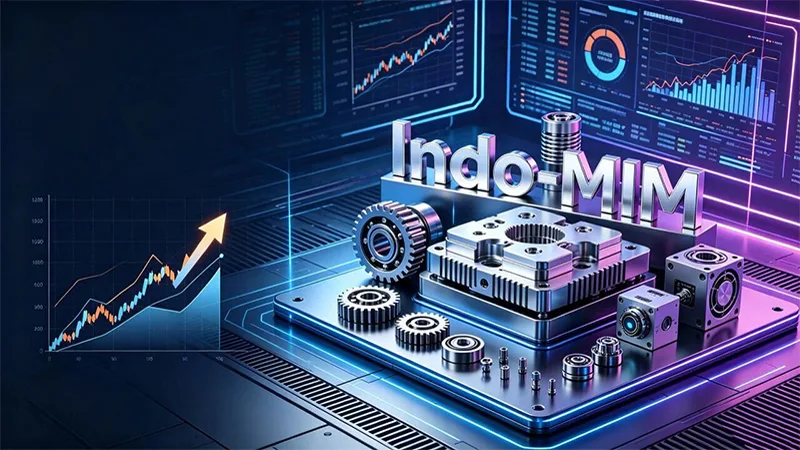
How did global MIM leader Indo-MIM reach the pinnacle of the capital market-and what’s the secret to its dominance in precision manufacturing?
MIM
IPO 2026
Metal Powder
Precision Manufacturing
3D Printing
⚡ Key Takeaways
- Initially, Indo-MIM listed on India’s NSE and BSE on July 30, 2026, with an IPO price band of Rs 461-486 and a total issue size of approximately Rs 3,812 crore (about $450 million).
- Subsequently, the offering attracted 72.34x subscription on the final day, with qualified institutional buyers subscribing 204.34x, reflecting strong institutional confidence.
- Furthermore, Indo-MIM held roughly 6.7%-6.8% of the global MIM market in 2025-2026 and has led in installed MIM capacity for six consecutive years.
- Meanwhile, its vertical integration spans gas-atomized metal powder production (~1,100 tonnes/year), tooling, MIM sintering, ceramic injection molding, precision machining, and HP Metal Jet binder-jet 3D printing.
- Ultimately, the company demonstrates that powder metallurgy leadership rests on material formulation, international certification, and overseas production layout—not capacity alone.
A Listing That Redefined India’s Precision Manufacturing Image
Many observers still associate Indian manufacturing with low-cost assembly, yet Indo-MIM’s public debut tells a different story. The Bengaluru-headquartered company opened its IPO on July 23, 2026, at Rs 461-486 per share, raising approximately Rs 3,812 crore (about $450 million) through a combination of a fresh issue and an offer for sale. Shares listed on July 30, 2026, on both the National Stock Exchange and the Bombay Stock Exchange. Institutional demand proved especially intense: the issue received 72.34x subscription on the final day, with qualified institutional buyers subscribing 204.34x and non-institutional investors 50.63x. This level of appetite signals that capital markets now recognize precision powder-metallurgy manufacturing as a high-barrier, high-value sector.
Thirty Years of Focus, One Global Lead
Founded in 1996, Indo-MIM produced its first MIM parts and firearm components in 1997 and has since grown into the world’s largest MIM specialist by installed capacity. The company now operates 15 production facilities across India, the United States, the United Kingdom, and Mexico, serving more than 1,000 customers in over 45 countries. Annual shipments exceed hundreds of millions of parts, and the company can produce more than 12,000 distinct MIM component references. According to 2025-2026 industry data, Indo-MIM held approximately 6.7%-6.8% of the global MIM market, ranking first in capacity for six consecutive years despite a fragmented competitive field.
Notably, the global MIM market remains highly dispersed. Some 2026 estimates place GKN Powder Metallurgy near 12%, Form Technologies / Dynacast around 9%, and Indo-MIM at roughly 6.7%, while other assessments put Indo-MIM closer to 5% depending on segmentation. This fragmentation means that no single player dominates, yet Indo-MIM’s combination of scale, certification breadth, and international footprint gives it a structural advantage in winning multi-year OEM programs.
The Real Moat: From Metal Powder to Finished Part
Indo-MIM’s core advantage lies in end-to-end control rather than single-process specialization. The company produces its own gas-atomized spherical metal powders for MIM, 3D printing, and thermal spraying, with an annual melting capacity of approximately 1,100 tonnes. Its material portfolio covers stainless steels, tool steels, iron-based alloys, and nickel- and cobalt-based superalloys, giving it flexibility across medical, aerospace, and automotive specifications.
Beyond MIM, Indo-MIM has added ceramic injection molding, precision investment casting, CNC machining, and metal additive manufacturing to its toolkit. The company has deployed multiple HP Metal Jet S100 binder-jet 3D printers in India and the United States, positioning itself to produce high-precision metal parts for automotive, aerospace, defense, and medical customers without traditional prototyping bottlenecks. For advanced materials practitioners, this integration matters because powder morphology, binder chemistry, debinding kinetics, and sintering shrinkage must align precisely; controlling each link reduces variation and accelerates qualification.
Metal Powder
~1,100 t/year gas-atomized powder for MIM and additive manufacturing.
Metal and ceramic injection molding with in-house tooling and sintering.
Metal 3D Printing
HP Metal Jet binder-jet systems in India and the US for production-grade parts.
Five High-Barrier Sectors, One Supply Chain Anchor
Indo-MIM does not sell to end consumers, yet its components appear inside surgical instruments, endoscope mechanisms, hearing-aid structures, EV sensors, transmission parts, smartphone hinges, wearable-device frames, turbine accessories, and aerospace fittings. The medical segment particularly benefits from its ISO 13485 certification and clean-room production, while aerospace programs rely on AS9100 and NADCAP credentials. Such certifications require years of process validation and cannot be replicated through capacity expansion alone.
| Sector | Typical MIM Parts | Key Requirement |
|---|---|---|
| Medical | Surgical tools, endoscope parts, hearing-aid housings | ISO 13485, biocompatibility, clean-room molding |
| Aerospace | Turbine accessories, brackets, fasteners | AS9100, NADCAP, high-temperature alloys |
| Automotive | EV sensors, brake components, transmission parts | IATF 16949, high-volume repeatability |
| Consumer Electronics | Hinges, camera rings, wearable frames | Miniaturization, surface finish, tight tolerances |
| Industrial | Valve bodies, sensor housings, tool inserts | Corrosion resistance, custom alloy development |
Capital Fueling the Next Phase of Competition
Indo-MIM intends to deploy IPO proceeds toward advanced additive-manufacturing R&D, global capacity expansion, and higher-end production-line upgrades. Consequently, the listing amplifies advantages that already existed in powder formulation, sintering know-how, and international certification. Chinese MIM players have grown rapidly in recent years, yet many still face challenges in stable high-volume qualification for medical and aerospace customers, in overseas production layout, and in proprietary metal-powder development. Indo-MIM’s trajectory therefore underscores a broader lesson for powder metallurgy professionals: sustainable leadership comes from controlling materials, processes, and customer qualification simultaneously.
What This Means for the Advanced Materials Industry
For engineers and manufacturers working in advanced ceramics, powder metallurgy, and precision metal components, Indo-MIM’s rise offers several practical reference points. First, metal-powder capability is not merely a cost item; it shapes density, shrinkage control, and mechanical consistency across batches. Second, multi-process integration—MIM, ceramic injection molding, metal 3D printing, and precision machining—allows one supplier to address complex component families that would otherwise require multiple vendors. Third, international certifications and overseas production bases remain decisive when serving medical, aerospace, and automotive OEMs. Finally, binder-jet metal printing may increasingly complement MIM for low-volume, high-complexity parts, suggesting that powder-based forming technologies will continue to converge rather than compete in isolation.
❓ Frequently Asked Questions
What is Indo-MIM and what does it manufacture?
Indo-MIM is a Bengaluru-headquartered manufacturer specializing in metal injection molding precision components for medical, aerospace, automotive, consumer electronics, and industrial applications. It operates 15 production facilities across India, the US, the UK, and Mexico.
How large was Indo-MIM’s IPO in July 2026?
Indo-MIM’s IPO opened on July 23, 2026, with a price band of Rs 461-486 per share and a total issue size of approximately Rs 3,812 crore (about $450 million). It listed on July 30, 2026, on both NSE and BSE, and was subscribed over 72x, with QIB demand exceeding 200x.
What is Indo-MIM’s global market share in MIM?
Indo-MIM held approximately 6.7%-6.8% of the global MIM market in 2025-2026 and has ranked first in installed MIM capacity for six consecutive years. The global MIM market remains fragmented, with the top players each holding single-digit shares.
What makes Indo-MIM’s vertical integration unique?
Indo-MIM controls the full chain from gas-atomized metal powder production (about 1,100 tonnes annual melting capacity), through tooling and MIM sintering, to precision machining, ceramic injection molding, and metal binder-jet 3D printing. This end-to-end capability is rare among MIM specialists.
What lessons does Indo-MIM offer for the powder metallurgy industry?
Indo-MIM shows that leadership in powder metallurgy requires more than capacity: it demands proprietary powder formulation, international certification (AS9100, ISO 13485, NADCAP), overseas production layout, and the ability to serve medical and aerospace OEMs with stable, high-volume quality.
Related topics: Metal Injection Mimming • Gas-Atomized Metal Powder • Ceramic Injection Molding • Binder Jet 3D Printing • Precision Machining • Medical MIM Parts • Aerospace Powder Metallurgy