Advanced Ceramics | Materials Research
Three Technical Routes Overcome Thermal Conductivity Bottlenecks in Highly Thermally Conductive Silicon Nitride Ceramics
Article Summary
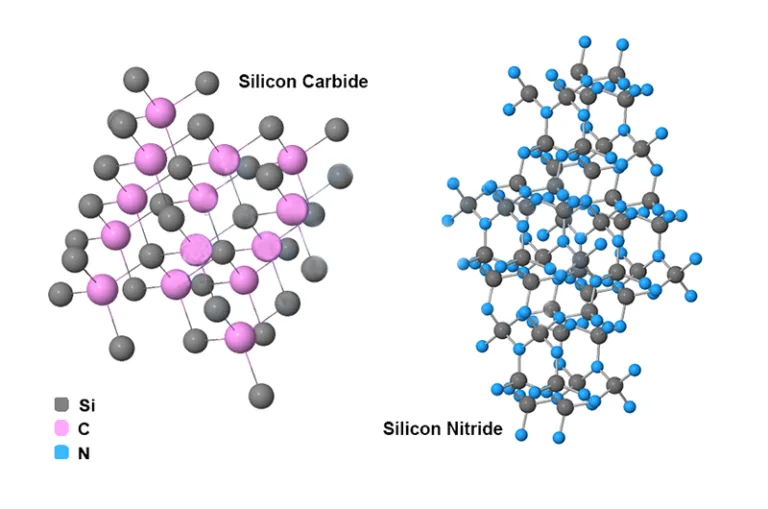
A review published in KONA Powder and Particle Journal examines three research approaches to improving silicon nitride (Si3N4) thermal conductivity: grain orientation through seed-assisted forming, rotating strong magnetic field alignment, and reaction-bonded silicon nitride processing. Across different studies, researchers reported thermal conductivity values of approximately 155, 176, and 177-180 W/(m·K). Together, these approaches show how microstructure control, oxygen-defect reduction, and grain-boundary engineering can improve heat transfer while preserving important mechanical properties.
Why Does Silicon Nitride Need Higher Thermal Conductivity?
In advanced power electronics, effective heat dissipation plays a major role in component reliability and service life. Meanwhile, engineers also need insulation, mechanical strength, fracture resistance, and thermal shock performance from the materials used in demanding electronic packages.
Unlike many conventional insulating ceramics, silicon nitride combines useful thermal transport with high strength and fracture toughness. Consequently, researchers continue to explore its potential for electric vehicle power modules, industrial power electronics, and high-reliability electronic packaging.
However, conventional silicon nitride does not always deliver the thermal conductivity required by advanced applications. In particular, oxygen-related lattice defects, grain-boundary phases, and non-uniform microstructures can scatter phonons, which carry heat through the ceramic.
For this reason, recent research focuses not only on densification but also on controlling grain orientation, reducing defects, and improving heat transfer across grain boundaries.
Three Research Routes at a Glance
| Technical route | Main approach | Reported thermal conductivity | Main consideration |
|---|---|---|---|
| Seed-assisted grain orientation | β-Si3N4 seeds, tape casting, and high-temperature processing | Approximately 155 W/(m·K) | Directional thermal transport and processing cost |
| Rotating strong magnetic field alignment | Magnetic anisotropy-assisted grain alignment | Approximately 176 W/(m·K) | Field equipment and alignment uniformity |
| Reaction-bonded silicon nitride (SRBSN) | Low-oxygen raw materials and control of defects and grain boundaries | Approximately 177–180 W/(m·K) in cited studies | Nitridation, densification, and process consistency |
Note: These values come from different research systems and test conditions. Therefore, they should not be interpreted as results from a controlled, direct comparison of the three routes.
1. Seed-Assisted Forming and Grain Orientation: Approximately 155 W/(m·K)
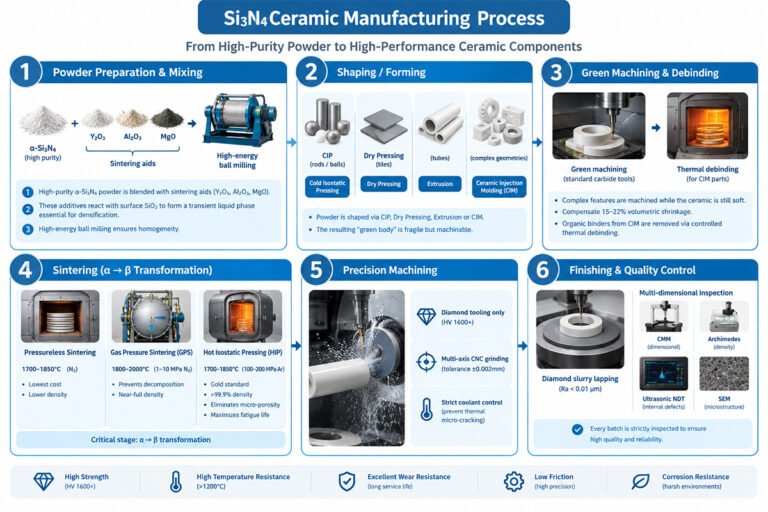
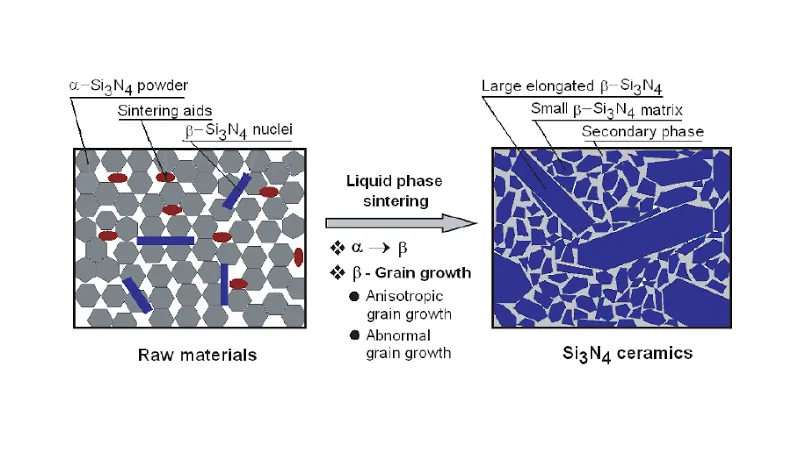
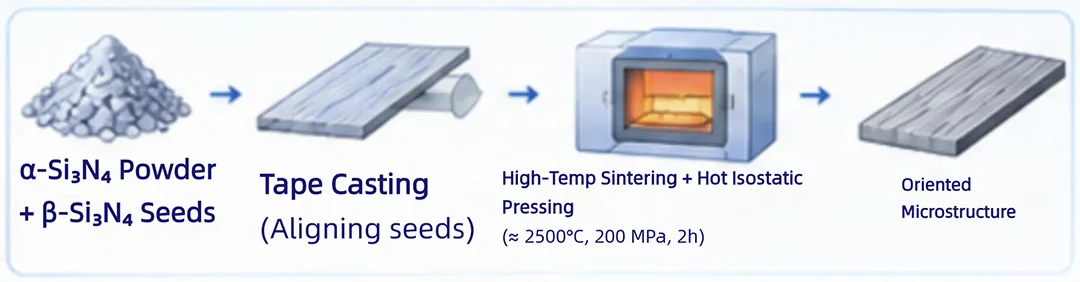
Initially, researchers explored the use of β-Si3N4 seed crystals to guide the growth and orientation of silicon nitride grains. By combining α-Si3N4 starting powder with β-Si3N4 seeds, they encouraged the development of elongated grains with preferred crystallographic orientations.
During processing, tape casting helped establish directional alignment in the green body. Subsequently, high-temperature sintering and hot isostatic pressing promoted densification and grain growth, producing a microstructure with a more organized heat-transfer pathway.
As reported in the cited research, the resulting material achieved a room-temperature thermal conductivity of approximately 155 W/(m·K) along the preferred orientation direction.
Key technical point
Grain orientation can improve heat transport along a selected direction, although the resulting thermal conductivity may differ between directions.
Nevertheless, directional performance creates an important design consideration for engineers. In addition, high-temperature and high-pressure processing can increase equipment requirements and manufacturing costs.
For practical applications, designers therefore need to evaluate the heat-flow direction, component geometry, and the uniformity of grain alignment before selecting this route.
2. Rotating Strong Magnetic Field Alignment: Approximately 176 W/(m·K)
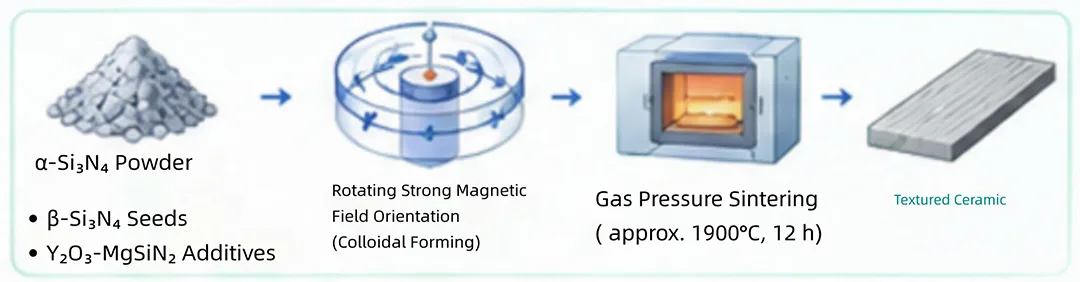
Building on grain-orientation research, another approach uses a rotating strong magnetic field to control the crystallographic alignment of silicon nitride particles or seed grains. This method takes advantage of magnetic susceptibility anisotropy, which allows an external field to influence grain orientation.
In the reported 2014 study, researchers combined α-Si3N4 powder, β-Si3N4 seeds, and a Y2O3-MgSiN2 sintering additive system. Additionally, colloidal forming and subsequent gas-pressure sintering helped develop the oriented ceramic structure.
Under the reported conditions, the researchers used a sintering temperature of approximately 1900°C and a holding time of 12 hours. The resulting silicon nitride reached a thermal conductivity of approximately 176 W/(m·K) along the grain-orientation direction.
Key technical point
A rotating magnetic field offers another way to control grain orientation, with potential flexibility beyond conventional mechanical alignment methods.
Even so, the approach introduces several engineering challenges. Specifically, manufacturers must consider strong-field equipment, slurry stability, forming consistency, and alignment uniformity throughout larger components.
Consequently, the feasibility of this route depends not only on laboratory thermal conductivity but also on equipment investment, component size, process repeatability, and production yield.
3. Reaction-Bonded Silicon Nitride (SRBSN): Approximately 177-180 W/(m·K)
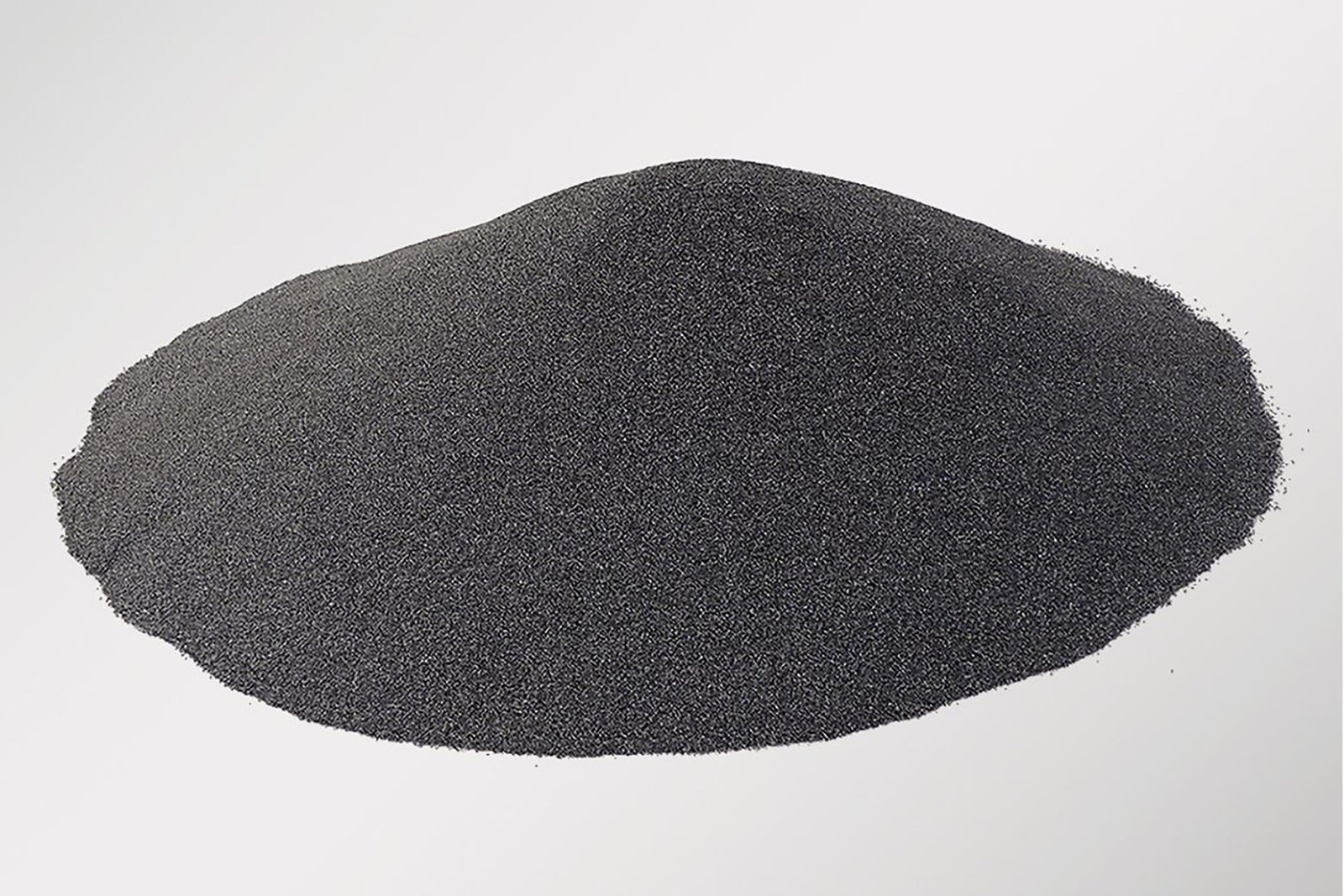
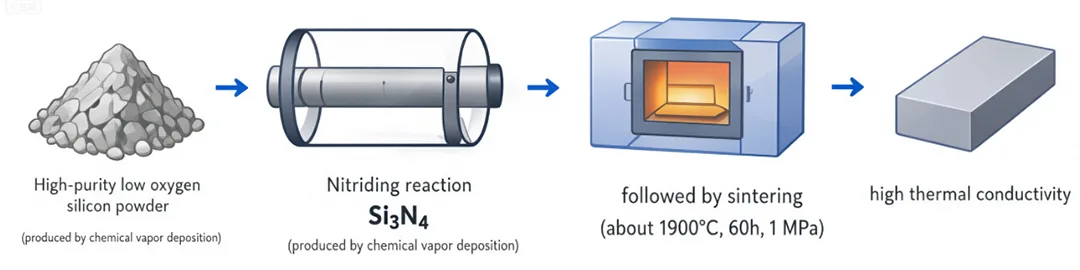
Unlike the first two approaches, reaction-bonded silicon nitride (SRBSN) places greater emphasis on raw material quality, oxygen-defect control, and grain-boundary properties. Rather than relying mainly on external-field or forming-induced grain alignment, this route starts with silicon powder and uses nitridation to form silicon nitride.
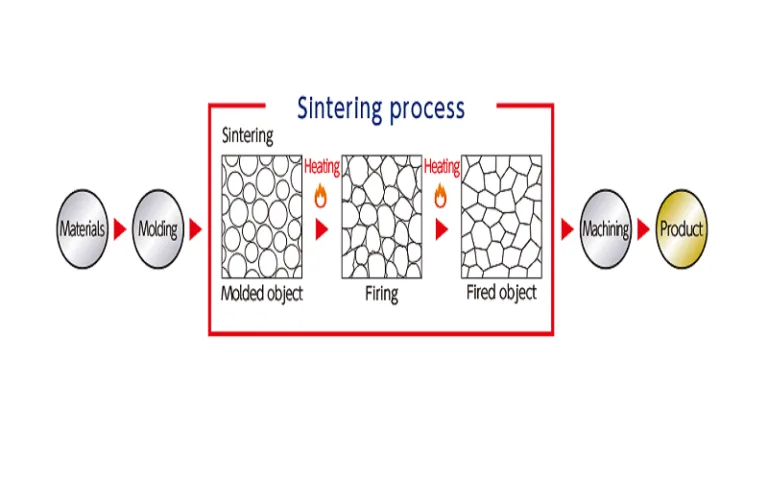
During the process, silicon powder reacts with nitrogen to form Si3N4. Subsequent sintering then improves densification and develops the microstructure needed for thermal and mechanical performance.
According to the studies discussed in the review, researchers used high-purity, low-oxygen silicon powder and carefully controlled nitridation, sintering, and cooling conditions. Reported thermal conductivity values include approximately 177 W/(m·K) and 180 W/(m·K) in separate studies.
Importantly, these figures represent results from different samples and research conditions, rather than two measurements of one identical specimen. The review also cites a related material with a flexural strength of approximately 600 MPa and a fracture toughness of around 11 MPa·m1/2.
Key technical point
SRBSN research highlights the importance of reducing oxygen-related defects and improving grain-boundary heat transfer, while also considering mechanical reliability.
At the microstructural level, oxygen-related defects can interfere with phonon transport through the silicon nitride lattice. Furthermore, grain-boundary phases can add thermal resistance and limit heat flow across adjacent grains.
Therefore, low-oxygen raw materials, controlled nitridation, and carefully designed sintering conditions all contribute to the development of high-thermal-conductivity SRBSN ceramics.
What Limits Thermal Conductivity in Silicon Nitride Ceramics?
To understand these processing routes, engineers first need to consider how heat moves through silicon nitride. In particular, phonons carry much of the heat in this electrically insulating ceramic, so defects and microstructural barriers can reduce thermal transport.
Lattice Oxygen
Oxygen-related defects can scatter phonons and reduce the efficiency of heat transport through the crystal lattice.
Grain-Boundary Phases
Secondary phases and imperfect interfaces can increase thermal resistance between neighboring grains.
Microstructural Variation
Non-uniform grain size, orientation, and density can create inconsistent heat-transfer pathways.
For this reason, improving thermal conductivity requires more than simply increasing sintering temperature or density. Instead, researchers must balance powder purity, defect chemistry, grain growth, grain orientation, and grain-boundary composition.
Ultimately, the best processing strategy depends on the target component, required heat-flow direction, mechanical loading, electrical insulation needs, and acceptable manufacturing cost.
From Laboratory Results to Industrial Manufacturing
Although thermal conductivity values of 155-180 W/(m·K) demonstrate significant research progress, laboratory performance alone does not establish industrial readiness. Meanwhile, manufacturers must deliver consistent properties across production batches and component dimensions.
For powder suppliers, oxygen content, impurity levels, and particle-size distribution require careful control. In addition, powder characteristics must match the selected forming, nitridation, and sintering processes.
For ceramic manufacturers, process repeatability, densification, machining quality, and production yield all influence the final cost and reliability of a component. Furthermore, large or complex parts may present additional challenges in maintaining uniform density and microstructure.
During application testing, engineers should also examine thermal cycling, dielectric performance, mechanical strength, fracture behavior, and long-term stability. As a result, a material with an excellent laboratory thermal conductivity value may still require substantial validation before it can serve in a demanding power module or electronic package.
In other words, successful commercialization depends on turning high thermal conductivity into a repeatable combination of thermal performance, electrical insulation, mechanical reliability, manufacturing yield, and acceptable cost.
What Should Engineers Evaluate When Selecting High-Thermal-Conductivity Si3N4?
When evaluating a high-thermal-conductivity silicon nitride material, engineers should look beyond a single conductivity figure. Instead, the following factors help determine whether a material can meet the requirements of a real component.
- Thermal conductivity and direction: Confirm the test temperature, measurement method, specimen orientation, and whether the reported value represents in-plane or through-thickness heat flow.
- Mechanical properties: Review flexural strength, fracture toughness, elastic modulus, and their variation across batches.
- Electrical performance: Check volume resistivity, dielectric strength, and dielectric properties under the intended operating conditions.
- Microstructural consistency: Examine density, grain size, grain orientation, oxygen content, and grain-boundary phases.
- Component geometry: Consider thickness, size, machining allowance, flatness, and dimensional tolerances.
- Manufacturing repeatability: Ask whether the supplier can reproduce the required material properties and dimensions at the intended production volume.
- Application validation: Test thermal cycling, insulation, mechanical loading, and long-term performance under representative service conditions.
Beyond thermal management applications, silicon nitride ceramics also offer valuable properties for specialized heating systems. Their high-temperature stability, mechanical strength, electrical insulation, and thermal shock resistance make them suitable for selected industrial heating applications. To learn more about their material characteristics and applications, explore our
Silicon Nitride Ceramic Heating Elements.
Frequently Asked Questions
1. What is the highest thermal conductivity reported in the studies discussed here?
Among the results summarized in the review, separate SRBSN studies report values of approximately 177 and 180 W/(m·K). However, these results come from different material systems and test conditions, so they should not be treated as a universal commercial specification.
2. Why does grain orientation improve silicon nitride thermal conductivity?
Because silicon nitride has crystallographic anisotropy, grain orientation can create more favorable heat-transfer pathways in a selected direction. Consequently, conductivity may vary depending on the measurement direction.
3. How does a strong magnetic field align silicon nitride grains?
A strong magnetic field can act on the magnetic susceptibility anisotropy of the material’s grains or seed crystals. Under suitable forming conditions, this effect helps establish preferred crystallographic alignment before sintering.
4. What does SRBSN mean?
SRBSN stands for reaction-bonded silicon nitride. Typically, the process uses silicon powder as a starting material, converts it into silicon nitride through nitridation, and then applies further processing to develop the required density and properties.
5. Why do oxygen defects reduce thermal conductivity?
Oxygen-related defects can disturb the crystal lattice and scatter phonons. Therefore, controlling oxygen content in raw materials and the final microstructure is an important strategy for improving heat transport.
6. Does higher thermal conductivity always mean better component performance?
Not necessarily. Although higher conductivity can improve heat dissipation, engineers must also consider strength, fracture toughness, dielectric performance, thermal cycling, component geometry, and manufacturing consistency.
7. Can laboratory thermal conductivity values be used directly as production specifications?
No. Before adopting a value as a purchasing or design requirement, engineers should confirm the material grade, test method, temperature, specimen direction, and batch consistency. Additionally, component-level validation should confirm performance under actual operating conditions.
Conclusion: Microstructure Control Is the Key to Better Thermal Performance
Taken together, the three research routes demonstrate different ways to overcome thermal conductivity limitations in silicon nitride ceramics. Seed-assisted forming promotes directional grain growth, rotating magnetic fields offer another means of controlling crystallographic alignment, and SRBSN emphasizes raw material purity and defect control.
Nevertheless, the reported values of approximately 155, 176, 177, and 180 W/(m·K) do not form a controlled performance ranking. Each result reflects its own powder system, processing conditions, microstructure, and measurement direction.
Looking ahead, the most important challenge is to combine high thermal conductivity with reliable mechanical properties, electrical insulation, consistent production quality, and economically viable manufacturing. For engineers and ceramic manufacturers, that balance will determine how effectively advanced silicon nitride research translates into practical power electronics and high-reliability packaging applications.