Technical Guide | Advanced Ceramic Bearings
How to Implement Ceramic Bearings in Film-Stretching Equipment?
As film manufacturers pursue higher production speeds, tighter dimensional tolerances, and more stable processing conditions, bearing selection becomes an important part of equipment engineering. Therefore, ceramic bearings may offer practical advantages in selected film-stretching applications, especially when engineers need lower rotating mass, electrical insulation, or improved resistance to specific corrosive environments.
However, successful implementation requires more than replacing a steel bearing with a ceramic alternative. Instead, engineers should evaluate bearing construction, ceramic composition, operating temperature, radial and axial loads, lubrication, mounting tolerances, and the actual motion profile before choosing a solution.
Key Takeaways
- First, identify whether the machine requires full ceramic bearings or hybrid ceramic bearings.
- Next, compare silicon nitride, zirconia, and alumina according to their mechanical and environmental properties.
- Meanwhile, consider bearing speed, temperature, loading, lubrication, contamination, and installation conditions as one system.
- Additionally, validate the selected bearing through operating tests rather than relying exclusively on material data.
- Ultimately, choose the bearing construction that meets the application’s requirements without introducing unnecessary cost or reliability risks.
1. What Is Film-Stretching Equipment?
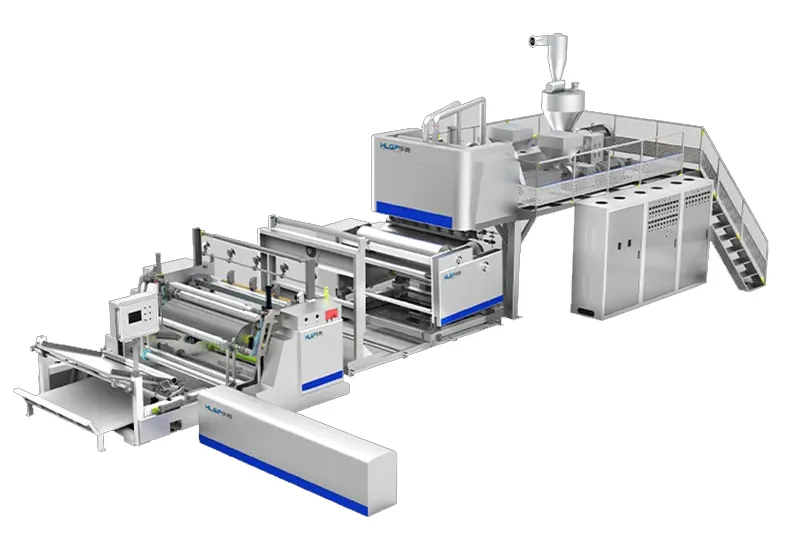
Film-stretching equipment is a specialized industrial or laboratory system that applies controlled mechanical and thermal conditions to polymer films. For example, biaxial stretching equipment stretches a film along two directions, usually the machine direction and the transverse direction, to modify its orientation and achieve specified material properties.
During laboratory testing, a tensile testing machine can also evaluate film strength, elongation, tearing behavior, and failure characteristics. Although these instruments share some testing terminology, a laboratory tensile tester and a continuous industrial film-stretching line perform different functions.
In production equipment, rollers, guide assemblies, drive shafts, and other rotating components help control film movement and tension. Consequently, their bearings must support the intended load and speed while maintaining suitable alignment and rotational stability.
Because many film-stretching systems operate with precise tension settings, temperature control, and continuous movement, bearing vibration, excessive friction, lubricant contamination, or premature wear can affect equipment stability. Therefore, bearing selection should follow the actual operating conditions instead of relying on a general claim that one material is always superior.
Where Do Bearings Matter?
- Roller support assemblies require stable rotation and suitable radial load capacity.
- Drive and transmission components need appropriate speed capability and mounting accuracy.
- Heated processing zones require a bearing system compatible with the actual temperature at the bearing location.
- Meanwhile, electrically sensitive or corrosive operating environments may justify evaluating ceramic rolling elements or full ceramic bearing constructions.
2. Understanding Ceramic Bearings
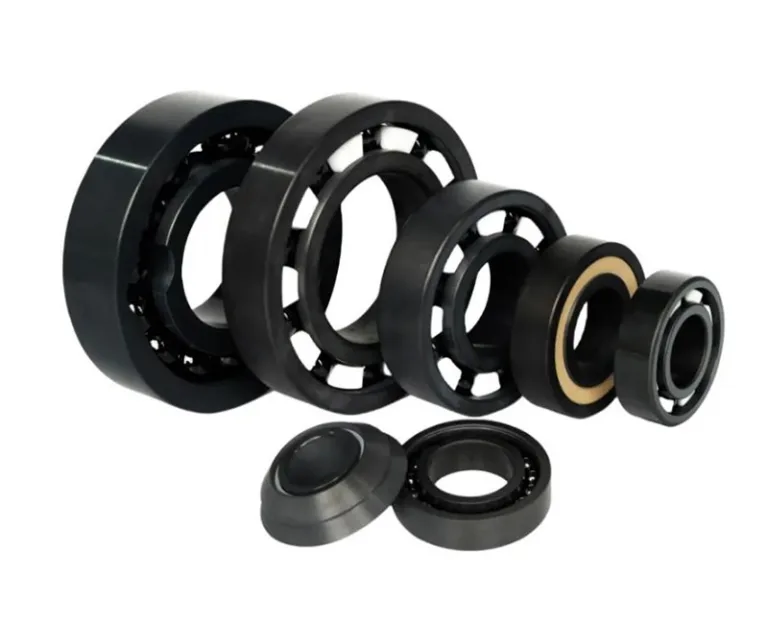
Ceramic bearings use technical ceramics in their rolling elements, raceways, or both. Compared with conventional all-steel bearings, selected ceramic designs can reduce rotating mass, resist particular corrosive media, and provide electrical insulation through the ceramic components.
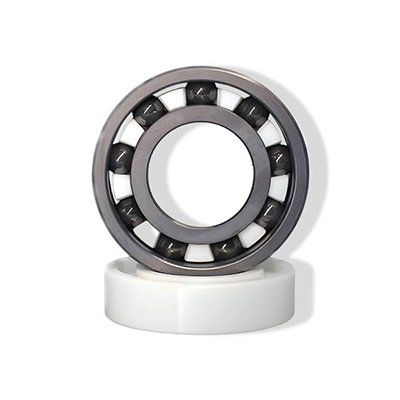
However, the term “ceramic bearing” describes more than one construction. Therefore, engineers should distinguish between full ceramic bearings and hybrid ceramic bearings before comparing performance or requesting a quotation.
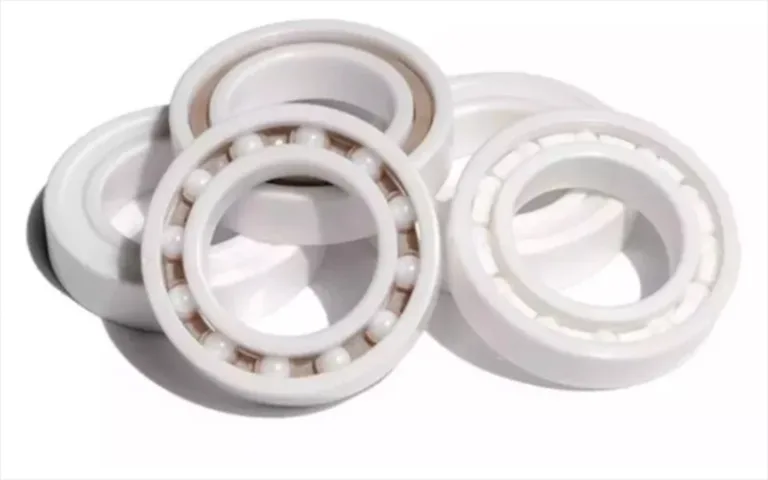
Full Ceramic Bearings
In a full ceramic bearing, both the inner and outer rings and the rolling elements use ceramic materials. Depending on the design, the cage may use a suitable polymer, ceramic, or metal.
Therefore, this construction may suit selected corrosive, electrically insulating, or specialized operating environments, provided the entire assembly meets the application’s requirements.
Hybrid Ceramic Bearings
In a hybrid bearing, the inner and outer rings typically use bearing steel, while the rolling elements use ceramic, commonly silicon nitride.
Because ceramic balls have lower density than steel balls, hybrid bearings can reduce rolling-element centrifugal effects in suitable high-speed applications. Nevertheless, the steel rings still influence corrosion resistance and electrical behavior.
Conceptual Material Structure Diagram
At the microscopic level, technical ceramics and stainless steel have different material structures. The following schematic illustrates the general distinction rather than a measured micrograph of a specific material grade.
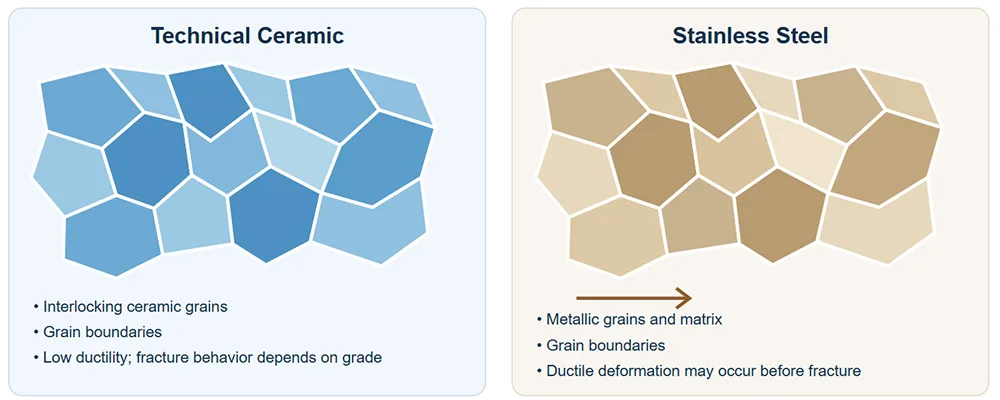
Note: Actual microstructures depend on composition, sintering or heat treatment, grain size, and processing history. The diagram is illustrative only.
3. Three Common Ceramic Bearing Materials
Although several technical ceramics exist, silicon nitride, zirconia, and alumina are three materials worth considering when evaluating ceramic bearing components. Each material offers a different balance of density, hardness, fracture behavior, thermal characteristics, and chemical compatibility.
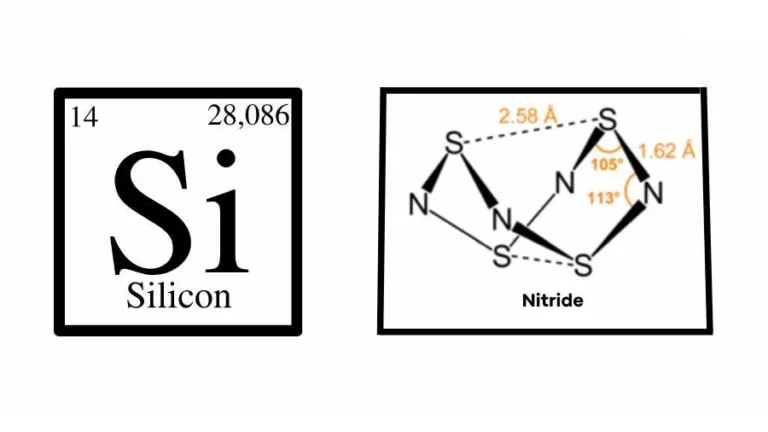
3.1 Silicon Nitride (Si₃N₄)
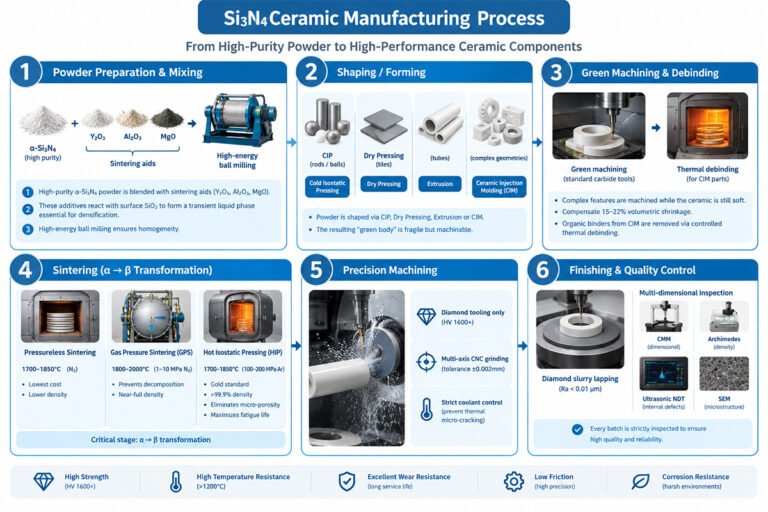
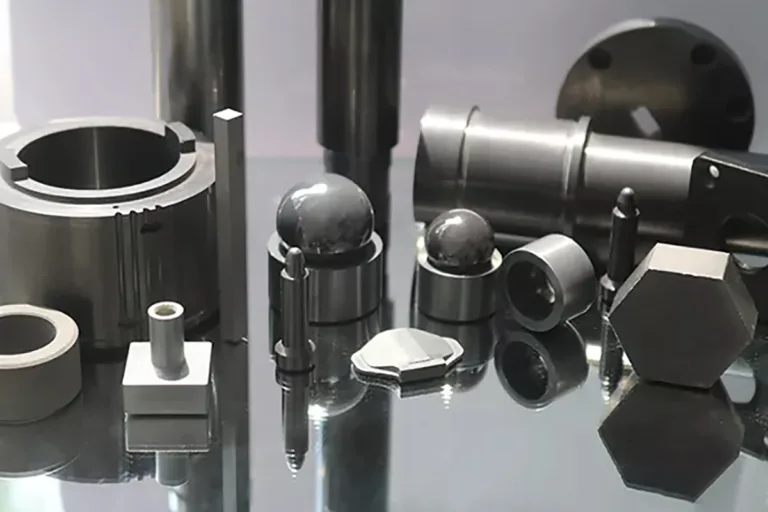
Silicon nitride is a widely used engineering ceramic for high-performance rolling elements, particularly in hybrid bearings. Because its density is approximately 3.2-3.3 g/cm³, a silicon nitride ball weighs considerably less than a steel ball of the same dimensions.
Moreover, silicon nitride typically combines high hardness, high stiffness, low thermal expansion, and good resistance to wear under suitable operating conditions. Consequently, engineers often consider it for high-speed spindles and precision rotating systems.
Nevertheless, silicon nitride remains a brittle ceramic rather than a ductile metal. Therefore, edge impact, poor mounting, misalignment, or unsuitable loading can cause damage, even when the material offers excellent hardness.
3.2 Zirconia (ZrO₂)
Zirconia provides a different performance profile because stabilized grades can offer higher fracture toughness than many conventional technical ceramics. Depending on composition and stabilizer, its density generally falls around 5.6–6.1 g/cm³.
Additionally, zirconia provides electrical insulation and can resist many corrosive environments. For that reason, engineers may evaluate zirconia components for selected chemical, fluid-handling, and electrically isolated applications.
However, zirconia’s properties depend strongly on the grade, stabilizer system, temperature, and environment. Therefore, designers should verify long-term stability and chemical compatibility instead of assuming that every zirconia formulation behaves identically.
3.3 Alumina (Al₂O₃)
Alumina is a common technical ceramic that offers high hardness, electrical insulation, and useful chemical resistance in many environments. Because it is widely used in insulating and wear-resistant components, it can also appear in specialized ceramic bearing designs.
Even so, alumina generally has lower fracture toughness than zirconia-toughened grades and is less common than silicon nitride for demanding high-speed rolling elements. Consequently, engineers should verify load, impact, and fatigue requirements before selecting alumina for a bearing application.
4. Ceramic Bearing Material Properties Compared
The following table summarizes typical material characteristics to support preliminary selection. However, actual values vary by grade, manufacturing process, temperature, and test method, so engineers should consult the supplier’s technical data for final design decisions.
| Property | Silicon Nitride | Zirconia | Alumina |
|---|---|---|---|
| Chemical formula | Si₃N₄ | ZrO₂ | Al₂O₃ |
| Typical density | About 3.2-3.3 g/cm³ | About 5.6-6.1 g/cm³ | About 3.8-4.0 g/cm³ |
| Hardness | Typically very high; grade dependent | High; grade dependent | Very high in common engineering grades |
| Fracture behavior | Brittle; strong performance in suitable bearing designs | Some stabilized grades offer relatively high fracture toughness | Brittle; impact needs careful control |
| Electrical behavior | Generally electrically insulating | Generally electrically insulating | Generally electrically insulating |
| Thermal characteristics | Low thermal expansion; relatively high thermal conductivity for a ceramic | Low thermal conductivity in many grades; expansion varies by formulation | Low thermal expansion; thermal conductivity depends on grade |
| Corrosion resistance | Good in many environments; verify chemical compatibility | Good in many environments; verify chemical compatibility | Good in many environments; strong-acid and strong-alkali behavior varies |
| Common bearing role | High-speed rolling elements and selected full ceramic bearings | Selected full ceramic and corrosion-resistant designs | Specialized insulating or wear-resistant applications |
Important: These figures are general engineering references, not guaranteed specifications for a finished bearing. For example, a bearing’s maximum speed or temperature also depends on its cage, lubricant, internal clearance, preload, seals, fit, load, and cooling conditions.
Ceramic Bearings Compared with Stainless Steel Bearings
Although ceramic bearings can offer lower mass and electrical insulation, stainless steel bearings retain important advantages in toughness, availability, and cost. Therefore, the comparison should include the actual bearing construction rather than the material name alone.
| Selection factor | Ceramic bearing | Stainless steel bearing |
|---|---|---|
| Rotating mass | Silicon nitride rolling elements are relatively lightweight | Generally heavier than silicon nitride rolling elements of the same size |
| Impact tolerance | Requires careful control because ceramic components can fracture under impact | Metallic toughness can provide better tolerance to shock in suitable designs |
| Corrosion resistance | Often strong, but the specific ceramic and other bearing components matter | Depends on stainless grade, lubricant, seals, and process chemicals |
| Electrical insulation | Ceramic components can provide insulation | Metallic rings and balls conduct electricity |
| Cost and sourcing | Usually higher material and manufacturing costs | Often more economical and widely available |
| Typical decision | Consider when a specific ceramic property solves a documented operating problem | Consider when toughness, cost, and corrosion resistance of the selected grade meet requirements |
5. Ceramic Bearing Applications and Classification
Engineers commonly classify ceramic bearing applications according to their dominant operating challenge. For example, some systems prioritize rotational speed, while others require electrical isolation, chemical resistance, or compatibility with elevated temperatures.
Nevertheless, these categories describe application goals rather than guaranteed performance. Therefore, each design still requires validation of the complete bearing assembly and its operating environment.
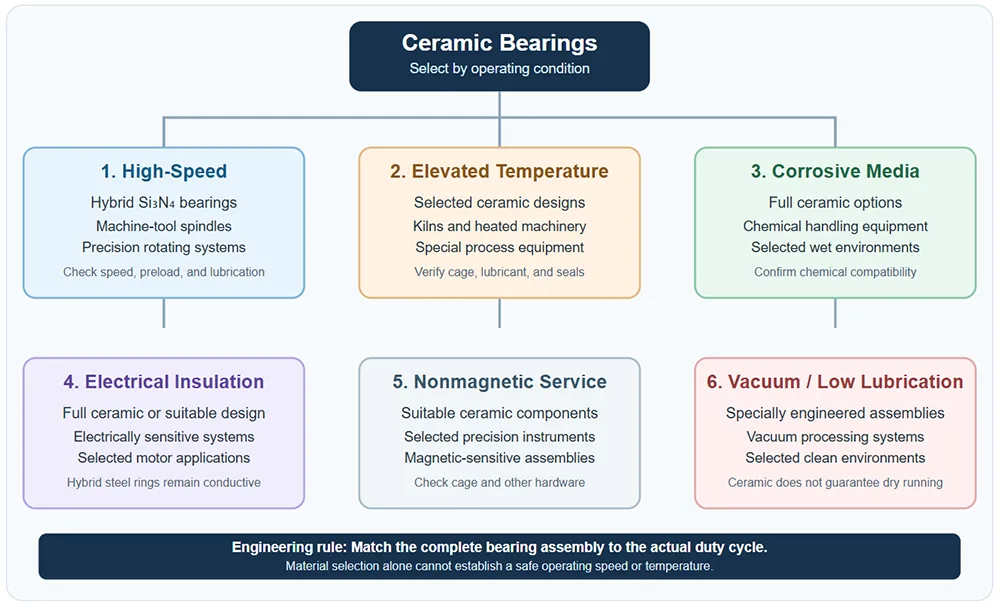
Figure: Application-based classification of ceramic bearings. This diagram is a selection guide, not a guarantee that every ceramic bearing can operate under every listed condition.
6. How to Implement Ceramic Bearings in Film-Stretching Equipment
To implement ceramic bearings successfully, start by identifying the failure mode or performance limitation that the new bearing should address. For instance, a machine may experience excessive bearing heating, lubricant-related contamination, corrosion, electrical damage, or instability at elevated rotational speeds.
Once the engineering objective becomes clear, follow a structured selection and validation process rather than choosing a ceramic material solely because it has high hardness or low density.
Define the Duty Cycle
First, record the rotational speed, radial and axial loads, acceleration, operating hours, temperature, and any shock or vibration.
Identify the Environment
Next, determine whether the bearing faces moisture, cleaning chemicals, process vapors, dust, electrical current, or vacuum conditions.
Choose the Construction
Then, compare full ceramic and hybrid bearings while considering whether the rings, balls, cage, seals, and lubricant suit the application.
Verify the Fit
Afterward, check shaft and housing tolerances, bearing clearance or preload, alignment, mounting methods, and thermal expansion.
Review Lubrication
Meanwhile, confirm lubricant compatibility, viscosity, supply method, cleanliness, and temperature limits instead of assuming that ceramic bearings always run without lubrication.
Validate the Installation
Finally, measure vibration, temperature, noise, film-tension stability, and bearing condition during controlled commissioning and representative production trials.
Which Ceramic Bearing Is Suitable for Film-Stretching Equipment?
For a high-speed guide roller or precision spindle, a hybrid bearing with silicon nitride balls may deserve evaluation because its lower rolling-element mass can reduce centrifugal effects. However, the final speed limit still depends on bearing geometry, cage design, lubrication, preload, and the manufacturer’s ratings.
In contrast, a full ceramic bearing may be worth considering when the operating environment requires electrical insulation or resistance to a compatible corrosive medium. Nevertheless, engineers should check the bearing’s load capacity and impact sensitivity, particularly where film tension fluctuates or the roller experiences sudden acceleration.
For a heated stretching zone, measure the temperature at the bearing itself rather than relying on the heater’s setpoint. Additionally, verify the limits of the cage, lubricant, seals, fits, and surrounding components, since the complete assembly may have a lower allowable temperature than the ceramic material.
Practical Engineering Checklist
- Record bearing designation, bore, outside diameter, width, and installation orientation.
- Document normal and peak rotational speeds, including acceleration and deceleration.
- Calculate radial and axial loads, including belt or film tension where relevant.
- Measure ambient temperature and the actual bearing operating temperature.
- Identify chemicals, cleaning agents, humidity, dust, and electrical requirements.
- Confirm cage material, lubricant type, seals, clearance, preload, and mounting tolerances.
- Define acceptance criteria for vibration, noise, temperature, and film-tension consistency before testing.
7. Advantages and Engineering Limitations
Potential Advantages of Ceramic Bearings
- Lower rolling-element mass: Silicon nitride balls can reduce inertial and centrifugal effects in suitable high-speed designs.
- High hardness: Technical ceramics can resist wear under appropriate contact, lubrication, and contamination conditions.
- Electrical insulation: Ceramic components can help isolate electrical paths, although hybrid bearings still contain conductive steel rings.
- Corrosion resistance: Selected ceramic grades can tolerate media that may damage some metals, subject to chemical compatibility.
- Thermal stability: Some ceramic properties remain stable under demanding temperatures, although the complete bearing assembly must also tolerate the operating conditions.
Important Limitations
- Brittle fracture risk: Ceramic rolling elements can crack or chip after impact, misalignment, or improper installation.
- Higher initial cost: Ceramic materials and precision finishing often increase purchase costs.
- Application-specific load capacity: Full ceramic designs may not match steel bearings in every load, shock, or fatigue condition.
- Lubrication requirements: Ceramic material alone does not guarantee self-lubrication or dry-running capability.
- System-level temperature limits: Cages, seals, lubricant, mounting fits, and surrounding machine parts can limit operating temperature even when the ceramic itself tolerates higher temperatures.
Accordingly, ceramic bearings are most valuable when their material properties address a specific engineering constraint. Conversely, stainless steel bearings may remain the better option when the machine needs higher impact tolerance, a lower initial cost, or a well-established bearing arrangement.
8. About AOFE MIMCustom
When a film-stretching equipment project requires a specialized ceramic or metal component, AOFE MIMCustom can serve as a contact point for discussing custom component requirements, material options, technical drawings, application conditions, and inspection expectations.
To support a more useful technical review, prepare the component drawing, required material grade, dimensions, tolerances, expected load, rotational speed, operating temperature, and environmental conditions. Additionally, describe the current component’s failure mode or performance limitation, since that information helps clarify the engineering objective.
For bearing-related projects, specify whether you need a complete bearing, a ceramic rolling element, a ring, a roller, or another precision component. Meanwhile, confirm AOFE MIMCustom’s actual supply scope, material availability, manufacturing capabilities, and inspection documentation directly before placing an order.
Ultimately, a clearly defined technical specification helps both parties assess whether a proposed component is suitable for the machine and whether further testing or engineering review is necessary.
Discuss Your Ceramic Component Requirements
To begin a technical discussion, prepare your drawing, material requirements, operating parameters, and target quantity. Then, request confirmation of the applicable material options, manufacturing scope, and inspection criteria.
Note: Confirm the company’s current product scope and technical capabilities before treating any proposed component as an approved bearing solution.
9. Frequently Asked Questions
Q1. Why should engineers consider ceramic bearings for film-stretching equipment?
Engineers should consider ceramic bearings when lower rolling-element mass, electrical insulation, or resistance to a compatible corrosive environment addresses a specific machine requirement. However, the final decision must also account for load, speed, temperature, lubrication, and impact risk.
Q2. Which ceramic material is commonly used for high-speed bearing balls?
Silicon nitride (Si₃N₄) is commonly used for high-performance ceramic rolling elements, especially in hybrid bearings. Because its density is relatively low, it can reduce rolling-element centrifugal effects, although the bearing’s complete design determines the actual speed capability.
Q3. Can ceramic bearings operate at 1200°C?
Not automatically, because the temperature capability of a ceramic material does not establish the operating limit of a finished bearing. Instead, engineers must verify the ceramic grade, cage, lubricant, seals, fits, load, speed, and thermal conditions; therefore, a conventional lubricated bearing assembly should never be assumed suitable for 1200°C without specific validation.
Q4. Do ceramic bearings always run without lubrication?
No, because ceramic rolling elements do not automatically eliminate friction or lubrication requirements. Although selected ceramic bearing designs can support specialized low-lubrication applications, engineers must confirm the manufacturer’s guidance and the suitability of the complete bearing construction.
Q5. Are full ceramic bearings better than hybrid ceramic bearings?
Neither construction is universally better, since each serves different engineering priorities. For example, hybrid bearings combine steel rings with ceramic rolling elements and may suit high-speed applications, whereas full ceramic bearings may be preferable when the rings also need electrical insulation or compatible corrosion resistance.
Q6. Can ceramic bearings improve film-stretching accuracy?
Ceramic bearings may contribute to stable operation when their design reduces a relevant source of vibration, heating, or wear. Nevertheless, film-stretching accuracy also depends on roller geometry, shaft stiffness, alignment, tension control, drive systems, and process temperature, so a bearing change alone cannot guarantee better film quality.
Q7. What information should I provide when requesting a ceramic bearing?
First, provide the bearing dimensions, type, speed, radial and axial loads, operating temperature, and duty cycle. Additionally, describe the process environment, lubricant, contamination risks, impact conditions, electrical requirements, quantity, and any existing failure history.
Q8. How can I verify whether a ceramic bearing is suitable for my machine?
Start by reviewing the supplier’s technical specifications and confirming the bearing’s allowable speed, load, temperature, and installation requirements. Subsequently, conduct a controlled trial under representative operating conditions and monitor vibration, temperature, noise, and film-tension stability before approving the design for routine production.
Conclusion: Choose Bearings Through Engineering Validation
In summary, ceramic bearings can provide meaningful advantages in film-stretching equipment when their material properties match the machine’s speed, environmental, and electrical requirements. In particular, silicon nitride rolling elements deserve consideration for suitable high-speed applications, while zirconia and alumina may suit selected specialized designs.
Nevertheless, reliable implementation depends on the complete bearing assembly rather than the ceramic material alone. Therefore, engineers should define operating conditions, verify fit and lubrication, review supplier data, and validate performance through controlled testing before adopting a ceramic bearing solution.