Advanced Ceramics | Welding Engineering | Precision Components
What Is the Core Function of Ceramic Welding Pins in Industrial Welding?
Ceramic welding pins are precision ceramic components that help locate workpieces, maintain alignment, provide electrical insulation where required, and withstand demanding thermal and mechanical conditions in industrial welding systems. In addition, suitable ceramic grades can resist corrosion, oxidation, and wear in environments where conventional metal components may require frequent replacement.
However, the best ceramic material depends on the welding process, contact conditions, electrical requirements, operating temperature, and mechanical loading. Therefore, engineers should evaluate alumina, zirconia, and silicon nitride according to the component’s actual function rather than assuming that one ceramic grade suits every welding application.
Quick Answer: What Does a Ceramic Welding Pin Do?
Primarily, a ceramic welding pin provides accurate positioning and mechanical support for a workpiece, fixture, or related assembly. Furthermore, its electrical insulation can help prevent unwanted current paths when the selected material and equipment design require electrical isolation.
Meanwhile, the ceramic body can resist high temperatures, chemical exposure, and wear when engineers select a suitable grade. Consequently, a well-designed pin may help maintain process consistency, reduce maintenance requirements, and support repeatable production.
For demanding industrial applications, silicon nitride offers a useful combination of low density, high strength, thermal-shock resistance, and wear resistance. Nevertheless, alumina may offer a more economical insulation solution, while zirconia can provide higher fracture toughness in selected mechanical applications.
1. What Is a Ceramic Welding Pin?
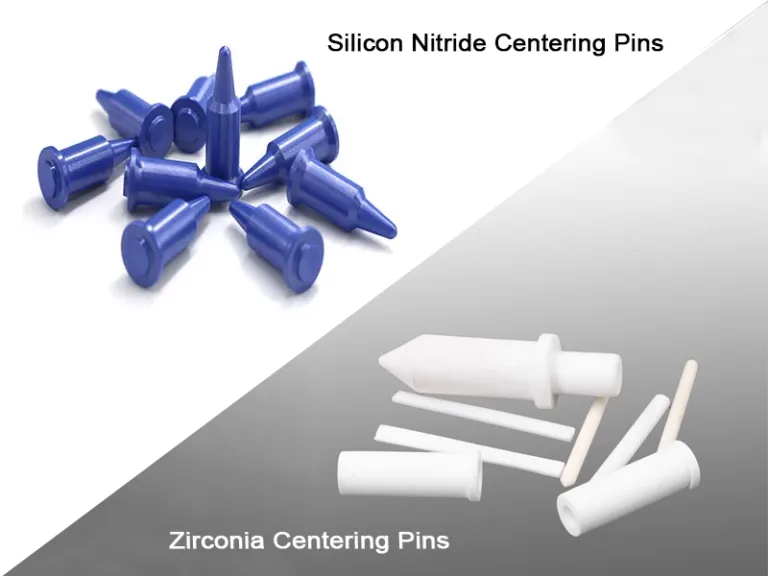
A ceramic welding pin is a precision component manufactured from an engineering ceramic such as aluminum oxide, zirconium dioxide, or silicon nitride. Depending on the machine design, the pin can locate a workpiece, guide a fixture, separate components electrically, or support a repeatable mechanical interface during welding.
Unlike a conventional metal pin, a ceramic pin can offer electrical insulation, high hardness, and strong resistance to many corrosive environments. Moreover, selected advanced ceramics retain useful mechanical properties at elevated temperatures, making them valuable in demanding production equipment.
Nevertheless, ceramic welding pins do not all perform the same function. Some pins act as locating or insulating components, while other ceramic parts serve as guides, supports, spacers, or wear-resistant fixtures around the welding zone.
1.1 How Does a Ceramic Welding Pin Differ from a Metal Pin?
Metal pins generally offer ductility and can tolerate certain forms of bending or impact without sudden fracture. By contrast, ceramic pins usually offer higher hardness and better electrical insulation, but their brittle behavior requires careful control of tensile stress, impact, and installation forces.
Furthermore, ceramic materials can resist oxidation and many chemical environments that attack particular metals. However, corrosion resistance remains material-specific, so engineers should verify compatibility with fluxes, cleaning agents, molten materials, and process chemicals.
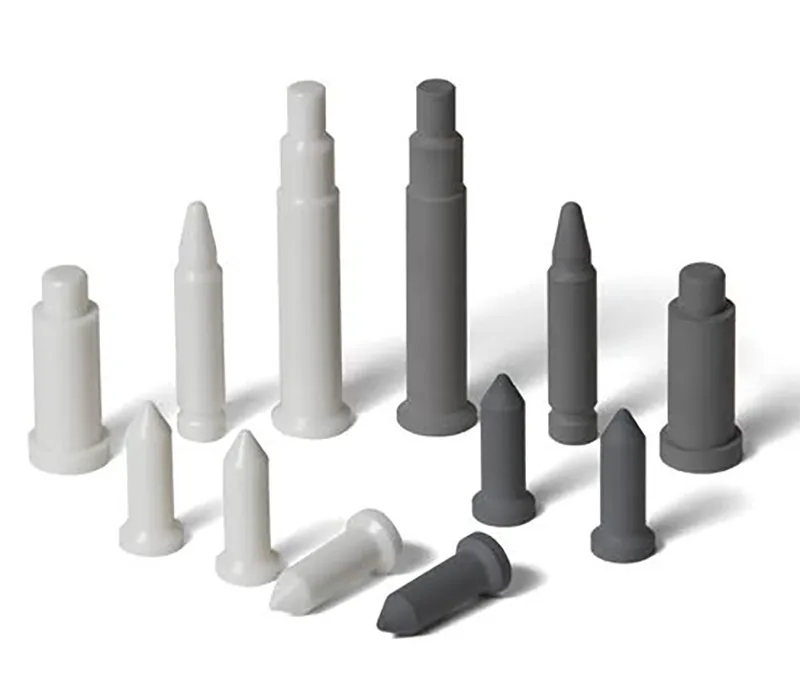
Typical Ceramic Welding Pin Configurations
- Straight pins: Provide simple locating or spacing functions.
- Stepped pins: Locate parts at different diameters or shoulder positions.
- Shouldered pins: Establish a defined seating position or axial stop.
- Insulating pins: Separate selected conductive components when the design requires electrical isolation.
- Custom-profile pins: Match specialized fixtures, automated production equipment, or application-specific interfaces.
2. Core Functions of Ceramic Welding Pins in Industrial Welding
The core function of a ceramic welding pin is to provide a stable, repeatable interface within a welding system. Depending on the design, this role may involve positioning, electrical isolation, thermal resistance, wear control, or a combination of these functions.
2.1 Precision Positioning and Alignment
First, a locating pin helps establish the relative position of a workpiece, fixture, or machine component. In automated welding, consistent positioning helps the welding equipment repeat the intended joint location and maintain the required relationship between the workpiece and the welding tool.
Consequently, the pin’s diameter, straightness, cylindricity, shoulder geometry, and mounting position can influence assembly repeatability. For high-precision equipment, engineers should also consider the fit between the pin and its mating hole, along with the effects of temperature and vibration.
2.2 Electrical Insulation
In selected welding fixtures, a ceramic pin electrically isolates a workpiece from a conductive support or separates components that must not share an unintended current path. Therefore, suitable electrical insulation can help protect the intended electrical arrangement and reduce the risk of unwanted conduction.
However, the pin does not automatically improve weld strength or concentrate current at the joint. In resistance welding, current distribution depends on the electrode arrangement, workpiece contact resistance, force, material thickness, and control settings; a ceramic pin contributes only where the fixture design assigns it an electrical-isolation role.
2.3 Resistance to Heat and Thermal Cycling
During welding, nearby fixtures and components may experience radiant heat, conductive heating, or repeated temperature changes. Accordingly, a suitable ceramic can maintain its shape and useful properties under thermal conditions that may accelerate deformation or oxidation in some metal components.
In addition, thermal-shock resistance matters when a component heats and cools rapidly. Silicon nitride often offers an advantage in this respect because it combines low thermal expansion with relatively high thermal conductivity, although the actual result depends on the grade, geometry, and temperature gradient.
2.4 Wear Resistance and Dimensional Stability
Repeated contact with workpieces, fixtures, or moving mechanisms can wear down a positioning component. Therefore, ceramic pins with suitable hardness and surface finish can help maintain locating geometry over repeated operating cycles.
Nevertheless, hardness alone does not determine wear life. Instead, engineers must evaluate contact pressure, friction, mating material, lubrication, abrasive particles, alignment, and impact loading.
2.5 Resistance to Weld Spatter and Contamination
In some welding environments, a suitable ceramic surface can reduce the tendency of certain contaminants or weld residues to adhere compared with an unsuitable metal surface. As a result, the component may simplify cleaning or reduce maintenance in a properly designed process.
However, no ceramic grade guarantees that weld spatter will never adhere. Surface roughness, spatter chemistry, temperature, coating, and the welding process all affect adhesion, so engineers should validate this benefit under actual production conditions.
Engineering Principle
A ceramic welding pin performs best when its material properties match the required function. Therefore, specify the pin according to positioning accuracy, electrical isolation, temperature, contact stress, wear conditions, and expected service life rather than choosing a ceramic solely because it has high hardness.
3. Which Materials Can Manufacture Ceramic Welding Pins?
Manufacturers can produce ceramic welding pins from several engineering ceramics, including alumina (Al₂O₃), zirconia (ZrO₂), silicon nitride (Si₃N₄), and, for selected specialized applications, silicon carbide (SiC). However, each material offers a different balance of electrical, mechanical, thermal, and chemical properties.
For that reason, material selection should begin with the pin’s function and the welding environment. In particular, engineers must distinguish electrical-insulation requirements from thermal conductivity requirements because a ceramic that transfers heat effectively may not provide the same electrical behavior as an insulating grade.
3.1 Alumina Ceramic (Al₂O₃)
Alumina is one of the most widely used technical ceramics because it combines high hardness, good electrical insulation, useful wear resistance, and broad industrial availability. Furthermore, its manufacturing maturity makes it a practical option for many general-purpose ceramic pins, spacers, and insulating components.
Depending on purity and formulation, alumina can operate at elevated temperatures and resist many industrial chemicals. Nevertheless, its thermal expansion is higher than that of silicon nitride, and its fracture toughness is generally lower than that of zirconia.
Consequently, alumina is often a strong starting point when electrical insulation, cost control, and general-purpose thermal resistance matter more than exceptional thermal-shock performance.
3.2 Zirconia Ceramic (ZrO₂)
Zirconia, especially yttria-stabilized zirconia, is valued for its high fracture toughness relative to many other ceramics. In addition, its strength and wear characteristics make it useful for precision components that encounter repeated mechanical contact.
Unlike silicon nitride, zirconia has a relatively high density and low thermal conductivity. Therefore, engineers should consider its greater mass and its response to temperature changes when designing high-speed or thermally demanding assemblies.
Even so, zirconia can be an appropriate choice for ceramic pins that prioritize resistance to crack propagation and mechanical damage, provided that the grade and mounting conditions suit the application.
3.3 Silicon Nitride Ceramic (Si₃N₄)
Silicon nitride is an advanced structural ceramic that combines low density, high stiffness, high strength, and favorable thermal-shock resistance. Moreover, its low thermal expansion can help maintain dimensional stability when a pin experiences changes in operating temperature.
In selected welding fixtures and precision mechanisms, these properties make silicon nitride attractive when the design must balance mechanical loading, thermal cycling, wear, and component mass. However, the material remains brittle and requires appropriate design against bending, tensile stress, edge impact, and installation damage.
Furthermore, silicon nitride can provide electrical insulation in suitable grades, although engineers should confirm the electrical properties of the actual material rather than assuming every ceramic formulation behaves identically.
3.4 Silicon Carbide Ceramic (SiC)
Silicon carbide offers high hardness, excellent wear resistance, and high thermal conductivity in many grades. Consequently, it can suit specialized components that require effective heat transfer or resistance to severe abrasive conditions.
However, silicon carbide does not always provide the electrical insulation expected from a ceramic welding pin. Depending on purity, additives, and manufacturing route, its electrical resistivity can differ substantially, so engineers should verify the specific grade before using it in an electrically insulating fixture.
4. Detailed Material Comparison for Ceramic Welding Pins
The table below compares representative properties of common engineering ceramic grades. Although the ranges provide a useful starting point, actual values depend on composition, purity, microstructure, processing, test method, and operating temperature.
Therefore, use these figures for preliminary engineering assessment rather than as guaranteed values for a finished welding pin. For critical applications, request the material datasheet and confirm the relevant properties with the supplier.
| Property | Alumina (Al₂O₃) | Zirconia (Y-TZP) | Silicon Nitride (Si₃N₄) | Silicon Carbide (SiC) |
|---|---|---|---|---|
| Density (g/cm³) | 3.7-3.95 | 5.7-6.1 | 3.2-3.3 | 3.1-3.2 |
| Young’s modulus (GPa) | 300-390 | 200-220 | 280-320 | 350-450 |
| Flexural strength (MPa) | Approximately 250-450 | Approximately 800-1,200 | Approximately 600-1,000 | Approximately 300-700 |
| Fracture toughness (MPa·√m) | Approximately 3-5 | Approximately 6-10 | Approximately 5-8 | Approximately 3-5 |
| Hardness (HV) | Approximately 1,400-1,800 | Approximately 1,100-1,400 | Approximately 1,400-1,800 | Approximately 2,000-3,000 |
| Thermal conductivity (W/m·K) | Approximately 20-35 | Approximately 2-3 | Approximately 15-30 | Approximately 80-200 |
| Thermal expansion coefficient (10⁻⁶/K) | Approximately 7-8.5 | Approximately 9-11 | Approximately 2.8-3.3 | Approximately 4-5 |
| Electrical behavior | Generally insulating | Generally insulating | Generally insulating in suitable grades | Grade-dependent; may be semiconductive |
| Main advantage | Insulation and cost-effective performance | High fracture toughness | Low density and thermal-shock resistance | Hardness and thermal conductivity |
Technical note: These are approximate representative ranges for selected engineering-grade materials. Silicon carbide and alumina values can vary widely by grade, purity, porosity, and additives. Electrical resistivity, high-temperature performance, and chemical compatibility require specific grade-level verification.
4.1 Which Material Offers the Best Electrical Insulation?
Alumina is a common choice for electrical insulating components because it combines good dielectric performance with broad industrial availability. In addition, suitable zirconia and silicon nitride grades can also provide electrical insulation for demanding assemblies.
However, silicon carbide may exhibit semiconductive behavior depending on its grade and processing route. Therefore, do not select SiC for an electrically insulating welding pin without confirming its resistivity and dielectric requirements.
4.2 Which Material Handles Thermal Shock Best?
Silicon nitride often performs well under thermal cycling because its low thermal expansion and relatively high thermal conductivity help reduce thermal stress. Meanwhile, silicon carbide can also offer strong thermal-shock performance in suitable grades, particularly where high thermal conductivity is beneficial.
By comparison, zirconia has much lower thermal conductivity and a higher expansion coefficient, while alumina’s thermal-shock behavior depends strongly on grade, geometry, and temperature gradient. Consequently, the best choice requires an assessment of the actual heating and cooling cycle.
4.3 Which Material Is Most Resistant to Mechanical Damage?
Zirconia often offers higher fracture toughness than the other listed ceramics, which can help resist crack propagation under certain loading conditions. Nevertheless, silicon nitride combines useful toughness with high strength and low density, making it attractive for many structural applications.
Ultimately, no ceramic is immune to fracture. Sharp corners, excessive interference fits, bending loads, poor mounting, and impact against hard edges can damage even a high-performance ceramic pin.
5. Visual Material Comparison: Why Silicon Nitride Is Worth Considering
The following chart highlights selected differences between alumina, zirconia, and silicon nitride. For clarity, the chart uses representative values rather than universal material specifications, so engineers should consult the detailed table and grade-specific datasheets before final selection.
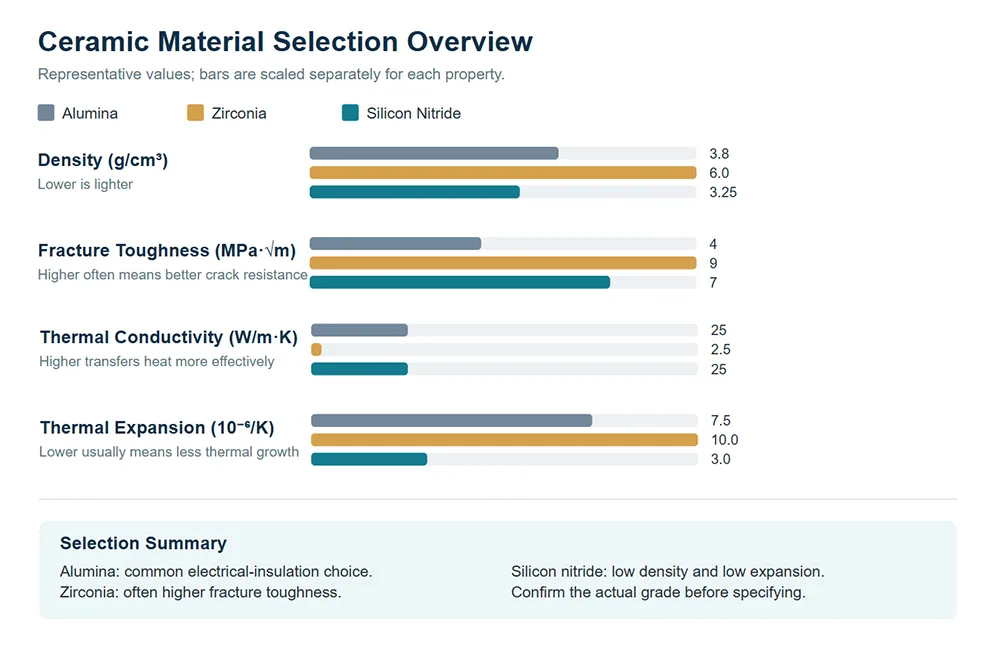
Note: The chart presents selected illustrative values. It does not predict actual welding-pin service life, electrical performance, or temperature limits.
6. Advantages of Silicon Nitride Ceramic Welding Pins
Silicon nitride is especially interesting for demanding structural applications because it combines low density with high stiffness, good mechanical strength, and favorable thermal properties. Moreover, these characteristics can help engineers balance component mass, positioning stability, and thermal durability.
6.1 Low Density and Reduced Moving Mass
Silicon nitride typically has a density of approximately 3.2-3.3 g/cm³, which is lower than that of many other engineering ceramics. Consequently, a silicon nitride pin may reduce moving mass when the component travels with a fixture or mechanism.
However, lower density does not automatically reduce total machine energy consumption. The actual effect depends on the moving assembly, acceleration profile, friction, drive system, and operating cycle.
6.2 Low Thermal Expansion and Dimensional Stability
Silicon nitride has a typical thermal expansion coefficient of approximately 2.8-3.3 × 10⁻⁶/K. Therefore, it generally expands less than alumina or zirconia under the same uniform temperature change.
For precision fixtures, this behavior can help maintain locating dimensions during thermal cycling. Nevertheless, the complete assembly also depends on the thermal expansion of the surrounding metal structure, the fit, and the actual temperature distribution.
6.3 Favorable Thermal-Shock Resistance
Rapid heating and cooling can generate thermal stresses inside brittle materials. Because silicon nitride combines low thermal expansion with relatively high thermal conductivity, it often offers favorable thermal-shock resistance compared with many conventional technical ceramics.
Even so, the material cannot eliminate thermal cracking under every condition. Component thickness, geometry, internal flaws, surface damage, and the severity of the thermal gradient still influence failure risk.
6.4 High Strength, Stiffness, and Wear Performance
Suitable silicon nitride grades provide high flexural strength and a Young’s modulus commonly around 280–320 GPa. In addition, their hardness and microstructure can support good wear resistance in demanding contact applications.
Consequently, silicon nitride may help maintain the geometry of a locating component during repeated service. However, engineers should verify wear behavior under the actual contact pressure, surface finish, mating material, and lubrication conditions.
6.5 Electrical Insulation in Suitable Grades
Silicon nitride can provide electrical insulation, making it a candidate for selected welding fixtures that require separation between conductive components. Furthermore, its structural properties can help a component combine insulation with mechanical support.
Nevertheless, the exact dielectric strength and electrical resistivity depend on the grade and material quality. Therefore, engineers should request relevant electrical data whenever the pin forms part of a safety-critical or electrically sensitive assembly.
When Should You Consider Silicon Nitride First?
Consider silicon nitride when the welding pin requires low mass, high stiffness, good wear performance, low thermal expansion, or resistance to repeated temperature changes. However, if the primary requirement is maximum fracture toughness, a suitable zirconia grade may offer an advantage; if cost-effective electrical insulation dominates, alumina may be the more practical starting point.
7. Main Industrial Applications of Ceramic Welding Pins
Ceramic welding pins can support different stages of industrial welding, from workpiece positioning to fixture insulation and wear control. However, the suitability of a particular ceramic depends on the welding method, machine layout, contact conditions, and required electrical behavior.
7.1 Automotive Manufacturing
In automotive production, locating pins can help position workpieces and fixture components during repetitive assembly operations. Furthermore, suitable ceramic pins may help reduce wear or provide electrical isolation at designated fixture interfaces.
7.2 Resistance Welding Fixtures
In selected resistance-welding fixtures, ceramic pins separate designated components electrically while helping maintain workpiece position. However, engineers must ensure that the pin does not interfere with the intended electrode contact, current path, or clamping arrangement.
7.3 Automated Welding Systems
In automated production lines, repeatable locating geometry helps reduce variation between successive workpieces. Consequently, precision-ground ceramic pins can support consistent fixture positioning where their material properties suit the machine’s load and temperature conditions.
7.4 Aerospace Component Manufacturing
Aerospace manufacturing may require precise fixturing and controlled handling of specialized metal components. In selected applications, advanced ceramic pins can support positioning or insulation, although the complete assembly must meet the applicable qualification and traceability requirements.
7.5 Electronics and Electrical Assembly
In selected electronics manufacturing processes, ceramic pins can provide precise locating features or electrical isolation. Meanwhile, alumina and suitable silicon nitride grades may offer useful combinations of insulation, dimensional stability, and mechanical strength.
7.6 High-Temperature Industrial Equipment
In selected furnace-related equipment and hot-zone fixtures, ceramic pins can provide positioning or support where conventional materials may lose performance. Nevertheless, engineers must verify the actual temperature, atmosphere, thermal cycling, and chemical exposure for the chosen grade.
7.7 Which Ceramic Should You Choose for Each Application?
| Application Requirement | Material to Evaluate First | Reason |
|---|---|---|
| General electrical insulation | Alumina | Broad industrial use and good insulating performance. |
| Low mass and thermal cycling | Silicon nitride | Low density and favorable thermal-shock resistance. |
| Higher fracture toughness | Zirconia | Y-TZP often offers stronger resistance to crack propagation. |
| High wear and thermal conductivity | Silicon carbide | Many grades offer high hardness and thermal conductivity; verify electrical behavior. |
| Precision locating with moderate thermal demand | Alumina, zirconia, or silicon nitride | Select according to load, fit, wear, cost, and operating environment. |
8. Ceramic Welding Pin Manufacturing Process
Manufacturing a reliable ceramic welding pin requires control over powder quality, forming, densification, dimensional finishing, and inspection. Although alumina, zirconia, silicon nitride, and silicon carbide share several production stages, each material requires its own qualified process parameters.
Unlike many metal pins, a sintered ceramic pin often requires diamond grinding to achieve demanding dimensions and surface finishes. Therefore, manufacturers must account for shrinkage, machining allowance, ceramic brittleness, and the risk of surface damage throughout production.
8.1 Step 1: Raw Material Selection
First, the manufacturer selects the ceramic powder according to the target material grade, purity, particle size, and required properties. In addition, the team evaluates the intended electrical, thermal, mechanical, and chemical requirements before confirming the formulation.
8.2 Step 2: Powder Preparation and Mixing
Next, the manufacturer prepares the powder using an appropriate mixing, milling, granulation, or dispersion method. Depending on the material and forming route, processing additives or binders may help achieve consistent flow and green-body strength.
8.3 Step 3: Forming the Green Body
Subsequently, the prepared material enters a suitable forming process, such as dry pressing, cold isostatic pressing, extrusion, or ceramic injection molding. The chosen method depends on the pin geometry, production quantity, material characteristics, and required dimensional consistency.
8.4 Step 4: Debinding When Required
When the forming route uses organic binders, a controlled debinding cycle removes those materials before or during the appropriate stage of thermal processing. Consequently, the manufacturer can reduce the risk of defects associated with unsuitable binder removal.
8.5 Step 5: Sintering and Densification
After forming, the manufacturer applies a material-specific sintering process to develop the required density and microstructure. For example, silicon nitride may require a specialized sintering route, while alumina and zirconia use different qualified temperature profiles and atmospheres.
Because densification causes shrinkage, the initial dimensions must account for the selected process. Furthermore, temperature uniformity, powder consistency, and furnace control influence the final component’s dimensions and material quality.
8.6 Step 6: Precision Grinding and Finishing
Once the ceramic body reaches the required material condition, the manufacturer uses suitable grinding and finishing operations to achieve the specified diameter, length, shoulder geometry, and end profile. In particular, diamond tooling often helps machine dense technical ceramics accurately.
Meanwhile, controlled edge finishing can reduce sharp corners that may initiate cracks during assembly. However, the appropriate chamfer, radius, and surface roughness must follow the engineering drawing rather than a generic assumption.
8.7 Step 7: Inspection and Quality Control
Finally, the manufacturer inspects critical dimensions, geometric accuracy, surface finish, and visible defects according to the agreed quality plan. For demanding applications, the inspection plan may also include material identification, traceability, and additional tests specified by the customer.
Consequently, a well-defined inspection plan helps confirm whether the finished pin meets the drawing requirements. Nevertheless, customers should agree on acceptance criteria and documentation before production begins.
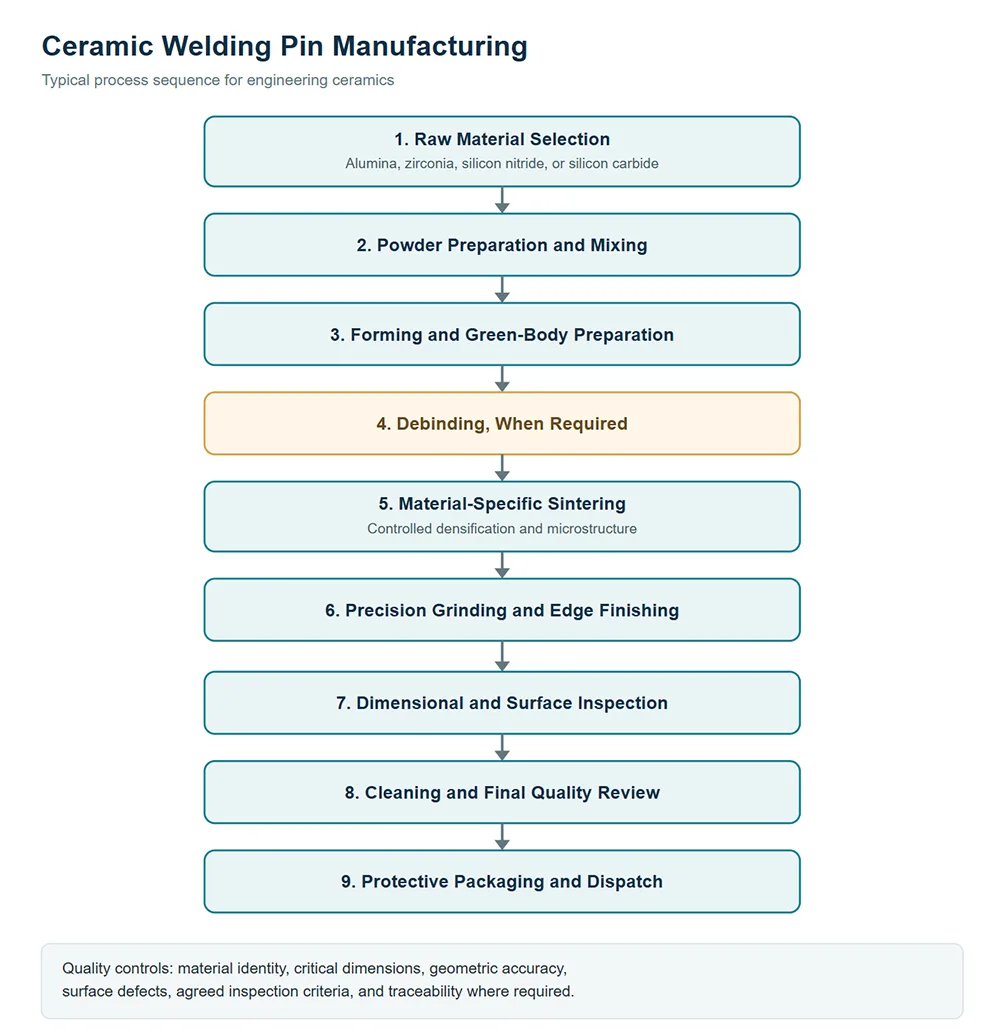
8.8 Diagram: Ceramic Welding Pin Production Flow
The following illustrates the typical manufacturing sequence. However, the exact process depends on the selected ceramic material, component geometry, and required performance.
9. AOFE MIMCustom: Custom Ceramic Welding Pin Solutions
Industrial welding applications often require components that match specific fixture geometries, operating temperatures, electrical requirements, and assembly tolerances. Therefore, a successful custom project starts with a clear understanding of the component’s function and the conditions it must withstand.
AOFE MIMCustom can work with customers to review custom ceramic component requirements and identify suitable manufacturing considerations. For ceramic welding pins, the following engineering support areas provide a practical framework for project evaluation.
9.1 Application-Based Material Review
First, evaluate alumina, zirconia, silicon nitride, or another suitable ceramic against the operating conditions. In addition, consider electrical insulation, temperature, thermal cycling, contact stress, wear, chemical exposure, and component mass.
9.2 Drawing-Based Customization
Next, review the engineering drawing to establish the pin diameter, length, shoulder dimensions, end profile, and critical tolerances. Consequently, the supplier can assess the geometry and identify important manufacturing constraints before quotation.
9.3 Manufacturing Route Evaluation
Meanwhile, the selected forming, sintering, and finishing methods should match the material grade and component design. For example, a straight cylindrical pin may require a different production plan from a pin with several shoulders or complex locating features.
9.4 Critical Dimension and Quality Planning
In addition, define the dimensions and surface characteristics that determine the component’s function. Where required, confirm inspection methods, acceptance criteria, available material data, and traceability documentation before production.
9.5 Prototype and Production Coordination
For new designs, begin with a review of the critical fit and functional requirements. Subsequently, validate the component in its intended assembly before finalizing the production specification or increasing order quantities.
9.6 Technical Communication
Finally, provide the drawing, material preference, operating environment, tolerance requirements, expected quantity, and intended use during the inquiry stage. Clear technical information helps the supplier evaluate feasibility and clarify the requirements for a quotation.
Discuss Your Custom Ceramic Welding Pin Requirements
Whether your project requires alumina for electrical insulation, zirconia for fracture toughness, or silicon nitride for low density and thermal stability, the first step is to define the component’s operating conditions and critical dimensions.
For a technical inquiry, prepare: the engineering drawing, preferred ceramic material, pin dimensions, tolerances, surface finish, operating temperature, loading conditions, electrical requirements, and expected order quantity.
Supplier verification note: Confirm AOFE MIMCustom’s available material grades, manufacturing routes, achievable tolerances, inspection capabilities, certifications, lead times, and documentation for your specific project before placing an order.
10. Technical Specifications for Custom Ceramic Welding Pins
Custom ceramic welding pins can feature straight bodies, stepped diameters, shoulders, chamfers, rounded ends, and other application-specific profiles. However, achievable dimensions and tolerances depend on the ceramic grade, forming method, grinding capability, and component geometry.
Consequently, engineers should provide a dimensioned drawing and identify critical-to-quality features instead of relying on a generic tolerance assumption. In addition, the specification should define the inspection method and acceptance criteria for the dimensions that affect the assembly’s function.
| Specification | Information to Define | Engineering Purpose |
|---|---|---|
| Ceramic material | Al₂O₃, ZrO₂, Si₃N₄, or SiC grade | Defines the baseline material properties. |
| Dimensions | Diameter, length, shoulder position, and end geometry | Controls fit and locating accuracy. |
| Dimensional tolerances | Specified limits for critical features | Supports repeatable assembly. |
| Geometric accuracy | Straightness, cylindricity, perpendicularity, or runout where relevant | Maintains positioning consistency. |
| Surface finish | Required roughness and finish condition | Influences contact, friction, and wear. |
| Operating environment | Temperature, atmosphere, chemicals, and thermal cycles | Determines material suitability. |
| Electrical requirements | Insulation, resistivity, or dielectric requirements where applicable | Helps confirm electrical compatibility. |
| Inspection documentation | Inspection plan, material data, traceability, and sampling requirements | Defines measurable acceptance criteria. |
For critical welding fixtures, engineers should also specify how the pin will be installed and retained. Therefore, the drawing review should include the mating hole, interference or clearance fit, support length, and any local stresses that could cause brittle fracture.
11. Frequently Asked Questions About Ceramic Welding Pins
Q1. What is the main function of a ceramic welding pin?
Primarily, a ceramic welding pin locates or supports components in a welding fixture. Depending on the design, it can also provide electrical insulation, resist wear, and maintain useful dimensions under elevated temperatures or repeated thermal cycles.
Q2. Which materials can manufacturers use for ceramic welding pins?
Common options include alumina, zirconia, and silicon nitride, while silicon carbide suits selected specialized applications. However, the best material depends on the required insulation, mechanical loading, thermal conditions, wear resistance, and chemical compatibility.
Q3. Why choose silicon nitride ceramic welding pins?
Silicon nitride combines low density, high stiffness, good strength, low thermal expansion, and favorable thermal-shock resistance. Consequently, it can suit demanding fixtures where thermal cycling, component mass, and dimensional stability matter.
Q4. Are ceramic welding pins electrically insulating?
Alumina, zirconia, and suitable silicon nitride grades generally provide electrical insulation. However, silicon carbide may be semiconductive depending on its grade, so engineers should verify electrical resistivity and dielectric requirements before selecting a material.
Q5. Can ceramic welding pins withstand temperatures above 1,000°C?
Certain engineering ceramics can retain useful properties above 1,000°C, but the actual temperature limit depends on the material grade, atmosphere, load, exposure duration, and thermal cycling. Therefore, engineers should confirm the supplier’s data for the intended service conditions rather than apply one temperature limit to all ceramic pins.
Q6. Do ceramic welding pins prevent weld spatter from sticking?
Certain ceramic surfaces may reduce adhesion under specific welding conditions, but no material guarantees spatter-free operation. In practice, surface finish, spatter chemistry, temperature, and the welding process determine the result.
Q7. Are ceramic welding pins suitable for resistance welding?
Yes, selected ceramic pins can support positioning or electrical isolation in resistance-welding fixtures. Nevertheless, the design must preserve the intended electrode contact and current path, while the ceramic grade must satisfy the required mechanical and electrical conditions.
Q8. How are ceramic welding pins manufactured?
Typically, production includes powder preparation, forming, debinding when required, sintering, precision grinding, inspection, cleaning, and packaging. Furthermore, the manufacturer adjusts the process to the selected material, component geometry, and required tolerances.
Q9. Can manufacturers customize ceramic welding pins?
Yes, manufacturers can produce custom ceramic pins according to suitable drawings and process capabilities. For an accurate feasibility review, provide the dimensions, material preference, tolerances, surface finish, operating conditions, and expected quantity.
Q10. How can engineers reduce the risk of ceramic pin fracture?
First, avoid excessive interference fits, direct hammering, sharp-edge impacts, and unnecessary bending loads. Furthermore, use suitable support geometry and edge finishing, while ensuring that the installation method matches the ceramic’s brittle behavior.
Q11. Which ceramic is best for high-temperature welding fixtures?
Silicon nitride often deserves consideration when thermal shock and dimensional stability matter, while alumina can be suitable for many insulating fixtures. However, the best choice depends on the actual temperature, atmosphere, load, thermal cycle, and component geometry.
Q12. What information should I provide when requesting a quotation?
Provide a technical drawing, target ceramic material, dimensions, tolerances, surface finish, operating temperature, mechanical loading, electrical requirements, and expected quantity. Consequently, AOFE MIMCustom can review the application requirements and clarify the information needed for a project-specific quotation.
Conclusion: The Core Function of Ceramic Welding Pins
Ceramic welding pins provide precision positioning, mechanical support, and electrical isolation where the equipment design requires it. In addition, suitable ceramic materials can improve resistance to heat, wear, oxidation, and chemical exposure, helping engineers design more durable welding fixtures.
Among the common materials, alumina offers a practical combination of electrical insulation and broad industrial availability, while zirconia often provides higher fracture toughness. Meanwhile, silicon nitride stands out for its low density, high stiffness, low thermal expansion, and favorable thermal-shock resistance.
For demanding welding applications, choose the ceramic according to the actual failure risks and operating requirements. Ultimately, the best result comes from matching the material grade, component geometry, manufacturing process, and inspection criteria to the intended application.