Technical Article | Advanced Ceramic Materials
Why Do Hybrid Ceramic Bearings Have a Longer Service Life Despite Higher Contact Stress?
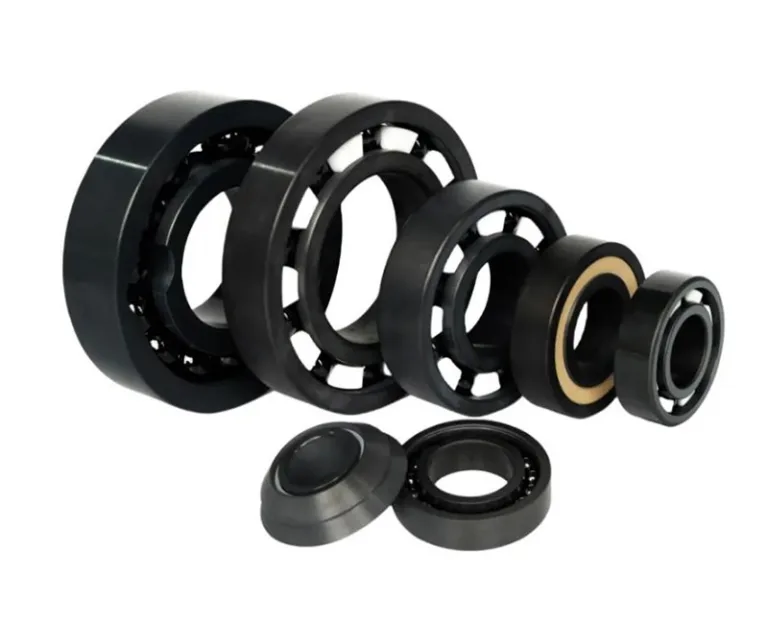
In high-speed machinery, hybrid ceramic bearings combine silicon nitride (Si₃N₄) rolling elements with precision steel rings to achieve a balance of speed capability, wear resistance, and mechanical reliability. Although the ceramic balls can create higher Hertzian contact stress than comparable steel balls under certain conditions, modern bearing-grade silicon nitride and improved manufacturing processes can help these bearings maintain strong rolling contact fatigue performance.
However, higher contact stress does not automatically mean longer bearing life, and ceramic construction does not guarantee a longer service life in every application. Instead, the outcome depends on material quality, contact geometry, lubrication, contamination, operating load, manufacturing defects, and the bearing’s actual failure mechanism.
Therefore, understanding the relationship between silicon nitride properties, contact mechanics, manufacturing quality, and rolling contact fatigue is essential when selecting hybrid ceramic bearings for demanding industrial applications.
Quick Answer: Why Can Hybrid Ceramic Bearings Last Longer?
In suitable operating conditions, hybrid ceramic bearings can deliver long service life because modern bearing-grade silicon nitride combines low density, high hardness, high stiffness, and good wear resistance with improved material consistency and surface quality.
- Lower rolling-element density: Consequently, silicon nitride balls generate lower centrifugal forces than comparable steel balls at the same speed and effective radius.
- High material stiffness: Additionally, silicon nitride’s high elastic modulus changes the contact deformation and stress distribution between the ball and steel raceway.
- Improved material quality: Meanwhile, better powder processing, sintering, finishing, and defect inspection can reduce critical flaws in ceramic rolling elements.
- Strong wear resistance: Furthermore, suitable silicon nitride grades can resist surface wear and retain their rolling contact integrity under appropriate conditions.
- Controlled manufacturing: Ultimately, consistent quality and suitable lubrication help the complete bearing system achieve its intended fatigue life.
Important qualification: These advantages do not eliminate ceramic fracture risk, lubrication requirements, contamination sensitivity, or the need to validate bearing life under the intended operating conditions.
1. What Is a Hybrid Ceramic Bearing?
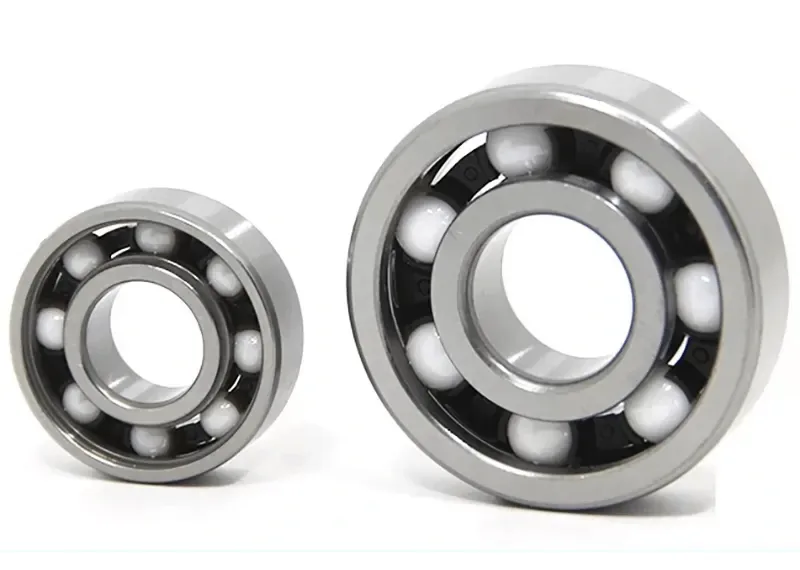
Fundamentally, a hybrid ceramic bearing uses ceramic rolling elements together with metal bearing rings, rather than manufacturing every major bearing component from ceramic. In a common design, silicon nitride balls run between precision-hardened steel inner and outer rings, while a cage maintains ball spacing and guides the rolling elements during operation.
Compared with a conventional all-steel bearing, this arrangement replaces the steel balls with lighter ceramic balls while retaining the established mechanical and manufacturing characteristics of steel raceways. Consequently, the hybrid configuration can be attractive for high-speed spindles, electric motors, turbochargers, and other precision rotating equipment.
Nevertheless, hybrid ceramic bearings are not the same as full ceramic bearings, because their steel rings can still corrode and remain susceptible to electrical damage. Therefore, engineers should evaluate the complete bearing construction rather than assuming that ceramic balls alone provide full corrosion resistance or complete electrical isolation.
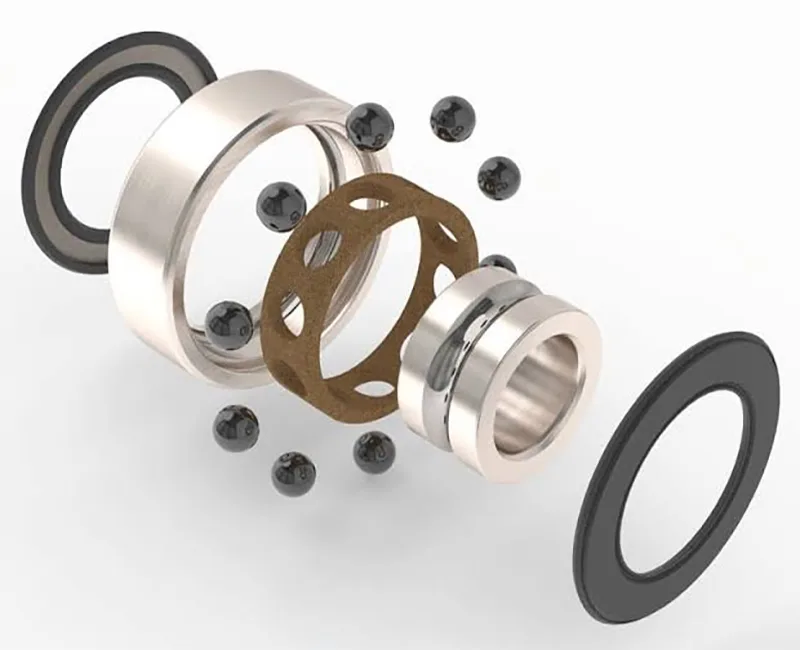
Typical Hybrid Ceramic Bearing Structure
- Inner ring: Typically precision bearing steel, with a finished raceway designed for the specified load and operating speed.
- Rolling elements: Typically bearing-grade silicon nitride ceramic balls, selected for their mechanical properties and dimensional accuracy.
- Outer ring: Typically precision bearing steel, with raceway geometry matched to the bearing design.
- Cage or separator: A suitable material that maintains ball spacing and controls rolling-element motion.
- Lubricant and seals: Components selected according to speed, temperature, environment, and maintenance requirements.
2. Silicon Nitride: The Core Material Behind Hybrid Ceramic Bearings
First, silicon nitride (Si₃N₄) is an advanced technical ceramic widely used for demanding rolling elements because it combines low density with high elastic modulus, high hardness, and good wear resistance. In addition, suitable bearing grades offer good resistance to thermal shock and many corrosive environments.
Unlike ductile steel, however, silicon nitride behaves as a brittle ceramic and does not yield plastically in the same manner under severe impact. Therefore, its advantages depend on careful control of defects, contact geometry, installation, and the operating loads that the bearing must support.
2.1 Silicon Nitride Material Structure and Performance
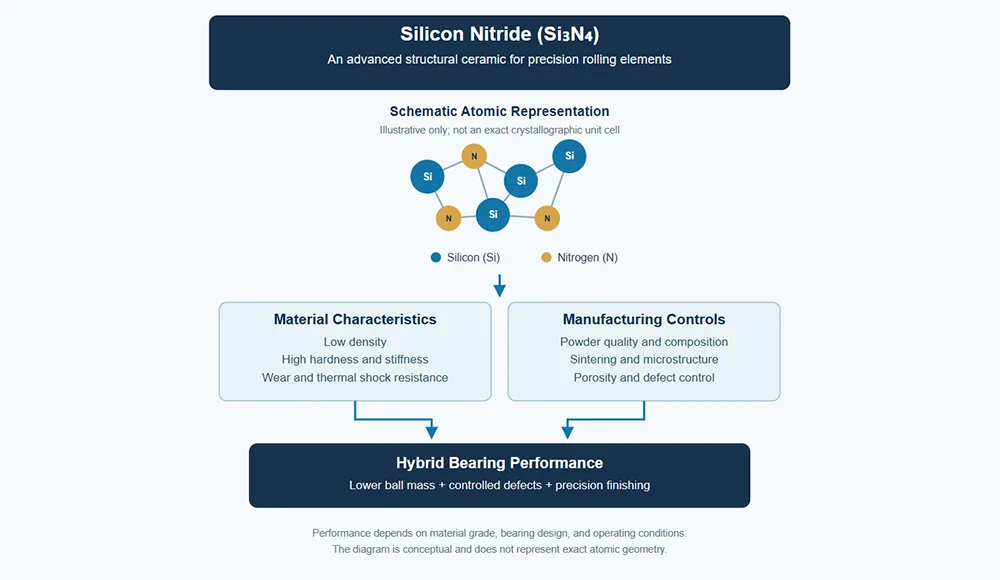
At the material level, silicon nitride’s engineering performance comes from its ceramic microstructure, phase composition, grain boundaries, and manufacturing history. Consequently, powder purity, additives, sintering conditions, porosity, and surface finishing all influence the properties of the final rolling element.
Silicon Nitride: Material Structure to Bearing Performance
2.2 Typical Properties of Bearing-Grade Silicon Nitride
For preliminary engineering comparisons, bearing-grade silicon nitride commonly exhibits the approximate properties listed below. However, exact values vary with grade, microstructure, test method, and supplier specifications, so buyers should confirm the actual data for the selected material.
| Property | Representative Range | Engineering Significance |
|---|---|---|
| Density | Approximately 3.2-3.3 g/cm³ | Reduces rolling-element mass and can lower centrifugal forces at high speed. |
| Elastic modulus | Approximately 280-320 GPa | Influences elastic deformation and Hertzian contact behavior. |
| Hardness | Approximately 1,400-1,800 HV | Supports wear resistance and surface durability under suitable contact conditions. |
| Fracture toughness | Often approximately 5-8 MPa·√m | Indicates resistance to crack propagation; grade and test method affect the value. |
| Thermal expansion coefficient | Approximately 2.8-3.3 × 10⁻⁶/K | Supports dimensional stability across temperature changes. |
| Thermal conductivity | Often approximately 15-30 W/(m·K) | Influences heat transfer within the ceramic component. |
| Electrical resistivity | Generally high; grade-dependent | Can help interrupt electrical current paths through hybrid bearing contacts. |
Note: These values are representative engineering ranges rather than acceptance limits. In particular, fracture toughness and hardness values depend on measurement method and material grade.
3. Hybrid Ceramic Bearing Properties: Advantages and Limitations
Compared with an all-steel bearing, a hybrid ceramic bearing changes the mass, stiffness, contact behavior, and surface interaction of the rolling elements. Consequently, engineers must consider both the benefits and the trade-offs rather than evaluating ceramic balls by hardness alone.
| Property or Factor | Hybrid Ceramic Bearing | Engineering Consideration |
|---|---|---|
| Rolling-element density | Lower than bearing steel. | Can reduce centrifugal loading at high speed. |
| Elastic modulus | Higher than conventional bearing steel. | Can increase Hertzian contact stress for comparable contact geometry and load. |
| Hardness and wear | High hardness and good wear resistance. | Surface finish, lubrication, and raceway condition remain critical. |
| Electrical behavior | Ceramic balls generally provide electrical insulation. | Actual current-path interruption depends on the complete bearing and machine design. |
| Corrosion resistance | Ceramic balls resist many corrosive environments. | Steel rings and other components may still corrode. |
| Impact tolerance | Ceramic rolling elements can fracture under severe impact. | Installation, shock loading, and handling require careful control. |
| Service life | Can be long in a suitably engineered application. | Actual life depends on fatigue, lubrication, contamination, defects, and load. |
4. Why Can Service Life Remain High Despite Higher Contact Stress?
The key lies in separating contact stress from fatigue resistance. Although silicon nitride’s higher elastic modulus can increase Hertzian contact stress under comparable loading and geometry, fatigue performance also depends on the material’s flaw population, microstructure, surface condition, lubrication regime, and the location where fatigue damage initiates.
4.1 Higher Elastic Modulus Changes Contact Stress
In a rolling bearing, Hertzian contact theory describes the local pressure distribution between the rolling element and the raceway. Because silicon nitride has a higher elastic modulus than bearing steel, the combined elastic contact can become stiffer and the contact area can become smaller under comparable loading and geometry.
Consequently, a smaller contact area can produce a higher peak Hertzian pressure even when the external load remains unchanged. However, the exact stress difference depends on the ball and raceway radii, elastic properties of both contacting materials, load distribution, and bearing geometry.
Engineering Principle: Hertzian Contact
For an idealized elastic point contact, the maximum contact pressure depends on the applied load, effective contact radius, and combined elastic modulus. Therefore, engineers should not compare ceramic and steel balls using material hardness alone.
In practice, reliable life evaluation requires an appropriate contact-mechanics model and the bearing manufacturer’s design data, particularly when the application involves high speed, preload, or demanding fatigue requirements.
4.2 Modern Silicon Nitride Has Better Controlled Material Quality
Over recent decades, improvements in ceramic powder processing, composition control, sintering, and nondestructive inspection have helped manufacturers produce more consistent bearing-grade silicon nitride. As a result, they can reduce the frequency and severity of defects that may initiate cracks or shorten rolling contact fatigue life.
In particular, pores, inclusions, abnormal microstructural regions, and surface flaws can act as local stress concentrators. Therefore, reducing critical defects and improving process consistency can help ceramic rolling elements tolerate demanding cyclic contact conditions more reliably.
Nevertheless, no manufacturing route removes every defect, and a single inspection method cannot detect all possible flaw types at every size. Consequently, material qualification should combine appropriate process controls, inspection methods, dimensional checks, and application-specific performance validation.
4.3 Sintering and Densification Influence Fatigue Reliability
During silicon nitride production, sintering develops the dense microstructure required for mechanical performance. Depending on the selected material grade and manufacturing route, manufacturers may use gas-pressure sintering, hot pressing, or other qualified densification processes to achieve the intended properties.
Additionally, hot isostatic pressing (HIP) may improve density and reduce residual porosity in suitable materials and process sequences. However, HIP is not a universal requirement for every silicon nitride bearing ball, because the appropriate route depends on the grade, production method, component geometry, and required performance.
For this reason, a well-controlled process should specify powder characteristics, forming conditions, sintering parameters, density requirements, finishing operations, and acceptance criteria. Ultimately, the goal is to produce a consistent microstructure with low defect levels rather than simply selecting a process name.
4.4 Rolling Contact Fatigue Depends on the Failure Mechanism
Under heavy loads and effective lubrication, rolling contact fatigue may initiate beneath the contact surface, where cyclic shear stresses interact with material imperfections. Consequently, subsurface material quality can become a major factor in fatigue performance under these conditions.
Meanwhile, surface-initiated damage may become more important when contamination, inadequate lubrication, rough raceways, or sliding dominates the contact. Therefore, an engineering comparison should identify the expected failure mechanism instead of assuming that every bearing will fail through the same fatigue process.
Accordingly, hybrid ceramic bearings can demonstrate fatigue performance comparable to steel-ball bearings in suitable tested designs, despite higher contact stress. However, this conclusion must remain tied to the tested bearing configuration and operating conditions rather than serving as a universal guarantee of longer service life.
4.5 Lower Ball Mass Can Improve High-Speed Operating Conditions
In high-speed bearings, ceramic balls weigh substantially less than comparable steel balls, so they generate lower centrifugal forces at the same effective radius and rotational speed. As a result, this reduction can help manage ball–raceway loading and improve high-speed performance in an appropriately designed bearing.
Moreover, lower ball mass can influence skidding, cage dynamics, and the distribution of rolling-element forces, although the outcome depends on the bearing’s internal geometry, lubrication, and operating speed. Therefore, engineers should evaluate the complete bearing rather than attributing all high-speed benefits to density alone.
4.6 Why Longer Life Is Not Guaranteed in Every Application
Although hybrid ceramic bearings offer important advantages, severe shock loads, poor installation, lubricant starvation, or abrasive contamination can still cause premature failure. Additionally, excessive preload, unsuitable fits, and damaged steel raceways can undermine the performance of otherwise high-quality ceramic balls.
Ultimately, hybrid ceramic bearings can achieve long service life when their material quality, contact stress, lubrication, and manufacturing tolerances work together. For this reason, buyers should compare validated fatigue data and application-specific results rather than relying on a universal lifetime multiplier.
5. Hybrid Ceramic Bearing Manufacturing Process
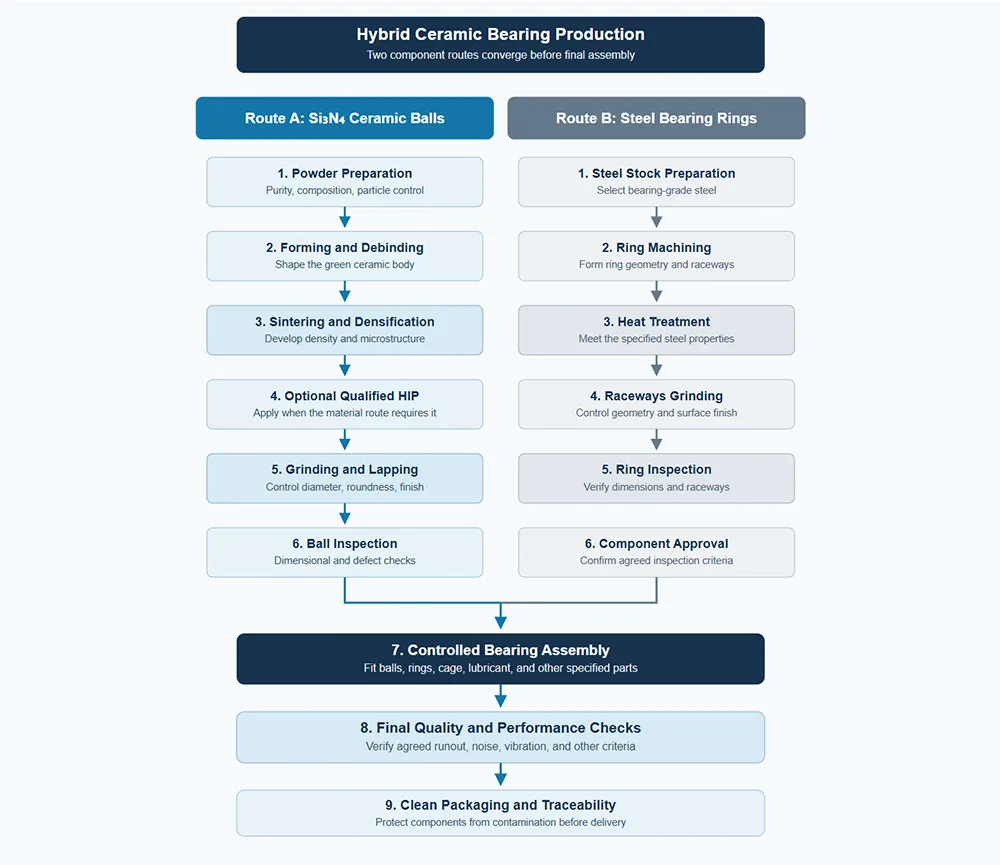
Manufacturing a reliable hybrid ceramic bearing requires two coordinated production routes: one for the silicon nitride rolling elements and another for the steel rings. Subsequently, manufacturers finish and inspect these components before assembling the complete bearing with the specified cage, lubricant, and other design features.
For silicon nitride balls, the process typically includes powder preparation, forming, sintering, precision grinding, lapping, and inspection. Meanwhile, steel rings undergo their own machining, heat treatment, raceway finishing, and inspection processes according to the bearing specification.
Manufacturing Route: Silicon Nitride Balls + Precision Steel Rings
5.1 Ceramic Ball Manufacturing: Critical Control Points
Powder preparation: First, manufacturers control powder purity, particle distribution, and additive composition to establish a suitable starting material.
Forming and debinding: Subsequently, they shape the ceramic body and remove temporary binders when the selected forming method requires that step.
Sintering and densification: Meanwhile, carefully controlled thermal processing develops the intended microstructure and density, while qualified post-sintering treatments may further reduce residual porosity where appropriate.
Precision finishing: Additionally, grinding and lapping establish the required ball diameter, roundness, and surface finish, all of which influence rolling contact behavior.
Inspection and traceability: Finally, agreed inspection procedures and lot identification help manufacturers evaluate product consistency and investigate quality issues when necessary.
5.2 Why Manufacturing Defects Matter
Because rolling contact applies repeated cyclic loads to a small contact region, even a localized defect can influence fatigue performance. Therefore, reducing critical porosity, inclusions, surface damage, and dimensional variation is an important part of manufacturing reliable ceramic rolling elements.
Nevertheless, material certificates alone do not establish the fatigue life of a finished bearing. Instead, a complete evaluation may require material characterization, dimensional inspection, surface assessment, appropriate nondestructive testing, and bearing-level performance testing.
6. Industrial Applications of Hybrid Ceramic Bearings
Beyond conventional industrial motors, hybrid ceramic bearings serve a range of applications that demand high rotational speed, precise motion, reduced rolling-element mass, or improved electrical insulation. However, each application presents different loads, temperatures, lubrication requirements, and failure risks, so engineers must match the bearing design to the operating environment.
| Industry | Typical Components | Why Hybrid Ceramic Bearings May Help | Key Design Considerations |
|---|---|---|---|
| Machine Tools | High-speed spindle bearings, precision rotary shafts, and machining-center spindles. | Low ball mass can support high-speed operation and help manage centrifugal loading. | Preload, spindle stiffness, lubrication, thermal growth, and precision requirements. |
| Electric Motors and Generators | Motor shaft bearings, generator bearings, and selected high-speed rotor assemblies. | Ceramic balls can interrupt certain electrical current paths through rolling contacts. | Current paths, grounding, lubricant, electrical discharge, and steel-ring corrosion. |
| Turbochargers and High-Speed Rotating Equipment | Selected turbocharger bearing systems, high-speed shafts, and specialized rotating assemblies. | Low rolling-element mass and suitable ceramic properties can support high-speed designs. | Extreme speed, lubricant delivery, temperature, rotor dynamics, and transient loads. |
| Pumps and Compressors | Precision shaft bearings, selected pump drive assemblies, and compressor rotor bearings. | Ceramic balls resist many forms of corrosion and wear, depending on the environment. | Fluid compatibility, contamination, axial loads, seals, and lubrication conditions. |
| Robotics and Automation | Precision rotary modules, servo motor bearings, and selected motion-control assemblies. | Suitable designs can support precision motion and reduce rolling-element inertia. | Acceleration, reversing loads, stiffness, alignment, and impact exposure. |
| Medical and Dental Equipment | High-speed dental handpieces, selected precision motors, and laboratory rotary tools. | Low ball mass and wear resistance can support high-speed precision applications. | Sterilization, lubricant compatibility, cleanliness, noise, and validated device requirements. |
| Industrial Turbomachinery | Selected turbine-related auxiliary assemblies and high-speed precision equipment. | Lower ball mass can benefit suitable high-speed bearing arrangements. | Operating temperature, load spectrum, lubrication, and application-specific qualification. |
For demanding machinery, hybrid ceramic bearings should be selected through a system-level engineering review. In particular, some shock-loaded or heavily contaminated applications may still favor conventional steel bearings or another bearing arrangement, depending on the operating requirements.
7. AOFE MIMCustom: Custom Ceramic Component Support
For manufacturers developing precision industrial equipment, selecting a ceramic material is only the first step toward a reliable component. Therefore, AOFE MIMCustom can support customer discussions around custom-component requirements, drawing review, material selection, and coordination of manufacturing and inspection expectations, subject to the company’s confirmed capabilities.
Rather than choosing a component by material name alone, buyers should define the application conditions, dimensional requirements, and quality criteria before requesting a quotation. Additionally, clear engineering communication helps determine whether a proposed material and production route fit the intended application.
7.1 Drawing and Application Review
First, customers can provide technical drawings, dimensions, tolerances, operating conditions, and intended component functions for an initial feasibility discussion.
7.2 Material Selection Discussion
Additionally, a technical review can compare suitable ceramic materials according to strength, wear resistance, chemical exposure, thermal behavior, electrical properties, and manufacturing constraints.
7.3 Manufacturing Route Evaluation
Meanwhile, customers can discuss the feasibility of relevant forming, sintering, finishing, and inspection operations according to the required material and geometry.
7.4 Quality Requirement Alignment
Furthermore, buyers can clarify dimensional tolerances, surface-finish requirements, material documentation, inspection records, and lot traceability, subject to the supplier’s available quality systems.
7.5 Information to Include in a Custom Component Inquiry
Before requesting a quotation, prepare the technical details that determine whether the component will meet the application’s requirements. In particular, include the following information where applicable:
- Component name, technical drawing, and intended function.
- Required ceramic material and grade, if already specified.
- Dimensions, tolerances, roundness, and surface-finish requirements.
- Operating speed, contact loads, temperature range, and duty cycle.
- Lubrication method, contamination exposure, and chemical environment.
- Required test reports, material certificates, and traceability documentation.
- Prototype quantity, expected production volume, and delivery schedule.
- Applicable industry standards or customer-specific acceptance criteria.
Ultimately, a complete technical inquiry allows the supplier to evaluate feasibility more accurately and helps the customer compare proposals against the same engineering requirements.
Looking for a Custom Ceramic Component?
Share your drawing, material requirements, and operating conditions to start a technical discussion with AOFE MIMCustom.
8. Frequently Asked Questions About Hybrid Ceramic Bearings
Q1. Why do hybrid ceramic bearings have higher contact stress?
Primarily, silicon nitride has a higher elastic modulus than bearing steel, which can make the ball–raceway contact stiffer and reduce the contact area under comparable conditions. Consequently, peak Hertzian contact pressure can increase, although the actual difference depends on bearing geometry, load, and material properties.
Q2. Why can hybrid ceramic bearings still achieve long fatigue life?
In suitable designs, high-quality bearing-grade silicon nitride combines favorable mechanical properties with controlled microstructure and surface quality. Additionally, improved powder processing, sintering, finishing, and inspection can reduce critical defects that may initiate fatigue damage, although the result must be verified for the intended application.
Q3. Do hybrid ceramic bearings always last longer than all-steel bearings?
No, because service life depends on the bearing design, load, speed, lubrication, contamination, installation, and material quality. Therefore, compare test results obtained under equivalent operating conditions rather than assuming that every hybrid bearing will outlast every steel bearing.
Q4. What is the role of hot pressing or hot isostatic pressing in silicon nitride manufacturing?
Generally, hot pressing and hot isostatic pressing are different processing techniques that can support densification under suitable conditions. However, not every bearing-grade silicon nitride component requires either method, because the appropriate process depends on the material composition, manufacturing route, geometry, and required properties.
Q5. Does silicon nitride eliminate the need for lubrication?
Generally, no, because most high-speed rolling bearings still require lubrication appropriate to their design and operating conditions. Consequently, ceramic rolling elements should not be treated as a substitute for correct lubricant selection, supply, and maintenance.
Q6. Can hybrid ceramic bearings handle severe contamination?
Although silicon nitride offers good wear resistance, abrasive particles can still damage ceramic balls and steel raceways. Therefore, suitable seals, clean assembly, contamination control, and a compatible lubrication strategy remain essential even when the bearing uses ceramic rolling elements.
Q7. Why are hybrid ceramic bearings used in electric motors and generators?
In many designs, silicon nitride balls provide electrical insulation across the rolling contacts and can help reduce certain bearing-current damage mechanisms. However, the effectiveness depends on the complete electrical system, because current may follow alternative paths through other machine components.
Q8. Are hybrid ceramic bearings suitable for heavy-load applications?
Potentially, but suitability depends on the bearing’s load rating, contact stress, internal geometry, material quality, and lubrication conditions. Accordingly, engineers should evaluate both fatigue performance and the risk of impact-related ceramic damage before approving a heavy-load application.
Q9. Which inspection methods help assess ceramic ball quality?
Depending on the specification, manufacturers may combine dimensional measurement, roundness and surface-finish inspection, visual examination, suitable nondestructive evaluation, and material or process checks. Additionally, bearing-level testing may help confirm performance criteria that material inspection alone cannot establish.
Q10. What information should buyers provide when sourcing hybrid ceramic bearings or custom ceramic components?
To begin, provide the bearing or component type, drawing, dimensions, material grade, operating speed, loads, lubrication, temperature, and environment. Furthermore, include expected quantity, inspection requirements, traceability needs, and any validated performance targets so the supplier can assess technical suitability.
Conclusion: Material Quality and Process Control Determine Bearing Reliability
Overall, hybrid ceramic bearings can maintain strong rolling contact fatigue performance despite higher contact stress because contact pressure is only one factor governing bearing life. In addition, low rolling-element mass, suitable silicon nitride properties, controlled microstructure, reduced critical defects, and precision finishing can all contribute to reliable operation.
However, no material or manufacturing process can guarantee longer service life under every combination of load, speed, lubrication, and contamination. Therefore, engineers should evaluate the complete bearing system, identify the likely failure mechanism, and validate performance under representative operating conditions.
Ultimately, the most reliable approach combines appropriate silicon nitride material selection, consistent ceramic processing, accurate steel raceways, clean assembly, and application-specific testing. For custom ceramic component projects, AOFE MIMCustom can be contacted to discuss technical requirements and confirm which material and manufacturing services match the intended application.