
What is Silicon Nitride?
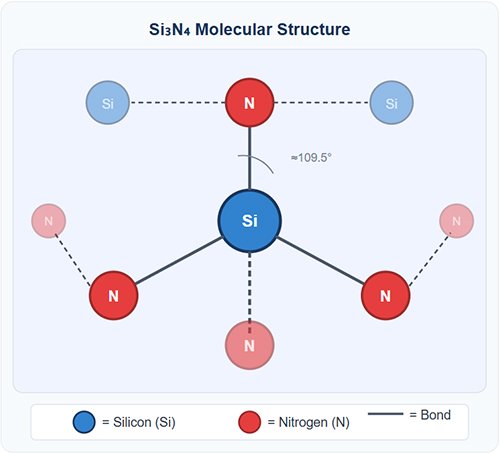
Silicon Nitride (Si₃N₄) is a synthetic covalent ceramic composed of silicon and nitrogen atoms arranged in a rigid 3D network of [SiN₄] tetrahedra. Unlike oxide ceramics, its strong covalent bonding makes it exceptionally tough but also inherently difficult to densify.
Industrial Si₃N₄ starts as metastable alpha (α) phase powder which transforms into thermodynamically stable beta (β) phase during sintering. This α→β transformation creates elongated grains that act like internal reinforcement fibers, giving the material its legendary fracture toughness.
Key Material Properties
| Property | Unit | Typical Value |
|---|---|---|
| Density | g/cm³ | 3.20 – 3.30 |
| Flexural Strength | MPa | 700 – 1000 |
| Fracture Toughness | MPa·m¹/² | 6.0 – 8.0 |
| Vickers Hardness | GPa | 14 – 17 |
| Max Service Temp | °C | 1200 – 1400 |
Manufactured Components
Bearing Elements
Grade 3-28 balls, rollers, and races for hybrid/full-ceramic bearings.
Power Substrates
AMB/DCB substrates for EV inverters and IGBT modules.
Precision Pins
Dowel pins, locating pins, and weld fixtures with ±0.002mm tolerance.
Wear Parts
Cutting inserts, waterjet nozzles, seal rings, and thermocouple tubes.
The 6-Step Manufacturing Process
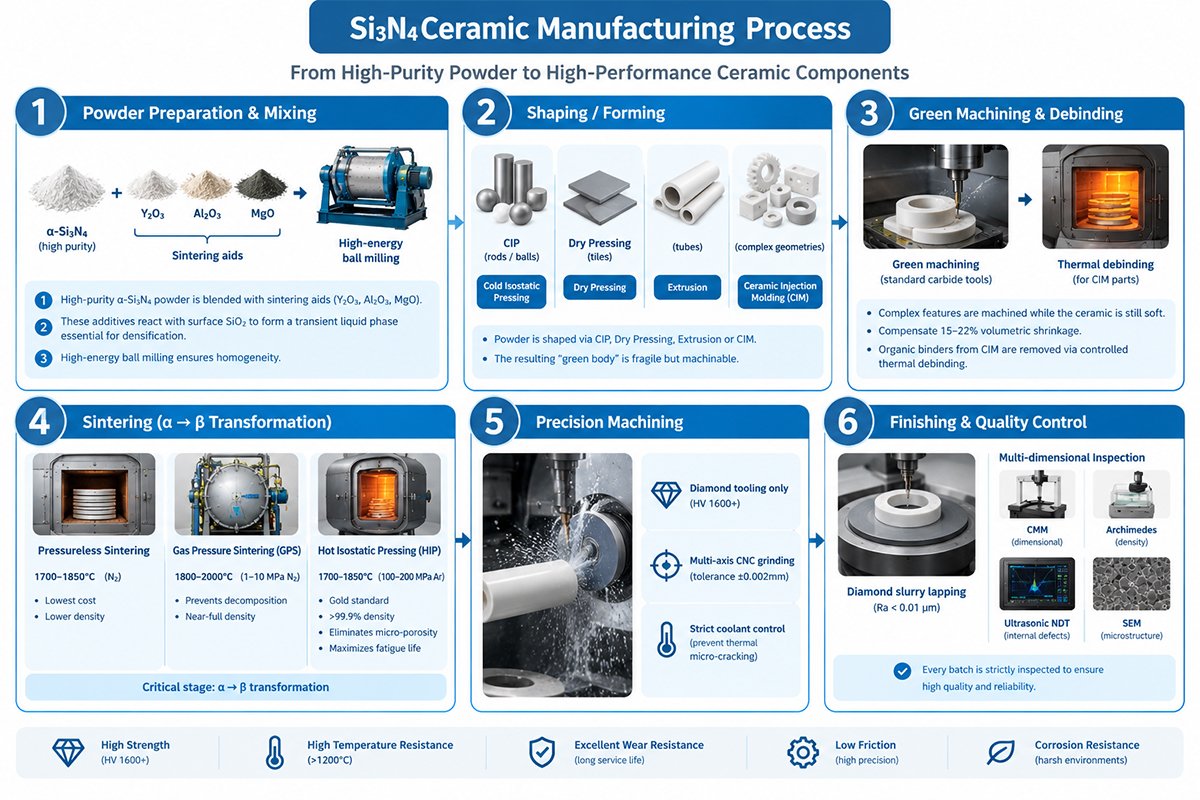
Powder Preparation & Additives
High-purity α-Si₃N₄ powder is blended with sintering aids (Y₂O₃, Al₂O₃, MgO). These additives react with surface SiO₂ to form a transient liquid phase essential for densification. High-energy ball milling ensures homogeneity.
Green Body Forming
Powder is shaped via Cold Isostatic Pressing (CIP) for rods/balls, Dry Pressing for tiles, Extrusion for tubes, or Ceramic Injection Molding (CIM) for complex geometries. The resulting “green body” is fragile but machinable.
Green Machining & Debinding
Complex features are machined using standard carbide tools while the ceramic is still soft. Designers must compensate for 15-22% volumetric shrinkage. Organic binders from CIM are removed via controlled thermal debinding.
Sintering (Phase Transformation)
The critical stage where α→β transformation occurs. Three methods exist:
- Pressureless: 1700–1850°C in N₂. Lowest cost, lower density.
- Gas Pressure Sintering (GPS): 1800-2000°C under 1-10 MPa N₂. Prevents decomposition, achieves near-full density.
- Hot Isostatic Pressing (HIP): 1700-1850°C under 100-200 MPa Ar. Gold standard. Achieves >99.9% density, eliminates micro-porosity, maximizes fatigue life.
Diamond Grinding & Hard Machining
Sintered Si₃N₄ (HV 1600+) can only be machined with diamond tooling. Multi-axis CNC grinding achieves tolerances of ±0.002mm. Strict coolant control prevents thermal micro-cracking.
Lapping, Polishing & QA
Diamond slurry lapping achieves Ra < 0.01 μm mirror finishes. Every batch undergoes CMM dimensional checks, Archimedes density verification, ultrasonic NDT for subsurface defects, and SEM microstructure analysis.
AOFE Manufacturing Excellence
AOFE Advanced Ceramics controls every variable in the Si₃N₄ manufacturing lifecycle. Our vertically integrated facility combines proprietary powder science with state-of-the-art HIP sintering and sub-micron CNC grinding.
Manufacturing Process FAQ
Why is Si₃N₄ harder to manufacture than alumina?
Alumina is an oxide ceramic that sinters easily in air. Si₃N₄ is covalent with near-zero self-diffusion, requiring liquid-phase sintering additives and pressurized atmospheres to prevent thermal decomposition above 1800°C.
When should I specify HIP vs GPS sintering?
Specify HIP for bearing balls, aerospace parts, and any application requiring maximum fatigue life and zero porosity. GPS is suitable for structural components, nozzles, and substrates where near-full density is acceptable at lower cost.
What is the typical lead time for custom Si₃N₄ parts?
Standard blanks/balls ship in 5-7 days. Custom green-machined + HIP-sintered components typically require 3-5 weeks. AOFE offers expedited prototyping in 2 weeks for urgent programs.
Ready to Engineer with Si₃N₄?
From prototype to mass production, AOFE delivers precision silicon nitride components manufactured to your exact specifications.